



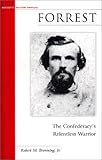
Robert M. Browning, Jr. Forrest: The Confederacy's Relentless Warrior. Washington, D.C.: Brassey's, 2004. xv + 132 pp. $19.95 (cloth), ISBN 978-1-57488-625-2.
Reviewed by Brian Neumann (Department of History, Texas A&M University)
Published on H-CivWar (February, 2007)
The Hollow Reconstruction of Nathan Bedford Forrest
No event in American history has captured the imagination and interest of historians and general readers alike as the Civil War. With its themes of racial, sectional, and Constitutional division coupled with the drama of massive military campaigns on American soil, the war has been a continual source of study and debate ever since the Confederate surrender in 1865. As part of this interest, a cult of personality has emerged around the principle actors of the conflict. Library and bookstore shelves are filled with works on Ulysses S. Grant, Robert E. Lee, Abraham Lincoln, Jefferson Davis, and many others. The fascination of American readers with the lives of the participants is only natural in this, the most personal of American wars. Added to this list is the new work of Robert Browning Jr., Forrest: The Confederacy's Relentless Warrior. This brief summary offers an introduction to a man whose own actions and legacy are as complex and controversial as the war in which he fought.
The most difficult challenge for a work such as this is to adequately describe the complexity of the subject matter in a confined amount of space, one that is only exacerbated when the subject matter is as controversial as the fierce Confederate cavalry commander, Nathan Bedford Forrest. In just over one hundred pages, Browning gives the highlights of Forrest's life, focusing most of his attention on the events during the Civil War, in order to provide an introduction to the cavalryman to the uninitiated. Browning makes a commendable effort, but in the end his work falls short in its delivery, reducing Forrest to an anecdotal figure without any real depth, and offering a reconsideration of Forrest without sufficient context to support the conclusions.
As explained in the preface, Browning's work is not a full biography, but rather "an overview of Forrest--a survey of his life, his leadership style, and his military career" (p. xii). The majority of the book deals with Forrest's wartime activities, offering only limited coverage to Forrest's pre- and post-war life. Given the length restrictions and Browning's stated purpose, this disparity is natural, but it limits his ability to delve into the character of the man. Browning argues that the traits that made Forrest a success on the battlefield--his independence, his determination, and his rugged nature?"stemmed from his formative years spent on the frontier. Added to these was a firm sense of honor and duty that provided Forrest with a self-righteousness that made him both inspiring and imperious to those around him. Browning succeeds in displaying the positive aspects of Forrest's self-assuredness and strong will when facing off against both Northern soldiers and critics within his own army.
The book is divided into seven chapters, with the middle five consisting of a chronological narrative of Forrest's actions during the war. From his beginnings as a recruiter in Tennessee and Kentucky, through his success as a semi-independent commander conducting raids throughout the Western Theater, Bradford effectively shows Forrest's natural leadership skills, his tactical ability to harass, confuse, and overwhelm Union forces that oftentimes significantly outnumber his own. Bradford indicates that Forrest's main successes came when he was able to act on his own, without having to act in a subordinate role. When Forrest did face defeat, as at Fort Donelson, Shiloh, and as a part of John Bell Hood's fateful campaign into Tennessee in 1864-65, it was due to the failures and ineptitudes of senior commanders. Bradford characterizes Forrest as a true warrior that was too often misused by superiors who failed to employ his talents as an independent commander. Allowed to act on his own, Forrest was able to utilize speed, deception, and rigorous pursuit to achieve startling successes in northern Alabama, Mississippi, and throughout Tennessee. His exploits earned him a loyal following amongst his own troops, a near mythic reputation amongst his enemies, and the begrudged respect of Union commanders Ulysses S. Grant and William T. Sherman. These same commanders also found Forrest to be a continual source of irritation, particularly Sherman, as Forrest was able to disrupt Union logistics to the degree that he threatened their ability to conduct large-scale operations deep into Confederate territory. On several occasions, Sherman dispatched sizable forces with the intent of destroying Forrest's command only to have them outmatched by the smaller Confederate force, as at Forrest's stunning victory at Brice's Cross Roads in 1864. But for all of Forrest's achievements, he was not able to shift the strategic balance in the Western Theater. Grant's seizure of Vicksburg effectively cut the Confederacy in half, and the Union victory at Chattanooga allowed Sherman to mount his assault on Atlanta and subsequent March to the Sea. Forrest's tactical brilliance could not overcome the Union's manpower advantages and he could not prevent the Union from carving up the South between 1863 and 1865.
Bradford effectively describes Forrest's battlefield successes, but too often he becomes consumed with describing the details of Forrest's movements, missing opportunities to put them into the larger framework of the war. At times this diminishes his explanation of Forrest's value to the Confederacy, as in his ability to frustrate Grant's campaign against Vicksburg in the winter of 1862-63. On other occasions it overemphasizes Forrest's activities, as in his successes during 1864 despite the slow collapse of Confederate forces in both the Eastern and Western Theaters. While Bradford's focus is understandably centered on Forrest himself, putting his activities into context would provide the reader with a better understanding of his larger significance.
This lack of context proves to be a more serious handicap given the stated purpose of Brassey's Military Profiles series. Ostensibly intended for both expert and general readers alike, Bradford's treatment of Forrest requires the reader to possess a general knowledge of the Civil War to be able to understand the strategic role Forrest played. However, given the limited scope of the work and its heavy reliance upon secondary sources, students of the Civil War and of Nathan Bedford Forrest specifically will find little new in the present treatment. The author would do better to sacrifice the specific details of Forrest's individual campaigns and provide more background for the general reader to aid in their understanding of the material.
Bradford's lack of context and depth also undercut his treatment of the more controversial aspects of Nathan Bedford Forrest. In describing Forrest's prewar life, Bradford indicates that Forrest amassed a considerable fortune as a businessman and planter. While the author indicates that Forrest took part in slave trading, he does not explain that this was a major part of his fortune. Bradford's only statement regarding Forrest's slave-trading activities presents him as a kind owner who "dressed and fed them well, as good business would dictate" (p. 8). Nowhere does Bradford deal with Forrest's attitudes towards African Americans or slavery in general. Considering Forrest's legacy as the leader of the Ku Klux Klan during Reconstruction, Bradford's whitewashing of Forrest's prewar activities raises questions concerning his argument that Forrest was largely misunderstood in terms of actions towards African Americans.
Bradford also takes a decidedly pro-Forrest stance when describing the circumstances surrounding the controversy at Fort Pillow during the war, where Forrest has been accused of orchestrating an unmitigated slaughter of black soldiers, and Forrest's role as the head of the Klan. While Bradford's conclusion that Forrest's role in both instances have been overly criticized by contemporaries and historians alike has merit, his failure to adequately address those criticisms and to delve into the more questionable aspects of Forrest's character comes across as hollow revisionism. For example, Bradford states that the Klan "served Forrest and other Southerners to support the defense of their concept of society and their principles of honor" without explaining that those concepts and principles were based upon the subjugation of others (p. 99).
Given his apparent goal of reconstructing Forrest's reputation, it is curious that Bradford relies so heavily on older sources, such as Thomas Jordan and John Pryor's The Campaigns of Lieut.-Gen. N. B. Forrest, and of Forrest's Cavalry (1868) and John Allan Wyeth's Life of General Nathan Bedford Forrest (1899). Bradford indicates that the two best works on Forrest are the most recent, Brian Steel Wills's A Battle from the Start (1992) and Jack Hurst's Nathan Bedford Forrest (1993), but uses these only sparingly. Both books offer a more balanced treatment of Forrest than the earlier ones and would give more solid support to Bradford's conclusions.
Bradford's work is commendable in its attempt to offer a starting point for general readers interested in the Confederacy's most successful and controversial cavalry commander. However, his decision to refrain from delving into the complexities of Forrest's character and the controversies that surround his actions limits the work's usefulness. As it stands, Bradford's book comes across as another in a long line of "guns and trumpets" treatments of Civil War leaders, describing the actions and characteristics that made Forrest a great commander but ignoring those deeper questions and flaws that made him human.
If there is additional discussion of this review, you may access it through the network, at: https://networks.h-net.org/h-civwar.
Citation:
Brian Neumann. Review of Browning, Robert M., Jr., Forrest: The Confederacy's Relentless Warrior.
H-CivWar, H-Net Reviews.
February, 2007.
URL: http://www.h-net.org/reviews/showrev.php?id=12867
Copyright © 2007 by H-Net, all rights reserved. H-Net permits the redistribution and reprinting of this work for nonprofit, educational purposes, with full and accurate attribution to the author, web location, date of publication, originating list, and H-Net: Humanities & Social Sciences Online. For any other proposed use, contact the Reviews editorial staff at hbooks@mail.h-net.org.

