



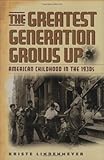
Kriste Lindenmeyer. The Greatest Generation Grows Up: American Childhood in the 1930s. Chicago: Ivan R. Dee Publisher, 2005. xiv + 305 pp. $27.50 (cloth), ISBN 978-1-56663-660-5; $18.95 (paper), ISBN 978-1-56663-730-5.
Reviewed by David MacLeod (Department of History, Central Michigan University)
Published on H-Childhood (February, 2007)
Still a Child at Seventeen? American Ideals and Realities during the Great Depression
To synthesize the history of childhood across the entire United States within a given period is not easy, whether one seeks to encompass a decade, a century, or the entirety of U.S. history. Should the author emphasize social, cultural, and policy changes that potentially affected children? Should the writer try to reconstruct changing economic, demographic, and cultural influences on child nurture? Can one evoke actual childhood experiences? And despite the overriding claims of historical chronology, the historian cannot ignore developmental stages, since generalizations about childhood that ignore age differences are naively artificial, as any schoolchild can tell us. Should a historian of childhood pick one age group to emphasize or try to touch on all? If one tries to do it all, the task becomes almost unmanageably complex.
Some previous attempts are instructive. In The Age of the Child: Children in America, 1890-1920 (1998), I tried to incorporate all the perspectives just mentioned, while keeping gender, class, racial, and regional differences prominent. Meanwhile, I sought to sustain a thesis that the sheltered childhood was fitfully growing longer and more widespread, but that these developments owed more to growing prosperity, social and cultural changes, and parental altruism than they did to reform movements, because those movements lacked the resources or power to force changes. Working against an eighty-thousand-word limit, I could not include any extended anecdotes about individual children, my thesis statements were telegraphic at best, and I still ran out of space and had to sketch the teenage years in fourteen pages. In his underused survey, Growing Up in Twentieth-Century America: A History and Reference Guide (1996), Elliott West cuts the century into four chronological periods and then follows children through an unvarying set of topical subsections for each historical time span: "At Home," "At Play," "At Work," "At School," "Health," and "Children and the Law." This seemingly mechanical approach impedes pursuit of any overarching thesis and does not itself guarantee balanced coverage of age groups, but it forces the author to follow subjects into periods during which reformers' attention moved elsewhere and public discussion flagged (such as child labor after the 1920s) and thereby supports informed comparisons across the whole century. In this case, structural constraints pay off handsomely. Faced with an even longer period and seeking maximum coverage of scholarly findings in the field, Steven Mintz has opted to mix thematic and chronological organization in shaping the chapters of Huck's Raft: A History of American Childhood (2005). Virtually every paragraph is packed with interesting, though sometimes disparate information.
Covering only a single decade, Kriste Lindenmeyer's narrative is more relaxed and less hurried than any of these three examples, though still very much a topical survey. The book's title both disguises and reveals some of the topical choices she has made. She quickly disavows any attempt to judge whether this cohort really became "the greatest generation"; nor does this study attempt to replicate Glen Elder's investigation of the 1930s' enduring effects on "children of the great depression" from preadolescence through early middle age.[1] But growing up is central to Lindenmeyer's book, as the teenage years receive much more emphasis than earlier childhood. She highlights efforts to make adolescence an extension of the sheltered, dependent childhood that was already normative in much of American culture. The title uses "childhood" rather than "children," since the author concentrates on "shifts in the cultural construction of childhood" (p. 3). Although she inserts elements from oral history reminiscences and young people's letters to Eleanor Roosevelt in order to suggest the experiences of children, these necessarily remain of secondary importance.
There are good reasons for these choices. Because the economic crisis manifested itself most dramatically through massive unemployment, much cultural concern and policy formation in the 1930s centered on youths and young adults preparing to enter the labor force or trying to find a job. Public alarm centered on teenage boy, girl tramps, and the potential for European-style youth movements, not the less politically pressing needs of small children. The Civilian Conservation Corps, National Youth Administration, and child labor provisions of the Fair Labor Standards Act all dealt with teenagers or young adults. Aid to Dependent Children, the main exception, passed quietly through a Congress preoccupied with legislation intended to soothe old age pensioners. Inevitably, reliance on oral history and children's letters for first-person accounts further skews emphasis toward the later phases of childhood and adolescence, when memories are more numerous and correspondence more articulate. "Interestingly," comments Lindenmeyer, the New Deal built "the legal and cultural infrastructure for the ideal of American childhood that proliferated in the postwar years" at a time when "children and adolescents made up a sharply smaller proportion of the total population than had been the case in the past" (p. 5). As birthrates fell, she notes, parents could "focus their available family resources and energies on fewer children" (p. 14). While facilitating investment in the young, these demographic shifts also reinforced the 1930s focus on adolescence and youth. The large birth cohorts of the 1910s and 1920s, which were entering later childhood, adolescence, and young adulthood in the 1930s, overhung the job market and drew public and private concern, whereas the smaller birth cohort of the 1930s required fewer resources and must have seemed relatively more manageable.
In summary, The Greatest Generation Grows Up traces the promotion and extension of the "ideal of childhood as a separate, sheltered and protected stage of life" until it became (by 1940, at least) "normative" for "all Americans through age seventeen" (p. 5). Of course, Lindenmeyer repeatedly emphasizes that this remained as yet very much an ideal and not a reality for many young people down through 1940. One might object that this project to make adolescence resemble an extended childhood had been underway for decades, but the onset of the Great Depression dealt it a severe shock.
Lindenmeyer's first three chapters detail the damage. An opening chapter on "Fragile Families in Hard Times" recognizes islands of relative serenity within prosperous families and quotes recollections of togetherness as parents and children cooperated to ensure subsistence and emotional security amid straitened circumstances. But stories of strain and family break-ups predominate. Many children's disrupted childhoods took them through orphanages, relatives' homes, and foster placements. Only gradually did complacent assumptions that privation built character and that voluntary charity would suffice for relief give way to what Lindenmeyer portrays as a laudable but inadequate patchwork of New Deal remedies. A particular strength of this chapter is extensive discussion of the hardships inflicted by widespread health problems, although the author may be overly impressed by hospitalization as a remedy. A complication here and elsewhere is the difficulty of disentangling problems specific to this decade from those of long standing. Most of the health problems and many of the familial conflicts would have been disruptive in any decade. Racism was hardly new either, and farmers' hard times had begun in the 1920s. But we all struggle with the "it-happened-in-my-period" syndrome. Nor should we ignore ongoing problems just because they changed little in the period under consideration. This chapter on "Fragile Families" begins and ends memorably with the story of black tenant farmers in isolated Gee's Bend, Alabama, who faced disaster in 1932 when cotton prices plunged and a local merchant's widow repossessed much of the farmers' property; only Red Cross emergency relief prevented outright starvation. By 1937 the Resettlement Administration had bought out white landowners and local children were marveling at their new school's flush toilets. And yet, as Lindenmeyer emphasizes, this story shows what federal efforts could do--not what they did everywhere.
The second chapter, "Work, if You Could Find It," oscillates between contemporary recognition that many teenagers needed to help support their families, but had trouble finding remunerative jobs, and concern that exploitive conditions in agriculture, street trades, and sweatshops harmed young laborers. Occasional strikes by youthful workers furnish interesting stories, but mainly a record of failure. The decade was rich in case studies of particular forms of child exploitation, but national statistics, which drastically undercounted both juvenile employment and child labor, are probably misleading. Ideally, Lindenmeyer might have pushed harder against these shortcomings in her sources, especially the tendency--which she does recognize--for public concern to bypass the masses of young toilers in agriculture. Elliott West's heartfelt and harshly critical account of both the miseries of children's farm drudgery and its massive underreporting by federal census authorities would furnish a good supplement.[2]
Next Lindenmeyer focuses more closely on a phenomenon deeply troubling to Americans of the depression decade--the quarter million or so adolescents and young adults, mostly male, who hit the road in the thirties. Many merely sought work, but alarmist commentators feared the boys would learn crime and revolution. A couple of those whose forays Lindenmeyer sketches had bland, uneventful outings. Others suffered sexual and physical abuse, injury, and, in the case of the Scottsboro boys whose case she summarizes, long prison terms. By the late 1930s, however, the Civilian Conservation Corps, perhaps the National Youth Administration, other relief programs, and an improving economy had reduced the numbers of transient youth.
With the fourth chapter, the book pivots toward forces fostering the extension of a sheltered childhood toward age seventeen. In general, education saw increased attendance, with 73 percent of those ages fourteen to seventeen enrolled in school by 1940 (p. 112). The chapter is, however, a bit of a hodgepodge: stories of students who had to drop out or who persevered; discrimination against Hispanic, black, and poor students; some limited resistance measures; sports, clubs, and can-do optimism in school-sanctioned student publications; and a gas explosion that killed five hundred pupils in New London, Texas's consolidated school (but consolidation of rural schools continued anyway), yet little on curriculum or instruction. Because education and much other policy toward children was a state and local responsibility, complexity overwhelms generalization.
The next chapter provides a counterpoint to the others as Lindenmeyer describes how, despite the Depression, a commercialized popular culture for the young expanded rapidly and took new forms during the thirties. Admittedly this built on momentum from the dating culture and commercial entertainments of the twenties, and it excluded the poor and dowdy, as letters from teenagers begging Eleanor Roosevelt for help make poignantly clear. But Lindenmeyer builds a strong case that media new to the 1930s, notably radio comedy and drama and comic books, gave teens a prefabricated world of imagination in common and that movies promoted an increasingly tame Andy Hardy image of adolescence. Though cultural critics worried that popular entertainment promoted sexual and criminal precocity at odds with a sheltered childhood, self-censorship somewhat sanitized the commercial media. And whatever their moral influence, their popularity testified to the fact that many children had leisure and some margin of resources for frivolous consumption. On the other hand, Lindenmeyer makes the sharp observation that boys played with dangerous slingshots and children rode bicycles without helmets even as advice literature fretted about the dangers of commercializing childhood. Swing music and dating provoked more conflict with parents, although premarital pregnancy rates declined. Summing up the overall trend as one that ran toward more play and leisure, Lindenmeyer sensibly does not force all developments to fit.
A culminating chapter, "Uncle Sam's Children," concludes that "federal law by 1940 included a clear definition of child dependency from birth to age eighteen" (p. 206) and that the New Deal undergirded this with supportive policies. To pursue state and local policy systematically is virtually impossible, and this was an era of federal activism. Curiously, however, the two prize examples of federal activism epitomize the New Deal's concern for youth more than childhood. The Civilian Conservation Corps was reserved for young men eighteen to twenty-five. Most were, to be sure, toward the lower end of the age range, and some vaguely defined educational benefits for seventeen-year-olds were added in 1935. The CCC is widely regarded as a hugely successful federal program--even if it was not exactly about children. For example, in The Failed Century of the Child, Judith Sealander praises the CCC at length as a model the later Job Corps should have followed.[3] Aiming to help those ages sixteen to twenty-five, the National Youth Administration reached beneficiaries a bit younger than did the CCC; almost one-third of those the NYA served were high-school students whom it helped remain enrolled in school. Programs for those we might unambiguously label "children" drew, by contrast, less public attention and federal funding. Federal day care was inconsequential. Various work relief programs helped build schools, playgrounds, and swimming pools that served younger children. The 1935 federal Aid to Dependent Children defined dependency as under age sixteen and by the 1940s assisted about three times as many children as the old localized mothers' pensions had in 1931, but discrimination against minorities and children of mothers deemed immoral still limited ADC coverage. The Fair Labor Standards Act of 1938 mainly banned work by children under sixteen, though it limited hours for those sixteen and seventeen. Again coverage was spotty, with notoriously broad exemptions for child agricultural laborers, making its impact less than Lindenmeyer implies. Whether or not the evidence justifies any sweeping conclusion about dependency reaching age seventeen, the New Deal certainly nudged the federal government toward protective intervention in favor of children and adolescents. At this point, reviewers commonly identify a few small errors to prove that they have exercised due diligence in reading the text. Lindenmeyer seems stingy with errors, and I will probably earn no alertness points for noting that Mary McLeod Bethune's name was not McCloud (pp. 218, 220). I was more troubled by loose organization and the extent to which extracts from children's letters and narratives derived from oral histories occasionally interrupt rather than support discussion of some issues. These inserted passages sometimes add color but at other times seem diffuse or tangential and dwindle down to flat conclusions: "She really wanted that Shirley Temple doll" (p. 174). "Even though she did not go to high school, Ann Witt shared the music and dance of her generation" (p. 194). While the effort to include "the voices of young people" (p. 3) by direct quotation and summaries of life histories is commendable, it poses unavoidable stylistic challenges that are extraordinarily difficult to master, because such extracts and summaries so often ramble and do not compress readily. However, a generous selection of photographs (and occasional poster reproductions) supports the text very effectively. The illustrations are well placed, and each has an interpretive caption, not just a label. Among the most intriguing are pictures of children at play: a boy working with an erector set (p. 13), rural schoolboys playing "six-man football" (p.147), a throng of preschoolers gazing raptly at a tiny wooden horse and rider (p. 186), and children of all ages in a shallow homemade swimming pool (p. 189). These are not images we associate with the Depression, and they evoke the varied pleasures of some 1930s childhoods.
As a survey of a difficult decade for children, The Greatest Generation Grows Up covers a broad range of experiences, often negative as well as positive. It features highly accessible writing as well as vivid illustrations. And although the book is a survey rather than a tightly argued monograph, Lindenmeyer shows how commercial, educational, and federal policy developments in the 1930s laid foundations--albeit somewhat flimsy and limited ones--for the wider spread of a sheltered childhood and adolescence in the years after World War II.
Notes
[1]. Glen H. Elder Jr., Children of the Great Depression: Social Change in Life Experience (Chicago: University of Chicago Press, 1974).
[2]. Elliott West, Growing Up in Twentieth-Century America: A History and Reference Guide (Westport, Conn.: Greenwood, 1996), 118-126.
[3]. Judith Sealander, The Failed Century of the Child: Governing America's Young in the Twentieth Century (Cambridge: Cambridge University Press, 2003), 158-175.
If there is additional discussion of this review, you may access it through the network, at: https://networks.h-net.org/h-childhood.
Citation:
David MacLeod. Review of Lindenmeyer, Kriste, The Greatest Generation Grows Up: American Childhood in the 1930s.
H-Childhood, H-Net Reviews.
February, 2007.
URL: http://www.h-net.org/reviews/showrev.php?id=12860
Copyright © 2007 by H-Net, all rights reserved. H-Net permits the redistribution and reprinting of this work for nonprofit, educational purposes, with full and accurate attribution to the author, web location, date of publication, originating list, and H-Net: Humanities & Social Sciences Online. For any other proposed use, contact the Reviews editorial staff at hbooks@mail.h-net.org.

