



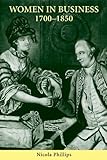
Nicola Phillips. Women in Business, 1700-1850. Rochester: Boydell & Brewer, 2006. xii + 299 pp. $85.00 (cloth), ISBN 978-1-84383-183-9.
Reviewed by Henry Horwitz (University of Iowa)
Published on H-Albion (February, 2007)
Nicola Phillips makes a noteworthy intervention in the ongoing debates on women's situation in her period, steering sensitively between the poles of continuity (patriarchy) and change (shaped by economic development, especially industrialization). Drawing on a wide variety of sources, she aims to integrate the study of women's actual place in the world of business and commerce with that of representations of women's roles.
Phillips begins with an analysis of legal materials--treatises and cases (local, common law, and equity)--to support her contentions that the common law doctrine of coverture was in practice modified by borough custom (the feme sole trader); that coverture cases at common law were more often than not conflicts between creditors and debtors, rather than about the "right" of women to trade itself; and that Chancery (C6--thirty cases, culled from the archive by Mary Clayton who made them available to Phillips) afforded considerable protection to business women via the doctrine of separate property (applied to sometimes quite informal arrangements). She continues in the second section of the book--using the evidence of insurance records (the Sun Fire Office), business correspondence (especially the rich archive of the gentlewoman Sarah Baker of Durham), and also newspaper advertisements (the London Daily Advertiser)--to demonstrate that significant numbers of women (including married women) entered and frequently remained in business throughout the period and to show that both in London and in the provinces male and female traders shared resources and premises, with family links common and with such trading networks sometimes extending from the locality to the rest of the kingdom (especially London and Bath). At the same time, she emphasizes the variety of "family" economies, a scene complicated by the frequency of women's remarriage and the possibility of conflict between the children of first and subsequent unions, while also demonstrating that women might well remain active in business through every stage of their life and marital cycle. Then in her third section--drawing upon didactic literature, pamphlet debates, and parliamentary reports of the early nineteenth century--she argues that representations of women in business (especially millinery) were complex and in flux, shaped in no small part by contemporary concerns about luxury, French influence, and political economy.
Thus, following in the footsteps of Amy Erickson, Margaret Hunt, and Amanda Vickery, Phillips tends to complicate--by a sensitive reading of her diverse sources--rather than to simplify our understanding of women in business during her period, and she is particularly keen to bring out the pitfalls of either a unilinear view of her subject or one (founded primarily on didactic literature) positing the emergence of a sharp separation between private and public spheres. Thus, her work should be of considerable interest not only to the specialists in women's and gender history, but to those interested in the economic and social developments of the eighteenth and early nineteenth centuries.
If there is additional discussion of this review, you may access it through the network, at: https://networks.h-net.org/h-albion.
Citation:
Henry Horwitz. Review of Phillips, Nicola, Women in Business, 1700-1850.
H-Albion, H-Net Reviews.
February, 2007.
URL: http://www.h-net.org/reviews/showrev.php?id=12855
Copyright © 2007 by H-Net, all rights reserved. H-Net permits the redistribution and reprinting of this work for nonprofit, educational purposes, with full and accurate attribution to the author, web location, date of publication, originating list, and H-Net: Humanities & Social Sciences Online. For any other proposed use, contact the Reviews editorial staff at hbooks@mail.h-net.org.

