



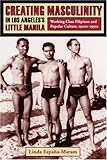
Linda España-Maram. Creating Masculinity in Los Angeles's Little Manila: Working Class Filipinos and Popular Culture, 1920s-1950s. New York: Columbia University Press, 2006. x + 288 pp. $75.00 (cloth), ISBN 978-0-231-11592-6; $26.50 (paper), ISBN 978-0-231-11593-3.
Reviewed by Dawn Mabalon (Department of History, San Francisco State University)
Published on H-Urban (February, 2007)
Little Brown Men in Sharp Suits: Understanding Filipino Immigrant Manhood
As an undergraduate history major writing a paper on Filipino immigrants for an Asian American history class, I conducted an oral history of a venerable Filipino community leader, Claro Candelario. "Uncle Claro" told me eye-opening stories about his glamorous life as Jean Harlow's houseboy in 1930s Los Angeles, a life far removed from the slower and more rural pace of Stockton, California, where he moved in the 1940s. Uncle Claro's experiences in the Liberty dancehall, the Chinese-owned gambling dens, and the boxing auditoriums of Los Angeles, along with the collective memories of thousands of working-class Filipino immigrants who called Los Angeles home, are brought to life in Linda España-Maram's engaging new book. The author has written a groundbreaking and fascinating study of gender and Filipino immigrant popular culture in Los Angeles's Little Manila neighborhood that brings together rigorous historical research with critical cultural analysis.
Her book, which began as a dissertation at the University of California, Los Angeles, challenges historians of Filipina/o American and Asian American (as well as many other immigrant) experiences to study how working-class immigrants used popular culture practices to fashion new, oppositional identities. España-Maram's book emerges as part of a recent explosion of pathbreaking scholarship by and about Filipinas/os in the United States. Though Filipinas/os are the largest immigrant group from Asia, the bulk of historical research in Asian American Studies has focused on the experiences of Chinese, Japanese, and Korean immigrants and their descendants. While there have been significant studies of Filipinas/os conducted over the past several decades, among them studies of ethnic organizations; labor unions and worker's experiences; women's experiences; and anti-Filipina/o exclusion movements, none have examined Filipinas/os as "simultaneously immigrants, gendered subjects, laborers, members of an aggrieved population, and consumers," España-Maram writes (p. 7).
From this perspective, España-Maram is able to create a complex portrait of the young, often teen-aged, single, working-class Filipino in downtown Los Angeles, whose arrival in the United States and subsequent coming of age paralleled two phenomena: the explosive growth of urban youth culture in the 1920s, and Los Angeles's dizzying trajectory from a town, albeit an important one, at the turn of the twentieth century to a bustling metropolis by the onset of World War II. Los Angeles was one of the major urban centers on the West Coast that drew a sizeable Filipino population; other cities with Little Manilas and Manilatowns include Stockton, San Francisco, and Seattle. Drawing from methodologies and concepts grounded in cultural studies, España-Maram writes an engrossing multidisciplinary history of the ways that working-class Filipino immigrants used places such as gambling dens and taxi dance halls, to "carve niches of autonomy where they fought against restrictions on space, expanded the opportunities for alternative expressions, and, in the process, established identities of their own" (p. 8).
Key to these identities was a particular conception of masculinity and manhood, España-Maram argues. Filipino men found their manhood and masculinity degraded and dismissed by the exploitative labor conditions in the Alaskan salmon canneries, the horrific working conditions in the agricultural fields, and in their treatment as feminized "houseboys" in the homes of elite whites. In turn, España-Maram writes, "young men flocked to the commercialized leisure centers to work out, wrestle with, and claim what it meant to be Filipino men within the context of a racist host society" (p. 8). The masculine subcultures of the boxing ring, dance hall, gambling den, and segregated Filipino army units during World War II were rich sites for these immigrants to explore and aggressively articulate what it meant to be a Filipino man.
By centering her study in Los Angeles's Little Manila neighborhood, España-Maram makes a major contribution to the understanding of Filipina/o American community formations in the early twentieth century. In early scholarship about Filipina/o Americans, some historians, framing their ideas about Asian immigrant ethnic community formation on a Chinatown model of small-business entrepreneurship, entirely dismissed the notion that Filipinas/os created their own ethnic enclaves in urban centers in the West.[1] Like Dorothy Fujita-Rony, in her recent book on Filipinas/os in Seattle, España-Maram challenges this idea, by offering evidence of a vibrant ethnic neighborhood developed by Filipinas/os living in an area near Little Tokyo, bounded by San Pedro and Sixth Streets, Figueroa Avenue and Sunset Boulevard.[2] Immigrants established restaurants and other businesses there. Along with these physical neighborhoods, España-Maram also suggests that we understand Filipinas/os as members of "a portable community" (p. 10).
The book, which consists of four chapters and an epilogue, covers expansive ground. The author starts her narrative in the early 1920s, as young immigrants from the Philippines are entering the United States. Because of their status as colonial subjects, they inhabit a category called "national" and, unlike Chinese, Japanese, and Korean "alien" immigrants, can enter the United States unchecked, while other Asians were effectively barred by the harsh 1924 Immigration Act. The first chapter of the book, "Making a Living: The Meanings of Work and the Struggle for Solidarity," provides an overview of immigration experiences and labor conditions in Los Angeles and throughout California. España-Maram discusses how Filipino immigrant laborers were pushed into labor-intensive, low-paying jobs upon their settlement in California, and how Filipinos struggled to create community networks with one another. The vast majority of Filipino immigrants became migratory laborers. Nonetheless, España-Maram notes, they did create concentrated communities in places like Delano, Salinas, Stockton, San Francisco, and Los Angeles. Filipino immigrants, she argues, "took their communities with them," drawing on ethnic newspapers, friends, and family and kinship networks (p. 39). But they also created a vibrant community in Los Angeles's Little Manila. She also notes how racism, low wages, and joblessness during the Depression crushed the dreams of many Filipino laborers.
Chapter 2, "Of Dice and Men," considers inter-Asian relations and the vice industry by critically examining gambling, the leisure activity of choice for many Filipino immigrant laborers. The majority of the gambling dens in Los Angeles were owned by Chinese people. This chapter offers a revealing portrait of Chinese-Filipino relations and the ways that the two groups negotiated sharing urban space in a rigidly segregated city. Gambling, according to the author, offered a kind of socioeconomic mobility for Filipinos.
The incredible popularity of boxing amongst Filipino immigrants is examined in chapter 3, "From the 'Living Doll' to the 'Bolo Puncher': Prizefighting, Masculinity, and the Sporting Life." Boxing played an important role in Filipino immigrant culture: Filipino prizefighters became heroes for Filipino immigrants, and the sport bolstered notions of heterosexual masculinity for both middle-class and working-class Filipino immigrants. While some Filipinos rejected the gambling dens, especially middle-class Filipinos, boxing was the most popular recreational activity for Filipinos.
In chapter 4, "White Trash and Brown Hordes": Taxi Dance Halls and the Policing of Working-Class Bodies," España-Maram takes up taxi-dance halls and Filipino-white gender and race relations. She argues that in the dance halls, where Filipino men paid to dance in timed sequences with women, Filipinos, and the women with whom they danced, used the dance hall to "create something other than what their ethnicity, class or national origin dictated" (p. 106). The chapter opens lyrically, and she quotes a poem, "taxi dance," by venerable poet Al Robles, in which he emphasizes Filipino immigrant laborers' penchant for blondes in the dance halls. España-Maram argues that by wearing flashy suits and dancing with working-class white women, Filipino immigrant laborers dared to challenge the prevailing white supremacist racial ideology that forbade their contact with white women. The dance halls also provided a space where Filipino laborers could forge new identities and cultural practices. There they flaunted their sartorial flair, traded gossip and stories, danced, played jazz music, and, most importantly, pursued "wine, women, and song" (p. 111).
By World War II, more than 100,000 Filipinas/os were living in the continental United States and Hawai'i. In her final chapter, "The War Years: Identity Politics at the Crossroads of Spectacle, Excess and Combat," España-Maram describes how dramatic political, social, and cultural shifts forever transformed the lives of Filipino immigrants. She examines Filipino immigrant experiences as zoot-suited hipsters on the streets of Los Angeles, includes a discussion of Filipino-Japanese relations at the outbreak of war, and describes the impact of internment and African American migration to Los Angeles on the Filipino community downtown. Particularly interesting is her description of Filipino involvement in the war movies produced in Hollywood during the war. Despite being middle-aged by the 1940s, thousands of Filipinos joined the newly created, segregated army units, the First and Second Filipino Infantries. With enlistment came the right to naturalize. By the end of the war, the majority of Filipinos in Los Angeles were no longer working in agriculture, signaling a major shift in demographics.
Given the dearth of written evidence about the Filipina/o American experience before World War II, España-Maram has assembled an impressive array of sources. She relies on city records, naturalization records, photographs, and ethnic newspapers. España-Maram conducted several oral histories for the book, and also used those conducted by researchers in the 1970s and 1980s. The rare archival photographs in the book--of Filipinos as virile boxers, as muscled, beach-bound Angelenos with their white dates, and as McIntosh-suited, immaculately attired Pinoys--are particularly appealing and support her larger arguments; one can see how Filipino immigrants have been transformed by, and have transformed, masculine popular culture in L.A. The voices of immigrant Pinoys and Pinays recounting their experiences as workers, consumers, boxers, dancers, musicians, tell of the vibrant world of Los Angeles's Little Manila.
Though España-Maram was remarkably comprehensive in her account of working-class Filipino life in Los Angeles, I wish that she had included more discussion about Filipino family life and religious leadership, and practices in Los Angeles's Little Manila. How did the small number of families and the few Filipino Protestant ministers who lived in Los Angeles affect the Filipino community before World War II? However, as her focus was on popular culture practices of working-class immigrant men, it is understandable that such topics were beyond the scope of the book. Perhaps future scholars in Filipina/o American Studies will take up these themes.
Sadly, much of the Little Manila of which España-Maram writes now lies underneath a freeway overpass, victim to urban redevelopment, as she notes in her epilogue. Newer immigrants moved elsewhere in Los Angeles, giving rise to a new Historic Filipinotown centered near the Temple/Beverly area. This book gives us a look into the lost world of Filipino American urban cultural creativity, when the Pinoy pioneers were young, virile, and immaculately dressed in sharp suits, ready for a night on the town. España-Maram's book makes a tremendous contribution to the study of gender and masculinity, Filipina/o Americans, Asian Americans, race, ethnic and cultural studies, immigrant experiences, and urban life in the West. Students in courses on race and ethnicity, gender, popular culture, labor, urban studies, and the West will find it an absorbing and exciting book to read.
Notes
[1]. In his survey of Asian American history, Ronald Takaki writes, "unlike the Chinese with their Chinatowns and the Japanese with their Little Tokyos and Nihonmachis, Filipinos did not develop their own ethnic sections in cities. The Filipino districts in Stockton and Los Angeles, for example, were mainly gathering places to live and build long-term communities. Unlike the Chinese and Japanese, they did not engage extensively in ethnic enterprise." See Ronald Takaki, Strangers from a Different Shore: A History of Asian Americans (Boston: Little, Brown and Co., 1998), 336.
[2]. Dorothy B. Fujita-Rony, American Workers, Colonial Power: Philippine Seattle and the Transpacific West, 1919-1941 (Berkeley: University of California Press, 2003).
If there is additional discussion of this review, you may access it through the network, at: https://networks.h-net.org/h-urban.
Citation:
Dawn Mabalon. Review of España-Maram, Linda, Creating Masculinity in Los Angeles's Little Manila: Working Class Filipinos and Popular Culture, 1920s-1950s.
H-Urban, H-Net Reviews.
February, 2007.
URL: http://www.h-net.org/reviews/showrev.php?id=12824
Copyright © 2007 by H-Net, all rights reserved. H-Net permits the redistribution and reprinting of this work for nonprofit, educational purposes, with full and accurate attribution to the author, web location, date of publication, originating list, and H-Net: Humanities & Social Sciences Online. For any other proposed use, contact the Reviews editorial staff at hbooks@mail.h-net.org.

