



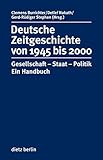
Clemens Burrichter, Detlef Nakath, Gerd-Rüdiger Stephan. Deutsche Zeitgeschichte von 1945 bis 2000: Gesellschaft - Staat - Politik. Ein Handbuch. Berlin: Karl Dietz Verlag Berlin, 2006. 1357 S. + 1 CD-ROM. EUR 98.00 (cloth), ISBN 978-3-320-02069-9.
Reviewed by Bernd Schaefer (Woodrow Wilson International Center)
Published on H-German (January, 2007)
Pluralism and Deutungshoheit
Forty authors from former East and West Germany and one French scholar have undertaken a unique task. They wanted to present the postwar history of Germany as parallel and simultaneous configurations of statehood and did so through a massive publication. Less geared toward the academic community and mostly void of cutting-edge research, this title is an informative book for "political education." Or, to use the corresponding German phrase, they want to contribute to politische Bildung through targeting "multipliers"; that is, teachers at schools and universities, their students, journalists and publishers. Overall, this publication somehow resembles what in U.S. academic publishing figures as an "encyclopedia." Sometimes excessively comprehensive and detailed, it dwarfs its American counterparts by sheer length and size of each entry, bibliography list and biographical index.
The first section, "Historical Overview," starts with two essays: a lengthy 150 pages of sometimes opinionated but overall solid analysis of both GDR and FRG economic and social history up to 1990 by Jörg Roesler, a foremost expert on East German economic history; and an abridged 20 pages by seasoned West German GDR analyst and journalist Johannes Kuppe on post-unification problems. This lopsided introduction is not reflected in the following thirty-two, mostly descriptive, analyses of every major field of politics and society in both German states. Just the assemblage of information constitutes a lasting achievement as such. As many contributors display significantly more GDR than FRG expertise, however, East German history is featured somewhat disproportionately. Such is due at least partially to the almost complete openings of GDR archival records up to 1990 versus the thirty-year rules and other limitations imposed by West German public and private archives for the period under discussion.
For reasons of space, it would go too far to comment on each of the individual contributions that sometimes widely differ in quality. Thus it may suffice to mention that the short essays stretch from solid overviews and larger contexts, for example, those by Siegfried Schwarz, Ulrich Pfeil, Bernd Florath, Michael Lemke and Detlef Nakath, Doris Cornelsen, Horst Dähn/Joachim Heise and Alexander von Plato, to overly cautious descriptions or convoluted attempts to understand why the events of 1989/90 occurred, such as the entries of Erhard Crome, Wilfriede Otto, Volkmar Schöneburg and Lothar Schröter and Joachim Schunke. Some contributions lack both detachment from the subject and truly analytic assessments. Yet all of them offer various shades of critical thought. They are almost completely free of "GDR nostalgia" and even Ostalgie, not to mention of Westalgie, which is not self-evident and therefore amounts to something.
The project was sponsored by the Rosa-Luxemburg-Stiftung, the publicly funded political foundation of the PDS, the successor party of the former communist SED. It is published by Dietz, its former publishing house, which has also come out recently with "encyclopedias" about the SED and other parties and mass organizations in the GDR. Yet the current volume is far from a post-communist take on German history. In it, the former GDR orthodoxy has been dissipated for good, though some authors struggle in their critical discussion of "flaws" in the pre-1990 "official line" of the GDR. Others proceed cautiously with neutral language. The majority of East German authors in this volume were either too young or not high enough in the GDR academic-political hierarchy to be writing with the burden of a doctrinaire past. On the other hand, for different individual and some general reasons, many East German authors did not succeed in pursuing academic careers in united Germany's academic mainstream. Thus it is commendable that twelve formerly West German scholars and publicists participated in a project like this, and that for the first time such a major joint East-West historiographical project was realized in united Germany.
This compilation may not be the most brilliant intellectual endeavor, despite its prodigious research and conceptual frameworks. Inadvertently, many scholars raise serious questions in their essays about whether writing parallel, not to speak of intertwining and dependent, histories of the GDR and FRG really works for the entire period between 1949 and 1990. Certainly it is worth noting that today such ideas emanate rather from East German scholars, thereby truly reflecting the former GDR's constant self-definition in terms of comparison or delimitation from the FRG. West German scholars, in contrast, indulged in growing indifference to the GDR between 1961 and 1989.
German historiographical debates about whether or not the GDR might become "historicized" are still nascent. In the meantime, however, the embrace of real pluralism and diversity in post-1945 German East-West comparisons seems to be warranted in both topical and personal terms. Fierce fights over who is "morally" entitled to write GDR history, to receive taxpayer funds for doing so and who should prevail in the court of public opinion were very much a phenomenon of the 1990s. Germans being Germans, and thus on principle always enjoying a quarrel on "principles," these skirmishes will never completely wane. As a first step toward coming to terms with lasting differences in the interpretation of postwar German history, and to acknowledge that such is neither moral nor amoral, remaining aspirations to achieve Deutungshoheit over Geschichtsbilder will eventually have to go. A way of thinking was very much present in the mindset of SED ideologues during the GDR period that normative interpretations can prevail and remain authoritative forever. Some of the communists' detractors seem to approve of this notion in general, even if, after 1990, they arrived at completely divergent interpretations of history. Fortunately, the volume under review has largely succeeded in avoiding such pitfalls.
Its futile "political education" impetus notwithstanding, these 1,357 pages are a tentative step towards the historicization of the querelles allemandes after 1945. In any event, it will not remain the final one. The book and accompanying CD-ROM contain many useful reference tools for teachers of German history, but they should only complement rather than replace deeper individual accounts and analyses if one is seeking a further understanding of "society, state, and politics" in the three Germanys between 1945 and 2000.
If there is additional discussion of this review, you may access it through the network, at: https://networks.h-net.org/h-german.
Citation:
Bernd Schaefer. Review of Burrichter, Clemens; Nakath, Detlef; Stephan, Gerd-Rüdiger, Deutsche Zeitgeschichte von 1945 bis 2000: Gesellschaft - Staat - Politik. Ein Handbuch.
H-German, H-Net Reviews.
January, 2007.
URL: http://www.h-net.org/reviews/showrev.php?id=12756
Copyright © 2007 by H-Net, all rights reserved. H-Net permits the redistribution and reprinting of this work for nonprofit, educational purposes, with full and accurate attribution to the author, web location, date of publication, originating list, and H-Net: Humanities & Social Sciences Online. For any other proposed use, contact the Reviews editorial staff at hbooks@mail.h-net.org.

