



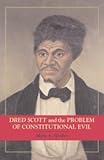
Mark A. Graber. Dred Scott and the Problem of Constitutional Evil. New York: Cambridge University Press, 2006. xiii + 264 pp. $40.00 (cloth), ISBN 978-0-521-86165-6.
Reviewed by Michael Taylor (Department of Social Sciences, Dickinson State University)
Published on H-CivWar (January, 2007)
The Best of Intentions: A Treatise on Constitutional Evil
There is an old saying that the "road to Hell is paved with good intentions." Consistent with that adage, Mark A. Graber has constructed a work that intelligently examines a controversial topic and, in the process, successfully shines new light through old windows. However, though the book is one that should be read widely, its dense compositional style will alienate all but the most devoted scholars and practitioners. This is most disheartening, for this work effectively dissects one of the most "infamous" decisions of the U.S. Supreme Court and then uses it as the means by which more fundamental flaws of the Constitution can be recognized and discussed.
The author effectively contends that the best of intentions of the framers led directly to the constitutional protection of human chattel slavery, as stated by the U.S. Supreme Court in its majority opinion in Scott v. Sandford (1857) seven decades later. Having been acculturated into believing that the Constitution was sacrosanct, it is difficult for most Americans to believe that it could also be an instrument of malevolence. However, Graber effectively contends that it is the misinterpretation of the document that has wrought iniquity within the nation's history. This is the case with the Scott decision and the Constitution: a document that purports to establish liberty was also the instrument of protection for human bondage on a national scale. The model that he presents within the pages of his latest work could apply to any contentious constitutional issue since the ratification of the document over 220 years ago.
This is Graber's most important contribution to scholarship in American constitutional history: his discussion of what he terms "constitutional evil." Rather than accepting the traditional view that the document produced at Philadelphia in 1787 was the intellectual equivalent of a "divine spark," Graber argues, consistent with recognized scholars such as Bruce Ackerman and Michael Kammen, that it was a document wrought from compromise and designed to achieve more urgent political goals. The author's most insightful analysis occurs in the chapters entitled "The Constitutional Politics of Slavery" and "Compromising with Evil," in which he demonstrates this adage with disquieting detail. As such, the author effectively substantiates his argument by demonstrating that the Constitution was designed to protect the short-sighted political/social/economic interests of those instrumental in its construction, and therefore became an instrument of protection for many practices that later generations would determine were "evil."
There is much to commend in this work. The author has taken the complex abstract idea of constitutional evil and has daringly attempted to realize it in a manner in which its concrete application is clear and distinct. Rather than being a staid either/or proposition of morality, the author has investigated the nuances of his concept that provides for the reader a disturbing portrait of how the fundamental charter of the American nation can justify a myriad of disturbing paradigms. Also, few narratives adequately convey the levels of compounded dysfunction inherent within antebellum America in a way in which the tensions at all levels of society are so readily apparent. Graber has also woven several competing contemporary views of the Scott decision, within their contemporary political contexts, into a fabric that depicts an active, yet futile debate over human chattel slavery. As a result, Chief Justice Taney's majority opinion is both a source of praise, and a menacing iniquity, acting as a corrosive acid on the sinews of union.
Secondly, as attested to by the sheer number of sources cited, the author has done extensive research into foundations, contexts, and implications of the Scott case. Graber's mastery of a variety of primary source materials is to be wholly commended, for they provide a depth to his primary argument, while providing the breadth of vision necessary to understand it. In his working of these materials many competing voices are given fair hearing, but in a way that stresses conflict, rather than resolution. What results is a dense antagonistic collage of views that, when placed in tandem with one another, create a sense of foreboding that comes to the fore with the Court's decision.
Finally, rather than taking a position in which Chief Justice Roger Brooke Taney, the author of the Scott decision, is portrayed as a pariah, the author has actively sought to place the chief justice within the complex constitutional timbre of his time. As the leader of the Court, according to Graber, Taney was placed in the unenviable position of deciding a controversial case based upon the law at a time when high emotion ruled the political landscape. Rather than playing to a specific constituency, the chief justice wrote a long opinion that ultimately pleased no one, yet was uniform with the Constitution as it stood in 1857--with much of the precedent established by the Court that he led. Roger Taney is portrayed as neither saint nor satyr, but simply as a man attempting to do his job to the best of his ability under the worst of circumstances. As a result, Taney's constitutional dilemma speaks more of the time in which the decision was rendered than of the man who rendered it.
However, there is also much that detracts from the overall work. The dense style in which the information is presented, combined with the often erratic flow of the written narrative, seriously detracts from its overall readability. It can be assumed that the author has compressed the language in order to ensure the book's brevity; yet, in doing so, what should be intellectually stimulating, soon becomes a terse and cheerless task. This is most troubling, for overall Graber's book has much to both add to, and actively challenge, the accepted interpretation of this controversial case.
Finally, the vast array of quoted sources within a paragraph following a single sentence of Graber's own well-founded contentions, have the effect of densely cloaking the very points he has argued. So many others are liberally quoted to the point that they hold sway within its pages that the primary argument becomes muddled in repetition. Granted, the source material is relevant and does much to solidify the author's assertions; however, after several chapters of quotations, the sources effectively stifle the author. Furthermore, by the time the author has laid the vital foundations of his primary argument, due to the format of the work itself, only the most ardent practitioners of American constitutional history have retained their interest. Though this is the most troubling aspect of the book, for this work makes an important contribution that seeks a deeper understanding of this case and its repercussions through a myriad of diverse perspectives, they are overused to the point of distraction.
What this author should consider--as should all historians whether of a scholarly or popular bent--is the ultimate value of history if but a very few ever read it. The whole point of writing of the past is to convey its importance and relevance to an audience that will digest the lessons it has to offer. If the work is to be savored by but a few scholars, the whole purpose of writing history is futile--it is akin to preaching to the faithful. An idea expressed in but a few eloquent words can prove timeless, while the most intelligent effusion of expression will be forgotten by the time it is uttered.
Ultimately, I would recommend this book solely to specialists in the field of American constitutional history, for, as previously stated, it is an important contribution. It successfully confronts long-held partisan interpretations and actively dispels one myth after another with true scholarly vigor. Yet, it is also regrettable that the writing style is not more accessible to a wider audience, for the unique interpretation and well-argued and sourced assessments could have had a much wider impact. It is a pity when a work based upon the best of intentions falls short of its more significant purpose.
If there is additional discussion of this review, you may access it through the network, at: https://networks.h-net.org/h-civwar.
Citation:
Michael Taylor. Review of Graber, Mark A., Dred Scott and the Problem of Constitutional Evil.
H-CivWar, H-Net Reviews.
January, 2007.
URL: http://www.h-net.org/reviews/showrev.php?id=12736
Copyright © 2007 by H-Net, all rights reserved. H-Net permits the redistribution and reprinting of this work for nonprofit, educational purposes, with full and accurate attribution to the author, web location, date of publication, originating list, and H-Net: Humanities & Social Sciences Online. For any other proposed use, contact the Reviews editorial staff at hbooks@mail.h-net.org.

