



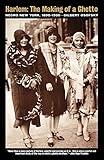
Gilbert Osofsky. Harlem: The Making of a Ghetto. Negro New York, 1890-1930. Chicago: Ivan R. Dee Publisher, 1996. xiv + 276 pp. $14.95 (paper), ISBN 978-1-56663-104-4.
Reviewed by Ellen Stroud (Columbia University)
Published on H-Urban (September, 1997)
An Enduring But Troubled Classic
Gilbert Osofsky's Harlem: The Making of a Ghetto is back in print, which is good news for teachers of history. Thirty years after it was originally published, and more than twenty years after its author's death, Osofsky's book is still a vital part of any course on the history of Harlem and an important text for courses in African-American and urban history. Despite serious flaws, Osofsky's Harlem remains the best treatment of the formation of Harlem's African-American community.
Ironically, the flaws in the text are highlighted by the new cover photo on this reprint edition. The cover of the previous edition, published in 1971, was dominated by a drawing of a deteriorating apartment building, an image appropriate for a book about a slum. The cover of this new edition is a peculiar choice to illustrate Osofsky's unrelentingly bleak story. It features a photograph of three young, elegant African-American women of the jazz age, decked out in fancy clothes, stylish hats and furs. These are women of the Harlem Osofsky doesn't show us, the Harlem of hope and glamour.
Osofsky has organized his work into three parts. In "Part One: The Negro and the City," Osofsky writes of the early black neighborhoods of Manhattan, far south of Harlem. He describes the pressure put on these old neighborhoods by the early twentieth century migration of African-Americans to northern cities. Osofsky argues that as racism and economics excluded black residents from many parts of the city, and as the old black neighborhoods began to burst at the seams, African Americans were poised and ready to take advantage of the 1904 real estate bust in Harlem.
In "Part Two: The Making of a Ghetto," Osofsky describes the real estate bust. In the late nineteenth century, when the elevated railway reached Harlem, developers built luxurious homes, and wealthy white people began to move in. However, when real estate speculation moved ahead of the railroad, the market collapsed. Fine apartment buildings stood tenantless, and landlords were in trouble. African-American entrepreneur Philip A. Payton, Jr., saw the collapse as an opportunity, and through his African-American Realty Company, he convinced cash-strapped landlords to accept black tenants, opening the door for a rapid African-American migration to Harlem (p. 92).
"Part Three: Harlem Slum" is the story of the once-exclusive neighborhood's decline. More and more black people moved to Harlem, willing to pay higher than market rents for the opportunity to live in fine housing. Osofsky writes that high rents and low wages soon strained the growing black community, as did the influx of rural migrants with little training in urban sanitation, and the reluctance of racist landlords to maintain their property once black tenants had moved in. In addition, Osofsky argues, housing built for people with larger families, along with high rents, encouraged Harlem's new residents to take in boarders. Osofsky claims that such living arrangements further compromised a family structure already severely weakened by the legacy of slavery, and contributed to juvenile delinquency and the general decline of the neighborhood. His comments about the structure of the black family are among the most troubling and dated in the book, though his original point that overcrowding was a serious problem may be granted. Osofsky writes that Harlem in the 1920s came to be characterized by poverty, congestion, disease, and crime, a legacy which Harlem had not been able to escape (pp. 134-47).
In Osofsky's telling, this is a Harlem without hope. From the moment in 1904 when Philip Payton's first tenants moved in, the Harlem of the 1960s was fore-ordained. Osofsky's is a vision of Harlem that relegates the Renaissance to an epilogue, in which he portrays it as a false image masking the squalor that was truly Harlem. In his story, the hope and the promise of Harlem are lost.
The sense of hopelessness and inevitability that drive Osofsky's telling of Harlem's history severely weaken his work, as does his slighting of Harlem's glittering image and of the cultural achievements of the Harlem elite. Despite a particularly strong chapter on the growing political clout of the concentrated black community, Osofsky gives too little attention to positive aspects of Harlem life. In addition to allowing greater leverage in politics, concentrated settlement provided a wide audience for black art and literature. It also meant the chance for black businesses to flourish and for a black middle class to develop, and it provided support networks for new migrants from the South, advantages of Harlem life which Osofsky does not discuss.
Despite the bleakness of the story he tells, Osofsky illuminates aspects of Harlem's history neglected by other authors. Nathan Huggins, in Harlem Renaissance (1971) and Jervis Anderson, in This Was Harlem (1981), for example, write of Harlem as though the Renaissance were the essence of Harlem life. Cabaret culture and the publishing and art worlds, significant though they were, had little to do with the day-to-day lives of the majority of Harlem residents, lives which Osofsky strives to put at the center of his story. Huggins's book was the standard text on the Harlem Renaissance until David Levering Lewis's When Harlem Was in Vogue (1981) took a more critical look at 1920s Harlem. But even Lewis, who argues that the Harlem Renaissance was manufactured by a small elite and was largely irrelevant to Harlem's masses, has little to say about the everyday lives of Harlem residents. Osofsky, in contrast, attempts to describe life as it was for the majority.
Harlem has not been so blessed with historians as Chicago. Osofsky's contemporary, Allan Spear, wrote a similarly bleak history of the "ghettoization" of Chicago's African Americans in Black Chicago (1967), describing black life there as a battle with the overwhelming forces of racism, poverty and overcrowding. Since then, James Grossman's Land of Hope (1989) and Nicholas Lemann's The Promised Land (1991) have given us more nuanced and complete stories of the formation of the black community of Chicago, stories placing the goals, hopes and actions of African Americans at the center. Evidence drawn from oral histories, literary sources, and African-American newspapers, for example, coupled with an interpretative framework that emphasizes the agency of ghetto residents rather than their victimization by outside forces contribute to a richer and more complete picture of the lives of black people in Chicago. Grossman and Lemann each give attention to both hardship and hope.
Harlem's history, unfortunately, has not yet had its Grossman or Lemann. Osofsky's book remains the best there is on the formation of the Harlem's black community, its shortcomings a product of the time it was written rather than of any serious deficiency in scholarship. The fashionable, smiling women on the cover of this new edition make clear what we are missing in the history of Harlem: a story that successfully unites the hope with the faults. Until such a book is written, Harlem: The Making of a Ghetto should remain on our required reading lists.
Copyright (c) 1997 by H-Net, all rights reserved. This work may be copied for non-profit educational use if proper credit is given to the author and the list. For other permission, please contact H-Net@H-Net.MSU.EDU.
If there is additional discussion of this review, you may access it through the network, at: https://networks.h-net.org/h-urban.
Citation:
Ellen Stroud. Review of Osofsky, Gilbert, Harlem: The Making of a Ghetto. Negro New York, 1890-1930.
H-Urban, H-Net Reviews.
September, 1997.
URL: http://www.h-net.org/reviews/showrev.php?id=1273
Copyright © 1997 by H-Net, all rights reserved. H-Net permits the redistribution and reprinting of this work for nonprofit, educational purposes, with full and accurate attribution to the author, web location, date of publication, originating list, and H-Net: Humanities & Social Sciences Online. For any other proposed use, contact the Reviews editorial staff at hbooks@mail.h-net.org.

