



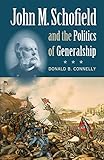
Donald B. Connelly. John M. Schofield and the Politics of Generalship. Chapel Hill: University of North Carolina Press, 2006. xiv + 471 pp. $49.95 (cloth), ISBN 978-0-8078-3007-9.
Reviewed by Bruce Tap (Independent Scholar)
Published on H-CivWar (January, 2007)
The recognition of military professionalism was not widespread in American society during the nineteenth century. In a society that placed little emphasis on professional training, an elite corps of West Point-educated officers struggled to claim its rightful place and prestige in American society. Disputes between educated officers and their civilian overseers were commonplace. Hence, Winfield Scott quarreled with President James K. Polk during the Mexican War and Secretary of War, Jefferson Davis, during the Franklin Pierce administration. George McClellan's disagreements with Abraham Lincoln and Secretary of War, Edwin M. Stanton, are well documented. Regarding civilian overseers as ignorant about military affairs, such generals as McClellan believed that they should formulate military plans and policy without interference from civilian leaders. John McAllister Schofield, according to Donald B. Connelly, was a far different military leader. Schofield, Connelly states, "saw that professional development could only be achieved by subordination to, not autonomy from, political leaders. Civilian control required accommodation to politics, not separation" (p. 11).
A number of important themes emerge in Connelly's detailed and impressive study. Throughout his life, John Schofield was moderate in all things. Shunning extreme partisanship, he valued efficiency and excellence above all. "Though a man of principle," Connelly observes," he was not a crusader" (p. 338). As a West Point graduate and a professional soldier all of his life, Schofield understandably developed a fierce loyalty to the U.S. Army. An advocate of military professionalism, Schofield viewed the army as a national institution that had the obligation of rising above state and local matters to act in the best interest of the country. Even more fundamental to Schofield's worldview, however, was his deep and abiding commitment to civilian authority. While a determined advocate of military professionalism, Schofield also developed a viewpoint that willingly submitted to civilian authority and, in intentional ways, sought to develop harmonious relationships with the president, the secretary of war, and congressional committees. Born in Chautauqua New York on September 29, 1831, Schofield moved to Freeport, Illinois in 1845. Schofield entered West Point in 1849, where he graduated seventh in his class and received a commission in the artillery. Despite an abiding interest in studying law, Schofield's West Point matriculation led to a life long commitment to the U.S. Army interrupted only briefly when he took an academic position at Washington University in St. Louis in 1860. As soon as the Civil War began, Schofield returned to the army, where he served in the Department of the West under John C. Fremont and Henry W. Halleck. By November 1861, Schofield would become a brigadier-general of U.S. volunteers.
Throughout his Civil War career, Connelly portrays Schofield as a political moderate who attempted to steer a neutral course between partisan extremes. In no place was this exemplified more than in the Department of Missouri. Torn by bitter rivalry between conservative supporters (known as Claybanks) of provisional governor Hamilton R. Gamble and radicals led by Charles Drake and others (known as Charcoals), Schofield's moderate approach, when he commanded the department from May 1863 through January 1864, ultimately satisfied no one. When guerilla William Clarke Quantrill, for instance, successfully raided Lawrence, Kansas on August 21, 1863, radicals blamed Schofield for keeping too few troops in Kansas. After Schofield's subordinate, Brig. Gen. Thomas Ewing, implemented harsh measures such as General Order No. 11 to retaliate, Schofield was then criticized by conservatives for bowing to radical pressure. Because of the relentless criticism of radicals, President Lincoln eventually removed Schofield from command of the department, appointing him to command the Department of the Ohio and the small Army of the Ohio. Schofield served under Maj. Gen. William T. Sherman in the Atlanta Campaign. He also served under Maj. Gen. George Thomas in Tennessee where he directed the battle of Franklin on November 30, 1864 and participated in the battle of Nashville on December 15-16, 1864. In early 1865, Schofield was sent east to command the Department of North Carolina, where he served again under Sherman and participated in the surrender of Joseph Johnston's Confederate army.
During the Reconstruction period, Schofield became embroiled in political controversies as he once again tried to negotiate a moderate course between unrepentant Confederates, on the one hand, and radical Republicans, on the other. While not a hard-bitten racist, Schofield, according to Connelly, paternalistically viewed African Americans through the lens of inferiority. As commander of the Department of the Potomac (Virginia and West Virginia) and, later, the First Military District under the Military Reconstruction Acts, he would, when necessary, aggressively protect the interests of African Americans. Hence, in 1867 Schofield intervened to integrate four of six streetcars in the city of Richmond when African Americans were denied access. Schofield also diligently followed congressional outlines for re-organizing state governments, registering both whites and African Americans as voters. At the same time, because of his racial prejudice, Schofield was skeptical of black voting and disagreed with section three of the fourteenth amendment, which disqualified many white voters. Always a bit of a mugwump, who emphasized honest and efficient government above all, Schofield, Connelly maintains, believed wholesale black enfranchisement would lead to corrupt and inefficient government. Schofield's political moderation meant that he pleased neither conservatives nor radicals. During the impeachment controversy, Schofield would play a small but significant role in the resolution of the controversy. President Andrew Johnson, through his advisor William Evarts, offered Schofield the war office. This, argues Connelly, would appease Republicans in Congress who previously sought to maintain Edwin M. Stanton, who had thoroughly alienated the president. Schofield, however, agreed to take the office only after Johnson assured him that he would observe the chain of command and not work around the secretary of war. The appointment of Schofield, according to Connelly, may have helped provide the "cover" some Republican moderate Senators needed to justify a negative vote on an impeachment verdict.
After a nine-month stint as secretary of war, Schofield held commands in the department of Missouri (1869-70), the department of the Pacific (1870-76), and West Point (1876-80). At the latter, he attempted numerous reforms, including the elimination of hazing. He also made perhaps his biggest career mistake when he presided, rather unfairly, over the court marital of Whittaker Johnson, an African American cadet who was assaulted in his West Point barrack. Schofield never accepted Johnson's version of events, in part, Connelly maintains, because of his belief in black inferiority. Schofield's bungling of the Johnson case was a principal reason why President Rutherford Hayes removed him from command of West Point in December 1880, just a few weeks after the presidential election. During the 1880s, Schofield commanded the departments of the Pacific, Missouri, and the Atlantic. Finally, after the death of Lt. Gen. Philip Sheridan in August 1888, Schofield achieved the ultimate distinction for a professional American soldier when he became the commanding general of the U.S. Army. The title, as Connelly points out, was largely meaningless. As Schofield quickly realized, he had little formal authority, only influence. At the same time, in this position, Schofield worked diligently to implement his vision of civil-military relations.
As commanding general of the army, Connelly views Schofield as a moderate reformer who accomplished a number of important reforms before his 1895 retirement. First and foremost, Schofield worked to clarify the position of the commanding general. While Schofield was an eager advocate of military professionalism, he was also cognizant of the subordinate role of professional soldiers to civilian authorities. Hence, while Schofield would vigorously endorse professional education, officers training, and army reforms that improved the efficiency and competence of the army, he also understood that the role of the commanding general was subordinate to the secretary of war. While it was traditional for bureau chiefs to act independently, each operating their own fiefdoms, Schofield worked hard to coordinate the war department, acting as sort of a chief of staff or assistant for the secretary of war. In all matters, army officers must recognize the priority of civilian authority. Schofield also was influential in bringing about several small, but significant reforms. First, he supported the adoption of lineal promotions to address inequities in the way officers were promoted in the regular army. Second, by issuing General Order No. 41 in April 1890, Schofield initiated performance reviews for officers, a practice that would eventually be a major factor in officer promotions and eliminated political patronage considerations from the promotion process. "Slowly Schofield and the other army leaders," notes Connelly, "both staff and line, forged a set of professional standards for merit ... these criteria gradually penetrated the largely politician-controlled selection process" (p. 309). After retirement and until his death in 1906, Schofield remained active in military affairs, advising presidents and testifying before congressional committees. According to Connelly, Schofield largely inspired the reforms pushed through by Secretary of War, Elihu Root. These included, for instance, the Army Reorganization Act of 1901, which increased the size of the regular army and, among other things, provided for four regional training camps; and the Dick Act of 1903, which was the foundation for the modern day National Guard. Despite numerous accomplishments in the area of reform and education, Connelly believes Schofield's most significant contribution was the creation of a new paradigm of civil-military relations, a relationship that was rooted in professional competence and subordination to civilian institutions. "John M. Schofield's admonition should remind us," Connelly concludes, "that while an army deeply involved in politics is dangerous, so is one completely segregated from the values, institutions, and people of the nation" (p. 341).
Connelly's work rigorously and meticulously covers the details of Schofield's professional career; however, the reader who wants information on Schofield the man will be disappointed as scant attention is paid to Schofield's personal life. For instance, one learns next to nothing about Schofield's parents, children, and siblings, except for those, like his brother, George W. Schofield, who chose an army career. Even Schofield's relationship with his two wives, Harriet Bartlett and, the much younger second wife, Georgia Wells Kilbourne, is superficially treated. The reader learns only the bare details of these relationships. Although Connelly focuses on Schofield's professional career, a bit more emphasis on his family and personal life could be provided without detracting from the author's central purpose. Most readers, however, will find Connelly's biography readable, informative, and sound in its conclusions. Although Connelly appears to like the subject of his biography, he can also be critical of some of the decisions and actions undertaken by Schofield throughout his long career. As Schofield was temperate and moderate in most of his actions and decisions, so is Connelly's treatment of his subject. Well written and meticulously researched, Donald Connelly has provided a timely study to an oft-neglected figure in Civil War military history as well as informative source for nineteenth-century civil-military relations.
If there is additional discussion of this review, you may access it through the network, at: https://networks.h-net.org/h-civwar.
Citation:
Bruce Tap. Review of Connelly, Donald B., John M. Schofield and the Politics of Generalship.
H-CivWar, H-Net Reviews.
January, 2007.
URL: http://www.h-net.org/reviews/showrev.php?id=12723
Copyright © 2007 by H-Net, all rights reserved. H-Net permits the redistribution and reprinting of this work for nonprofit, educational purposes, with full and accurate attribution to the author, web location, date of publication, originating list, and H-Net: Humanities & Social Sciences Online. For any other proposed use, contact the Reviews editorial staff at hbooks@mail.h-net.org.

