



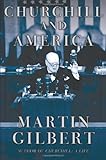
Sir Martin Gilbert. Churchill and America. New York: Free Press, 2005. xxiv + 501 pp. $30.00 (cloth), ISBN 978-0-7432-5992-7.
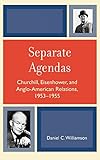
Daniel C. Williamson. Separate Agendas: Churchill, Eisenhower, and Anglo-American Relations, 1953-1955. Lanham: Lexington Books, 2006. 145 pp. $70.00 (cloth), ISBN 978-0-7391-1164-2.
Reviewed by Antoine Capet (Université de Rouen)
Published on H-Albion (January, 2007)
The Forest and Some of the Trees
Anglo-American relations are of course an inexhaustible subject, with a continuous flow of new books examining or re-examining particular aspects of what the British (though not the Americans) like to call the Special Relationship. Naturally Winston Churchill, who liked to remind people that he embodied Anglo-American union in his parentage, figures prominently in this process. Curiously, no comprehensive study of Churchill and Anglo-American Relations as such was available until his Official Biographer, Sir Martin Gilbert, wrote Churchill and America; the only comparable work, which receives due tribute in the footnotes, Robert H. Pilpel's Churchill in America, 1895-1961: An Affectionate Portrait (1976) does not cover exactly the same ground. Nobody was better suited than Gilbert to write that particular monograph, since his command of the sources and his knowledge of Churchill are unparalleled.
The story begins with Churchill's early interest in the United States, as expressed in his schoolboy's letters to his American mother, before going there for his first visit (out of sixteen) in 1895, when he was twenty-one. In New York, he stayed with Bourke Cockran, a Democratic Congressman of Irish origin who had a profound, lifelong influence on him. Interestingly, Churchill wrote of his experience to his brother in tones which seem directly inspired by Alexis de Tocqueville, speaking of "a very great country," "not pretty or romantic but great and utilitarian" and adding that there seemed to be "no such thing as reverence or tradition" (p. 16). Further down in that letter, he asked his brother to imagine "the American people as a lusty youth whom neither age nor just tradition inspire with reverence" (p. 17). This is of the greatest interest, since later in his life he, of course, often spoke of the Great Republic in an admiring tone--and also because all his life he himself only respected his elders and betters in so far as they won respect by exemplary behavior. Five years later, in December 1900, he went back to the United States for another two-month tour of lectures, which added to his perception of the country and its inhabitants. Thus we are led to believe--with some justification--that from his formative years Churchill developed a taste for many aspects of American life which markedly distinguished him from the largely anti-American attitudes of his fellow countrymen at the time. It was twenty-eight years before he embarked on his third trip, and it is here that Gilbert's book distinguishes itself from a mere travelogue, because the author examines how, from his base in the Commons (he took his seat for the first time in February 1901) and later in the Government (1905) and Cabinet (1908), he became an indefatigable advocate and actor of Anglo-American cooperation, with the constant argument that this policy was in the best interest of Britain. Ironically, when the United States joined the war in April 1917, thus fighting on the side of Britain for the first time in its history, he was a mere backbencher, having been forced to resign his post at the Admiralty after the Gallipoli disaster (1915). But when he came back as Minister of Munitions in July 1917, the job was ideally suited for close cooperation with the new American allies. His efforts were indeed recognized by the American authorities, who awarded him the Distinguished Service Medal in 1919.
The failure of the American Senate to ratify the Treaty of Versailles--with the consequent absence of the United States from the League of Nations--came as a blow to Churchill. Gilbert reminds us that the American withdrawal rankled with Churchill for the rest of his life. People familiar with Churchill's The Second World War will of course remember the famous "theme of the volume" of The Gathering Storm (1948): "How the English-speaking Peoples through their Unwisdom, Carelessness and Good Nature allowed the Wicked to Rearm." Likewise, as we know (though curiously Gilbert does not remind us of all this), in the 1930s he never failed to denounce those (especially in the American press) who thought that Hitler was only acting in his own backyard, as when he undertook the remilitarization of Rhineland contrary to the clauses of the Treaty. Two other bones of contention were the repayment of British war debts (which the British insisted should be linked to German reparations) and attitudes to the British Empire, which were connected with the disputes over naval quotas and Indian and Irish independence.
Churchill paid two visits to the United States in the interwar years: one for pleasure in 1929, the other for profit in 1931-32--another lecture tour which he used to plead for better Anglo-American relations. Further plans for more lucrative American tours in the later 1930s were thwarted by the continuing Depression, the Abdication crisis, and the final descent into war.
Initially, the war itself did not make Churchill's plea for more cooperation easier, even in the desperate period of the Fall of France. For Gilbert, Churchill's "most serious error of judgment with regard to the United States in his whole career" (p. 192) was when, on June 13, 1940, he misinterpreted President Roosevelt's promise of help to the French Premier Reynaud as a virtual certainty of an American declaration of war. The reasoning was simple, but erroneous: why should Roosevelt send a message to France urging her to continue her agony unless he was certain that his country was coming to her aid? On June 14, Ambassador Joseph Kennedy informed Churchill that Roosevelt's message--which must not be made public--did not commit the United States, as only Congress could make such a commitment. One more fear for Churchill was in case Roosevelt called for a cessation of hostilities, which would have introduced confusion among the British population, destroying its unity and high morale. Gilbert quotes from a revealing minute of the War Cabinet of June 16, which shows that Churchill did not exclude that hypothesis (p. 195)--thereby indicating the limits of his trust in Roosevelt, let alone the isolationist American people.
By then, we have more or less covered half the book--the second half showing the gradual building of the Special Relationship and increased British subservience to American policy. So much has been written on the asymetrical relationship between Churchill and Roosevelt during the war that it is difficult for Gilbert to break new ground. Naturally, he goes back on how Churchill managed to persuade the President to give priority to the European theater, but he does not insist on his failure to persuade him to accept the Mediterranean "softbelly" strategy which he preferred over the head-on confrontation with the Germans on the Channel. Then, of course, there was the third partner, Josef Stalin, and Gilbert recounts once again how his intransigence over Poland, for instance at Yalta, successfully drove a wedge between Roosevelt and Churchill, with the latter, of course, always bowing to the President's decisions in the end.
Gilbert quite aptly remarks, "For the ten years between 1935 and 1945, Churchill's relations with America were focused on Germany. For the years after 1945, they were dominated by the Soviet Union" (p. 353). This is precisely the theme of Daniel C. Williamson's book--at least for Churchill's last months in power. The chosen format is clearly announced in the introduction--Williamson concentrates on four key points of Anglo-American disagreement in 1953-55: Churchill's efforts to convene an East-West Summit; the supply of arms to Iraq; the dispute between Saudi Arabia and the Trucial States; and the attitude toward China.
The first point has already been magisterially examined by John Young and Klaus Larres as Williamson readily admits.[1] His own conclusion is inconclusive: Churchill did not obtain his Summit (ironically, it only took place after his retirement), but the American Administration, though unyielding, had always been careful not to be too dismissive--for old time's sake but also because the United Kingdom was the United States' principal NATO partner.
On arming Iraq, the British dilemma was a familiar one, because the scenario had already been seen in postwar Greece: American aid in arms supplies was welcome, because it would relieve Britain's stretched resources; but then the United States would likely replace the United Kingdom as the dominant foreign power in Iraq. The chapter in fact does not mention Churchill and Eisenhower personally, but only the dealings between Anthony Eden's Foreign Office and the American Administration, thus making it clear that the title of Williamson's book was only dictated by commercial considerations--Churchill's name on a book cover always being a sure selling point.
Outside specialists of the Middle East in the 1950s, few people today are familiar with the Buraimi Dispute, Williamson's third case study. In August 1952, a military force from Saudi Arabia--then the United States' only Arab ally--seized the Buraimi Oasis, until then in possession of Abu Dhabi and Muscat, Trucial States which were traditional allies of the United Kingdom. The new Eisenhower Administration inherited the conundrum of how to reconcile its own support for Saudi Arabia with the support that its British allies gave to the Trucial States. The situation was further complicated by Aramco insisting that its oil interests should in no way be affected in any settlement. This time the dilemma was on the American side. In the event, the dispute was theoretically solved under Eden, when arbitration at Geneva failed and British troops occupied the Oasis in October 1955--with a definitive solution in 1974, when Saudi Arabia formally recognized Abu Dhabi's sovereignty over it. Churchill is only mentioned once--pleading in June 1954 against using force to dislodge the Aramco American nationals who had settled in Buraimi (p. 95). Once again, it is Eden who was at the forefront of the confrontation with the Eisenhower Administration, which in fact finally yielded, paying the price of temporary alienation of the Saudis.
The final example of estrangement is that of the attitude towards Communist China's attack in September 1954 on the Quemoy Island and its smaller neighbors, held by the Nationalists--America's allies. While the Eisenhower Administration declared that it was ready to fight Communist China--if necessary with atomic weapons--to defend the islands, Eden never agreed to follow suit. On the contrary, he constantly pleaded moderation, which eventually (1955) triumphed. Williamson, contrary to most of his predecessors[2] believes that "the first Chinese offshore islands crisis," as it is now known in the literature, in fact demonstrated British continued independence from American foreign policy. Could it be, we wonder once more, because British foreign policy was now (since Churchill's major stroke in June 1953, in fact) firmly in Eden's hands, as of course the latter was always more lukewarm towards unconditional alignment with U.S. policy ? The answer will not be found in Sir Martin Gilbert's book, because he does not discuss this in any depth--nor could we expect him to, as he could not examine every incident in Churchill's complex relations with the Americans. For instance, he does not mention the dissensions over the "Darlan affair" in 1942 and oversimplifies Churchill and Roosevelt's differences on recognition of de Gaulle's Free French Provisional Government (p. 329).
In a way, therefore, the two books demonstrate that, if need be, the two genres--the substantial overview which can be read as a "complete story" and provides overall context, and the spotlight thrown on a narrow period and the very specific incidents associated with it--are indispensable and complementary. To paraphrase the old expression, Williamson usefully provides some of the trees--but Gilbert provides the essential material which enables us not to miss the forest.
Notes
[1]. John W. Young, Winston Churchill's Last Campaign: Britain and the Cold War, 1951-1955 (Oxford University Press, 1996); and Klaus Larres, Churchill's Cold War: The Politics of Personal Diplomacy (Yale University Press, 2002). See my review in CERCLES: http://www.cercles.com/review/r7/larres.html.
[2]. Notably Robert Boardman, Britain and the People's Republic of China, 1949-1974 (Basingstoke: Macmillan, 1976); Michael Dockrill, "Britain and the First Chinese Offshore Islands Crisis, 1945-1955," in British Foreign Policy, 1945-1956, ed. Michael Dockrill and John W. Young (Basingstoke: Macmillan, 1989), pp. 173-196; and Qiang Zhai, The Dragon, the Lion and the Eagle: Chinese-British-American Relations, 1949-1958 (Kent State University Press, 1994).
If there is additional discussion of this review, you may access it through the network, at: https://networks.h-net.org/h-albion.
Citation:
Antoine Capet. Review of Gilbert, Sir Martin, Churchill and America and
Williamson, Daniel C., Separate Agendas: Churchill, Eisenhower, and Anglo-American Relations, 1953-1955.
H-Albion, H-Net Reviews.
January, 2007.
URL: http://www.h-net.org/reviews/showrev.php?id=12722
Copyright © 2007 by H-Net, all rights reserved. H-Net permits the redistribution and reprinting of this work for nonprofit, educational purposes, with full and accurate attribution to the author, web location, date of publication, originating list, and H-Net: Humanities & Social Sciences Online. For any other proposed use, contact the Reviews editorial staff at hbooks@mail.h-net.org.

