



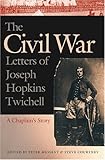
Peter Messent, Steve Courtney, eds. The Civil War Letters of Joseph Hopkins Twichell: A Chaplain's Story. Athens: University of Georgia Press, 2006. v + 333 pp. $34.95 (cloth), ISBN 978-0-8203-2693-1.
Reviewed by Jason Lantzer (Department of History, Indiana University Indianapolis)
Published on H-CivWar (January, 2007)
Once More into the Breach, but This Time with God
One of the drawbacks, for scholars and buffs alike, when it comes to the popularity of the Civil War, is the proliferation of material. Consistently one of the most common topics for both academic and popular presses, works on the War Between the States can occupy a shelf to a whole bookcase in the blink of an eye. So, when yet another book comes out about the conflict, offering yet another first-person account, it behooves readers to ask themselves if it is worth not only reading, but also the money and space involved as well. When it comes to Peter Messent and Steve Courtney's edited volume of Joseph Hopkins Twichell's Civil War letters, the answer to all three of those questions is an emphatic yes.
Twichell was not the typical letter writer. A Yale graduate, his letters are well written at every level. Nor was he a typical Union soldier. To begin with, Twichell was a Connecticut Yankee who served in the 71st Regiment of the New York State Volunteers or, as they preferred to call themselves, the Jackson Regiment of Daniel Sickles Excelsior Brigade from Lower Manhattan. Furthermore, the Republican Twichell served as a Protestant chaplain whose "congregation" was largely Democratic leaning Irish Catholics. Together, Twichell and his flock saw action as part of the Peninsula, Second Bull Run, Fredericksburg, Chancellorsville, Gettysburg, Spotsylvania, and Wilderness campaigns. Readers then garner a unique perspective on the bulk of the major campaigns of war in the East, and do so from a well-educated writer who was privy to many angles of the conflict that are often glossed over in other histories. In reading them today, it is little wonder that Twichell, following his service in the army and during his forty-seven-year pastorate of Asylum Hill Congregational Church in Hartford, Connecticut, became both a friend and even an inspiration to Mark Twain.
In the letters presented, which are just a portion of his lifetime of correspondence, Twichell writes almost exclusively to his family. Indeed, his chief correspondent was his father, who died in April 1863, but who never left his thoughts. Readers come away not so much with descriptions of the ebbs and flows of battles and campaigns, though that is often there, but with the effects of battles on the men who fought them, both in terms of wounds and in confidence in the cause for which they are fighting. This is the book's chief, and most welcome, contribution to an understanding of the war.
Much of what one reads in Twichell's letters is typical of other Civil War letter collections, of course. He complained about camp life and having to march. He missed his family. And yet those complaints were filtered through his role as a chaplain. In this position, Twichell gives modern readers new insights into not just what one would expect to find, but also into other events related to the war. When he railed against camp life, it was mostly to do with the concentration of vice, especially alcohol, amongst the men. He came to hate the fact that the war did not respect the Sabbath. Twichell served as a chaplain at an execution. He also escorted a young woman out of camp, incognito, before she could fall into prostitution. Such were the unheralded duties of a man of God serving as part of the Army of the Potomac.
Thus it is not surprising that God was ever-present for Twichell in the midst of the conflict. He was sure that the war was part of a divine plan and that he played a part in it for a reason. Twichell was constantly working to achieve a revival of Christian religion amongst his men, for his own spiritual journey was heavily influenced by the revivals of the antebellum period. What is of interest in all his theological discussions is that even though Twichell had seminary training when he entered the ranks, he was not an ordained minister for most of the first two years he served as a chaplain. Also of appeal is the friendship that developed between Twichell and Father Joseph O'Hagan, the Catholic chaplain assigned to the regiment. Though the war and his friendships with Catholics helped to erase creedal differences, at least to some extent, Twichell never quite lost his distrust of the ceremonial nature of the Catholic Church.
Twichell's faith, in the main, did not translate into respect for the white South. Twichell was reared to hate slavery, and his wartime experiences only enhanced this feeling. As the war progressed, this righteous hatred was transferred to the Rebels themselves. Twichell passed along what he saw and heard (even if only rumors) of real and perhaps imagined Southern atrocities, ranging from bayoneting wounded Northerners; to firing on Union men flying a flag of truce; to the use of "torpedoes" or landmines, by retreating Confederate units. Still, he was compassionate to wounded Confederates and to those who were taken prisoner. He much preferred fighting their armies to taking food from Rebel civilians.
Despite his chaplaincy, Twichell worried that he was becoming more soldier than chaplain, the longer he stayed in the service. He provides an infantryman's perspective on the cavalry, however, whom he labels as "big talkers" (p. 266). One of the more interesting perspectives Twichell gives to modern readers is his confidence in the superiority of the Eastern Theater of Operations to what is going on in the West. In writing about the Peninsula Campaign, he puts his full confidence in Gen. George McClellan's slow, deliberate advance at the rebel "heart," rather than the quick movements of the Western armies. Yet, even then, one can perceive a gradual disgust at the lack of real victories in the East. Readers also catch glimpses of how, and even why, President Abraham Lincoln, though he might appear comical during reviews, came to garner the affection and loyalty of the soldiers in blue. Twichell came to an early conclusion, in 1863, a year before Little Mac and Honest Abe faced off in the election, that the Democratic peace movement in the North was destined to fail because the army was true to the cause. Despite his devotion to the cause, and despite Ulysses Grant's arrival in the East and the energy that brought to campaigning, Twichell left the army when his three-year enlistment ended for unknown reasons, but possibly due to fatigue and/or desire to get married and settle down.
Readers will also learn a good deal about camp politics, and considering with whom Twichell served, there were a good deal of them. Daniel Sickles, Joe Hooker, George Hall, Henry Potter and others who are less well known make their appearances in Twichell's letters. Indeed, he was with Sickles at Gettysburg when the controversial general advanced his corps without orders; he avoided a court martial only because he lost a leg in the ensuing combat. Twichell actually helped perform the amputation.
Twichell offered other unique perspectives as well. As an officer, Twichell had a servant attend to his baggage. While this job would eventually fall to a private, for a time Twichell had a free black servant named Joe. Many of his letters deal with the time he spent working in the camp hospitals, dealing with illness as well as the aftermath of battles. He became an expert, perhaps as astute as many of the doctors serving in both armies, at the best way to treat wounds. In a way, this book is an afterthought for the editors, both of whom are composing other works that utilize Twichell's letters. And yet it is obvious that in those other works, they both became entranced by Twichell's story. Their introduction to this work as well as their chapter introductions and notes are wonderful. Yet readers are not getting the full picture. The editors have made a conscience decision to focus on Twichell's accounts of the war. Segments of letters appear, and others have had information removed from them. While this saves space and helps retain focus, readers also miss out, a bit, on what makes Twichell himself. This is not meant to be a biography, yet it does give hope that perhaps one on Twichell will soon emerge.
Beyond this criticism, readers might wish the editors had done a bit more with some of the historic characters Twichell encounters. For example, though they mention the controversy that surrounded Sickles long before he arrived at Gettysburg, more could have been made of it and more discussion of the unit that both he and Twichell were a part of would have been welcome. Likewise, the editors are a bit harsher on Grant as a general than one might expect, considering some of the recent trends in Civil War scholarship. Still, Messent and Courtney have produced a good book and one that is worth both the time to read and the treasure needed to acquire it.
If there is additional discussion of this review, you may access it through the network, at: https://networks.h-net.org/h-civwar.
Citation:
Jason Lantzer. Review of Messent, Peter; Courtney, Steve, eds., The Civil War Letters of Joseph Hopkins Twichell: A Chaplain's Story.
H-CivWar, H-Net Reviews.
January, 2007.
URL: http://www.h-net.org/reviews/showrev.php?id=12689
Copyright © 2007 by H-Net, all rights reserved. H-Net permits the redistribution and reprinting of this work for nonprofit, educational purposes, with full and accurate attribution to the author, web location, date of publication, originating list, and H-Net: Humanities & Social Sciences Online. For any other proposed use, contact the Reviews editorial staff at hbooks@mail.h-net.org.

