



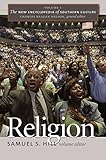
Samuel S. Hill, ed. New Encyclopedia of Southern Culture, Volume 1: Religion. Chapel Hill: University of North Carolina Press, 2006. xviii + 248 pp. $39.95 (cloth), ISBN 978-0-8078-3003-1; $19.95 (paper), ISBN 978-0-8078-5674-1.
Reviewed by Arthur Remillard (Newman Center Project Coordinator, Saint Francis University)
Published on H-Amstdy (December, 2006)
Revising Southern Religion
Since its publication in 1986, the 1,634-page Encyclopedia of Southern Culture has become a standard resource for scholars of the American South. With updated information and newly added entries, the New Encyclopedia of Southern Culture is a welcome and timely revision. Unlike its predecessor's single-volume presentation, the New Encyclopedia comes in twenty-four separate installments. Each concentrates on a specific topic such as architecture, folklife, language, media, race, and violence. Religion is the subject of the first volume. Divided into two sections, the first half's essay-length "thematic" entries cover broad matters ranging from Appalachia to Zion. The remaining "topical" entries supply concise descriptions of influential people, events, and organizations. This volume will be a welcome addition to the bookshelves of anyone interested in Southern religion. Additionally, those teaching courses on the topic may consider adding it to their reading lists. The encyclopedic arrangement permits the instructor to determine his or her own curricular direction, while also giving students a reliable depot of information.
Among the more noticeable revisions in this volume is its effort to look beyond the Protestant majority. No doubt, members of this faith have remained profoundly influential, a fact that the editor Samuel Hill explains in the first thematic entry. Outlining the "distinctive" qualities of Southern religion, the author repeats much of what he wrote for the encyclopedia's first edition. In the closing lines, however, Hill points out that the South's "interaction with global civilization" has brought the voices of Hindus, Buddhists, Muslims, and others into the religious mix (p. 19). Some of the encyclopedia's new entries expand upon Hill's concluding remarks. For example, Sam Britt's piece on Asian religions details how the 1965 Immigration and Nationality Act eventuated in more Buddhists, Hindus, Jains, and Sikhs living in Dixie. "Evangelical Christianity may yet continue to be the dominant form of religiosity," Britt admits, "but its role in shaping southern culture will increasingly be negotiated with other faiths" (p. 34). Some of the "other faiths" come with a New Age flavor, as Ted Ownby shows. While these diverse spiritual activities have "not had an especially friendly welcome in the South," the promises of health, healing, empowerment, and transformation have lured many to religious practices such as Wicca (p. 105). In an entry specifically addressing religious diversity, Charles Lippy also references Wicca, along with Asian religions, Catholicism, Judaism, and Islam. The author resolves that noting the presence of these religious communities "[highlights] a depth in southern religious life extending well beyond what the image of the Bible Belt suggests" (p. 62). Bringing the diversity theme into yet another realm, Joel Martin focuses on the Native American religions that have characterized the South, both before and after European contact. While perhaps not as vital in the present era, the author stresses that Indian cultures have left behind many indelible marks. He cites the massive ceremonial mounds in Moundville, Alabama. These former centers of spiritual activity are still the largest religious structures in the South. "Their silent monumentality," Martin writes, "belies the dynamism of the societies that constructed them" (p. 101).
In addition to highlighting the South's non-Protestant faiths, some of the encyclopedia's new entries reveal differences within this religious circle. Paul Harvey's coverage of social activism, for instance, identifies the varying public agendas of black and white Protestants. To make this point plainly apparent, Harvey contrasts the "godfather to the contemporary religious-political right wing" Jerry Falwell, with the "leader of the liberal-left 'Rainbow Coalition'" Jesse Jackson (p. 141). Just as race has contributed to differences within Protestantism, so too has time. In another new writing, Joseph Price documents a change in ministerial attitudes regarding sports. In the late nineteenth century, Southern Protestant ministers typically condemned cockfighting, horseracing, baseball, and football. Such activities, they proclaimed, led to Sabbath violations, drinking, gambling, and profane language. Price explains that, as the twentieth century continued, the culture of muscular Christianity convinced many ministers that sports could become an evangelization tool for unchurched men. As readers learn about this shift from abhorrence to incorporation, they will also witness a photograph of a race car with the words, "Trust in God," scrawled upon its rear spoiler. This is one of many images that complement the entries, each immeasurably improving upon the volume's overall quality.
The New Encyclopedia is comprehensive, relevant, and representative of past and present trends in the field of Southern religion. While compact and portable, the individualized volumes present an obvious drawback. Because Southern religion is inseparable from the region's culture and history, scholars may want to access the volumes on race, gender, myth, and the like. While the predecessor was bulky, it was also an "all-in-one" reference. Perhaps the University of North Carolina Press could make the entire encyclopedia available online. Besides enhancing accessibility, an online format would make it readily editable. In his introduction, the general editor Charles Reagan Wilson referenced C. Vann Woodward's review of the 1989 original.[1] Woodward rightly predicted that ongoing scholarship would create new ways of thinking about the South, thus necessitating the encyclopedia's unending stream of revision. A cursory survey of recent scholarship on Southern religion indicates that this discussion will continue generating new ideas.[2] As such, one can be reasonably assured that updates to this volume are inevitable. Whether free access or pay-for-use, an online format would help editors avoid the practical problems left by the printed version, and concentrate instead on making the contents both current and accessible.
Notes
[1]. C. Vann Woodward, "The Narcissistic South," New York Review of Books 36, no. 16 (October 26, 1989).
[2]. See, for example, Corrie E. Norman and Don S. Armentrout, eds., Religion in the Contemporary South: Changes, Continuities, and Contexts (Knoxville: University of Tennessee Press, 2005); Beth Barton Schweiger and Donald G. Mathews, eds., Religion in the American South: Protestants and Others in History and Culture (Chapel Hill: University of North Carolina Press, 2004); Charles Reagan Wilson and Mark Silk, eds., Religion and Public Life in the South: In the Evangelical Mode (Walnut Creek, Calif.: AltaMira Press, 2005); Samuel S. Hill and Charles H. Lippy, eds., Encyclopedia of Religion in the South, second edition (Macon, GA: Mercer University Press, 2005); Journal of Southern Religion (http://jsr.fsu.edu).
If there is additional discussion of this review, you may access it through the network, at: https://networks.h-net.org/h-amstdy.
Citation:
Arthur Remillard. Review of Hill, Samuel S., ed., New Encyclopedia of Southern Culture, Volume 1: Religion.
H-Amstdy, H-Net Reviews.
December, 2006.
URL: http://www.h-net.org/reviews/showrev.php?id=12674
Copyright © 2006 by H-Net, all rights reserved. H-Net permits the redistribution and reprinting of this work for nonprofit, educational purposes, with full and accurate attribution to the author, web location, date of publication, originating list, and H-Net: Humanities & Social Sciences Online. For any other proposed use, contact the Reviews editorial staff at hbooks@mail.h-net.org.

