



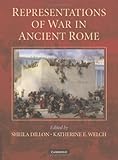
Sheila Dillon, Katherine E. Welch, eds. Representations of War in Ancient Rome. New York: Cambridge University Press, 2006. xiv + 365 pp. $90.00 (cloth), ISBN 978-0-521-84817-6.
Reviewed by Joseph Frechette (U.S. Army Center of Military History)
Published on H-War (December, 2006)
Intersections of Battle, Victory, Power, and Perception
Representations of War in Ancient Rome is an anthology which includes articles dealing with topics fairly narrow in focus as well as those extremely broad in focus and spanning over five hundred years of Roman history, from the early republic through the high imperial period. While likely of interest to many H-War list members, it is in no sense a typical military history.
The volume's stated premise is that warfare suffused Roman life to a degree unparalleled in other ancient societies and that the Romans' presentation of warfare was instrumental in constructing their beliefs about themselves as well as their past and their future. This notion of the Romans as exceptionally warlike clearly echoes William Harris's War and Imperialism in Republican Rome: 327-70 B.C. (1985). It might be noted, however, that although the Romans were certainly warlike, those states with which they came into contact (such as Carthage and the Hellenistic successor kingdoms) were in no sense particularly pacific.
Tonio Hoelscher's thought-provoking chapter (in many ways the capstone of the book), "The Transformation of Victory into Power: From Event to Structure" is easily worth the attention of military historians of any stripe if only because of his incisive observation that military victory is not identical, in and of itself, to political power. That is, the victor must find a way to fix and transform an event that is by its nature limited, both temporally and geographically, into long-term stable power against external and domestic enemies. Hoelscher argues that this was done, at least in part, by erecting monuments in conquered lands that "re-presented" the Romans' victories, both impressing the viewer and reinforcing the subjugation of the vanquished. Internally, rituals and monuments served to transmit victories and martial virtue throughout Roman society and helped form the ideological basis for domination in imperial Rome. Obviously, given the focus of the volume, this study is focused on propaganda and ideology more than on the perhaps more important practical accommodations between the Romans and the elites of the lands they conquered.
Only two chapters focus on the traditional narrative sources, and both are a bit out of place in a volume otherwise dedicated to various physical presentations of Roman victory and power. Jonathan Roth's "Siege Narrative in Livy: Representation and Reality" is a philological investigation of Livy's treatment of sieges and is a bit technical and specific for the casual reader. However, it will undoubtedly be useful for military historians of the early and middle republic.
William Harris's "Readings in the Narrative Literature of Roman Courage" examines the evidence in the narratives of Polybius, Caesar, and Ammianus for the nature of Roman virtus and morale. Harris rightly points out that many questions regarding Roman psychology and the nature of the small-group dynamic in antiquity may be unanswerable given the nature of our sources. His focus on ferocia as a particularly Roman attribute minimized in the narratives for propagandistic or literary motives may be somewhat misplaced. Obviously the Romans could be and were ferocious in battle, but it is not obvious that, among the peoples of antiquity, they were uniquely so.
Three chapters, each with a particular focus, deal with victory's transformation of the Roman aesthetic in the middle republic. Myles McDonnell argues convincingly that the effect of the quantity, quality, and novelty of Greek statuary displayed in 211 B.C. by Marcellus, as part of the spoils taken from Syracuse, had dramatic implications not only in the realm of aesthetics but also in providing successful Roman commanders a new mechanism for acquiring political capital within the Republic. Likewise, Katherine Welch and Laura Klar argue that this sudden influx of booty went on to influence the later aesthetics of decoratively "crowded" villas and the scaenae frons of theaters in the middle of the first century B.C. and later. Both would have originally provided opportunities for the display of looted statuary; thus these later aesthetics should be seen as the logical development of practices with their origins during the high point of Roman conquest in the third and second centuries B.C. Obviously both of these discussions are fairly speculative, but both Welch and Klar marshal the evidence convincingly.
The remaining chapters deal with the influence of the imperial ideology of victory in various contexts. Michael Koortbojian effectively uses a denarius issued in the aftermath of Actium as a touchstone for a detailed discussion of the gradual evolution of numismatic and artistic representations of Augustus and imperial victory in the early principate. Explicit representation as divine give way to one more in keeping with the republican mos maiorum, in which Augustus is merely in receipt of the favors of the gods but is now also in sole possession of their auspicia under which victories are won.
Somewhat less convincing is Rachel Kousser's discussion of sculptural representations of the personification of victory on the Column of Marcus Aurelius as well as on various monuments erected on the Rhine frontier. While Kousser is clearly correct that many of these images were based upon the form of Aphrodite of Capua, her conclusion that their seductive nature helped to highlight the desirability of Roman rule may be imputing more conscious ideology to the aesthetic of the female form than necessary. However, her point that the integration of these metropolitan forms into provincial art would have helped demonstrate integration into the settled life of the empire is well taken.
The essays of Sheila Dillon and Susann Lusnia present a study in contrasts as each analyzes the Roman state's construction and depiction of victory in the "historical" reliefs of the Columns of Trajan and Marcus Aurelius and the Arch of Septimius Severus, respectively. Dillon argues quite reasonably that the violent treatment of women in the scenes of Marcus' Marcommanic wars in contrast to the representations of Trajan's conquest of Dacia should be seen as the result of differing emphases of imperial ideology on each monument rather than as evidence for specific historical differences in the two sets of wars. On the other hand, Lusnia's study of the Severan reliefs makes a good case that they were, in fact, based on reports and commemorative paintings of the historical events of Severus' Parthian campaign as a way of emphasizing the legitimacy of the new emperor and his two sons.
Overall, on first glance, one might be tempted to relegate this volume to the realm of art history or classics. That would be a shame. Although several of the articles do have one foot firmly in those camps, and there is much here that may be a bit specialized, it is certainly useful for those with an interest in the ideology and representation of Roman imperialism and warfare.
If there is additional discussion of this review, you may access it through the network, at: https://networks.h-net.org/h-war.
Citation:
Joseph Frechette. Review of Dillon, Sheila; Welch, Katherine E., eds., Representations of War in Ancient Rome.
H-War, H-Net Reviews.
December, 2006.
URL: http://www.h-net.org/reviews/showrev.php?id=12654
Copyright © 2006 by H-Net, all rights reserved. H-Net permits the redistribution and reprinting of this work for nonprofit, educational purposes, with full and accurate attribution to the author, web location, date of publication, originating list, and H-Net: Humanities & Social Sciences Online. For any other proposed use, contact the Reviews editorial staff at hbooks@mail.h-net.org.

