



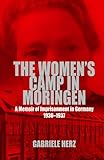
Gabriele Herz. The Women’s Camp in Moringen: A Memoir of Imprisonment in Germany 1936-1937. New York: Berghahn Books, 2006. 200 S. $45.00 (cloth), ISBN 978-1-84545-077-9.
Reviewed by Marie-Luise Gattens (Department of Foreign Languages and Literatures, Southern Methodist University)
Published on H-German (December, 2006)
A Valuable Memoir
In this volume Gabriele Herz recollects her three-month stay (October 1936-March 1937) in the women's prison in Moringen. She was arrested upon return to Berlin from Italy by the Gestapo and placed into "protective custody." Herz had been in Italy to explore the possibilities for settling there with her family. But prospects in Italy seemed doubtful and her husband Emil had fallen ill. Upon her return to Germany, she learned that the Nazis had issued a new regulation that imposed "protective custody" on German nationals, including German Jews, who returned to Germany after an absence from the country that had lasted longer than three months, because they were seen as a danger to national security. Jews were only released from this "protective custody" if they undertook to leave Germany permanently.
When Herz was sent to the workhouse in Moringen near Hanover in October 1936, she was a fifty-year-old housewife, married to the formerly very successful Ullstein editor Emil Herzog and a mother of four children. The family belonged to the assimilated Jewish bourgeoisie of Berlin and lived very comfortably in a villa in Berlin Dahlem. Emil had been pushed out of his position at Ullstein by the Nazis as part of their effort to gain control over the publishing industry. Emil's loss of his position and Gabriele's subsequent imprisonment made it absolutely clear to both of them that there was no future for their family in Germany. They left Germany shortly after Gabriele's release, traveled through several countries and finally settled in the United States in 1940.
Moringen, whose history as an institution of confinement dates back to the early nineteenth century, was part of the vast system of concentration camps that existed before the war. In the prewar years most of the inmates in the Moringen camp were Schutzhäftlinge, literally "protective detainees," who were members of the opposition to the National Socialists. The largest groups in Moringen were communists and Jehovah's Witnesses. A small group of Jewish women included mostly returning émigrés like Herz. Other "undesirable groups" in residence were recidivist criminals and "asocial" offenders, such as beggars, prostitutes and drunkards. The latter had to work, which was supposed to bring about their reform. Meanwhile, the Schutzhäftlinge were segregated from the "common" criminals and divided into groups according to their "offense." During Herz's time, the women at Moringen were subjected neither to routine physical violence or intimidation. Yet they suffered from inadequate food, space, warmth and a complete lack of rights. The arbitrariness of their prison terms weighed heavy on these women, who often had left children behind. Communist women often came to Moringen in very bad physical and emotional states because of their previous imprisonments. Although segregated into groups, the women were able visit each other in their respective quarters.
For Herz, arrest and subsequent incarceration were a deep shock. The deprivations and the enforced inactivity of life in Moringen were difficult. Her lack of knowledge about the length of her imprisonment made her stay at Moringen hard to bear. Yet Herz used her time at Moringen to get to know as many of her fellow inmates as possible, to lend them a sympathetic ear and to offer them friendship. Moringen brought Herz into contact with women she would otherwise never have gotten to know, and despite the harsh circumstances, she relished the acquaintance of many of them. Her account of imprisonment contains many small portraits of the women she knew, particularly the communists, for whom Herz felt great sympathy. The book offers a glimpse into the experiences of many women caught in the Nazis' machinery of oppression in the years before the war.
While the memoir is organized in a form similar to a dairy, it is important to note that Herz wrote her account after she had left Germany. There is some uncertainty as to when she wrote it. She seems to have started it in Lugano, Switzerland, in 1938 and completed it in Rochester, New York, in 1940. The work was not published during her lifetime and is the result of the collaboration of three generations of the Herz family who wanted to pay tribute to Herz. The memoir is an important contribution to the history of women's incarceration by the Nazis, particularly that of communists and Jehovah's Witnesses. In addition, the book has an excellent introduction by Jane Caplan that provides background information on Herz's life and carefully situates Herz's experience of incarceration in Moringen in the overall history of the Nazi camp system.
If there is additional discussion of this review, you may access it through the network, at: https://networks.h-net.org/h-german.
Citation:
Marie-Luise Gattens. Review of Herz, Gabriele, The Women’s Camp in Moringen: A Memoir of Imprisonment in Germany 1936-1937.
H-German, H-Net Reviews.
December, 2006.
URL: http://www.h-net.org/reviews/showrev.php?id=12652
Copyright © 2006 by H-Net, all rights reserved. H-Net permits the redistribution and reprinting of this work for nonprofit, educational purposes, with full and accurate attribution to the author, web location, date of publication, originating list, and H-Net: Humanities & Social Sciences Online. For any other proposed use, contact the Reviews editorial staff at hbooks@mail.h-net.org.

