



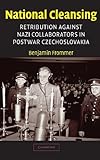
Benjamin Frommer. National Cleansing: Retribution against Nazi Collaborators in Postwar Czechoslovakia. New York: Cambridge University Press, 2005. xvii + 347 pp. $30.99 (paper), ISBN 978-0-521-00896-9; $75.00 (cloth), ISBN 978-0-521-81067-8.
Reviewed by David Gerlach (Department of History, University of Pittsburgh)
Published on HABSBURG (December, 2006)
The Politics of Retribution
The political nature of campaigns addressing wartime collaboration presents the danger that all such trials can be dismissed as victor's justice. In the case of Czechoslovakia's attempts to deal with Nazi collaborators after World War II such a claim appears particularly relevant given that most of the country's postwar leadership spent the war in exile and the highly charged nature of the postwar politics there. However, as Benjamin Frommer's insightful study of the retribution process demonstrates, politics did not always determine retribution's course and often times courts did their best to arrive at just punishments. This point deserves special note considering the Czechoslovak Communist Party's sustained efforts to make retribution work for their political ends.
National Cleansing: Retribution against Nazi Collaborators in Postwar Czechoslovakia focuses primarily on retribution's course in the Czech lands and only rarely on events concerning Slovakia, in part because both wartime and postwar developments differed significantly in both parts of the country. Even so, it offers a detailed and dynamic study of postwar "Czech" political battles until the Communists took power in February 1948. The study also illuminates some of the pressures leading to wartime collaboration, certain aspects of the Sudeten German "transfer," as well as the history of the retribution decrees, including their implementation and larger place in postwar Europe's attempts to deal with the Nazi past. Covering all these issues requires a certain skill that Frommer's research and writing ably match.
In the first chapter, Frommer focuses on what he labels the "wild retribution" that broke out immediately following the war. His portrayal echoes previous accounts of the so-called wild transfer of the Sudeten Germans, during which Czechs began violently expelling them from the country. The "wild transfer" has been used by both contemporaries and historians to distinguish between the expulsions immediately after the war and the "organized transfer" carried out under Allied supervision in 1946. Frommer expands this analysis in two important ways. First, he notes that "wild retribution" also included acts of Czech vigilantism against one another. Secondly, he rightly argues that such violence was not simply a matter of Czechs unleashing years of national animosity against Germans, but involved political leaders' plans and demands for a violent action to help force them from the country.
This argument, however, challenges the very notion that such retribution was in fact wild. As Frommer shows, violence and chaos often accompanied the campaigns against German speakers and collaborators during the summer of 1945. He also suggests that the government had the power to influence these actions. Although this claim does not contradict the nature of retribution immediately after the war, it gives the impression that it was both controlled and wild at the same time. In addition, the evidence he cites to make this argument often involves discussions, speeches and communiques from high-ranking officials. How these demands for harsh retribution against Germans filtered down to those who carried out such acts remains somewhat unclear through his account. While Frommer illustrates well this particular turbulent aspect of retribution and offers important insights into the actions of local officials and security organs involved in the process, the connections among politics, policy and practice appear less clear than in the subsequent chapters.
Frommer's treatment of the Great Decree, by contrast, examines its origins, implementation, and consequences in great detail. The Great Decree, developed in London under the auspices of Eduard Benes and other non-Communist leaders, sought to impose a quick and decisive penalty against those who had collaborated during the war. Like other systems of retribution in Europe it established a separate legal system based primarily on "people's courts" that tried a variety of crimes, including actions that subverted the Czechoslovak state, membership in one of the many Nazi groups or official positions (a measure intended, in part, to cover German speakers without reference to ethnicity), and the denunciation of individuals. Though originally limited to one year, the Great Decree and the people's courts operated until May 1947 and were briefly resurrected by the Communist government after it took power in 1948.
The Great Decree went into effect on July 9, 1945. By this point several acts of popular and vigilante justice had already occurred. The people's courts continued to rule severely and had the highest rate of execution among other European countries carrying out retribution for defendants who received the death sentence (see table 1, p. 91). Frommer argues that the Great Decree's provisions preventing appeals and demanding that death sentences be carried out within two hours of the verdict accounted for this result rather than a continued thirst for revenge. In fact, Frommer shows that people's judges proved willing to work outside of the Decree's stipulations when they found them inappropriate. They challenged limiting provisions in the Great Decree, such as minimum sentences beginning at five years and the inability to consider mitigating circumstances.
Frommer's narrative focuses primarily on the period before the Communist takeover, both because the bulk of the retribution trials had been completed before February 1948 and because what was at stake changed dramatically after the Communists controlled the state. Prior to this, Frommer argues that the Communists sought to make the most of retribution in order to weaken the opposition and to strengthen their own hand. For example, he demonstrates how the Communist-led police and security forces used the Great Decree to detain their political opponents and, at times, employed brutal force against them. While in some instances the false charges were uncovered during subsequent trials, Frommer argues that such cases "undermined popular confidence in the justness of postwar retribution" (p. 126). A growing lack of public support for retribution further eroded the courts' willingness to hand out steep punishments. In the end, retribution fell swiftly on many, wrongly on some and judiciously on others.
One of the most impressive traits of the book is Frommer's ability to capture certain wartime complexities through his study of postwar trials. The chapter on denunciation, for instance, provides examples of the types of pressures facing Czech speakers during the occupation that led them to denounce their neighbors and family. These examples highlight contingent events that often spurred denunciations. From family difficulties to drinking problems, denunciation became a potential weapon against one's enemies or a trap that awaited the unsuspecting victim. As such, it formed part of the experience of living under Nazi occupation, benefiting the occupiers and dividing the occupied.
Frommer's presentation of the case against Vaclav Pisa, the editor of Aryan Struggle, highlights the reach denunciation had in the Protectorate and in the postwar retribution process. Pisa authored several anti-Semitic articles and led what amounted to a denunciation campaign against local Czechs that he labeled "Jew lovers." As Frommer argues, Pisa served as a "go-between" from the general public to the Nazi authorities, and was a crucial link for Nazi repression and the Holocaust in the Czech lands. Most interestingly, he played a similar role following the war in Czech attempts to enforce retribution. He knew the people who had turned on their neighbors and once again served as the connection between collaborators and authorities, this time for the new Czechoslovak government. Through Pisa's testimony and other records, Frommer captures how denunciation functioned as a crime and how it was punished.
Frommer's study of national cleansing does not delve deeply into issues of national identity, national conflict, or postwar Czech nationalism. Only when such issues are particularly relevant to retribution do they receive focused attention, as, for example, in Frommer's analysis of the so-called Small Decree. The Small Decree emerged as a way to address delays and other shortcomings of the Great Decree. By September 1945 the number of defendants before the people's courts was high and few cases had even gotten under way. At that time, the government issued a second retribution decree to cover cases outside of people's courts' jurisdiction. The Small Decree gave the power to local governments to hand out sentences without the lengthy processes involved in a people's court case.
The Small Decree also extended retribution's scope. For example, it offered the opportunity to prosecute those defendants exonerated by the people's courts for lesser crimes. More importantly, it introduced punishment for "offences against national honor." This hazy notion allowed those who desired a more general cleansing to add to the list of transgressions that the Great Decree overlooked. These included provisions to punish Czechs for intimate relations with Germans, even after the war, and to ensure that those who had attempted to switch their nationality also faced retribution. As Frommer notes, such provisions "created an entirely new form of treason--against the nation, not the state" (p. 199). Although the distinction between the two may not have been as clear to the Ministry of Interior officials that penned the regulations, it demonstrates how nationalist politics distorted attempts to come to terms with collaborators..
The chapter on the official "transfer" of the Sudeten Germans also reveals how nationalist politics affected the retribution process. Frommer notes that retribution against collaborators helped to justify and enforce the collective punishment of Germans. Reports about the domestic trials of Nazi leaders and those at Nuremburg continually appeared in the newspapers and connected the guilt of these individuals to that of the entire German people. In addition, Frommer convincingly argues that the transfer of the Sudeten Germans sapped the energy and determination to punish Czech collaborators. Because many Germans were targeted for conviction by the Great Decree, they filled both the court dockets and prisons with people the country was simultaneously expelling. When the opportunity to remove the Sudeten Germans began to expire in late 1946, the government placed expelling them over attempts to bring those who may have committed substantial acts of collaboration to justice. Such official meddling undermined retribution's purpose and made judges more willing to release Czechs for similar offences.
For Frommer, the politics of retribution centered on the postwar party conflicts, particularly those between the Communists and the National Socialist party, which controlled the Ministry of Justice. Although much has been written about this struggle, Frommer sheds new light on the topic through his own research of Communist Party records as well as others' recent work. He shows how the Communists were able to place blame on the Ministry of Justice and the National Socialists not only for the delays in retribution, but also for releasing suspected collaborators. Nevertheless, despite the opportunities that retribution offered, he argues that Communist attempts to control and benefit from retribution often did not succeed.
One excellent example of how this played out involved the trials to punish several ministers of the former Protectorate government. While all parties supported the punishment of these men, Communists pushed for the harshest judgments against them. When the National Court, which was established to try these more serious collaborators, reached a verdict in August 1946 that included no death penalties, the Communist Party launched a protest campaign to demand a retrial. The campaign, in fact, had been organized prior to the verdict and involved protests sent by party organizations and factory councils to the government as well as a demonstration in Prague's Old Town Square. However, the campaign did little to stir general indignation at the verdict or move the other parties to accept Communist demands for further punishment. Frommer argues that the Communist failure to force a guilty verdict on the court demonstrated that the retribution courts remained independent of such pressures, which, in turn, represented an important chance for the legal order in postwar Czechoslovakia to prevail.
Likewise, the formal end of retribution in May 1947 appeared to signal a return to normal legal practices. However, following the events and machinations that helped bring the Communists to power in early 1948 the retribution decrees were revised and re-enacted. In many cases, the Communist authorities retried cases that had not turned out in their favor before 1948. While many prominent cases were resolved in their favor, by the end of the year--when retribution really ended--less than 50 percent of the cases involved convictions. As Frommer notes, even after the Communists seized power, retribution remained difficult to impose.
While Frommer is concerned primarily with the nature and course of the postwar political battles in Czechoslovakia, he does not neglect the wider context of European retribution against Nazi collaborators. Some of the most interesting points of the narrative are the comparisons of Czech developments to others in the immediate postwar period. All the countries carrying out retribution became involved in constructing new courts and legal practices to retroactively punish the crime of collaboration. Though the Czech case differed in some important ways, this work reminds us that it should be seen as a component part of Europe's emergence from the war. Thus, in addition to its interest for specialists in Czech history, this book deserves the attention of anyone wanting to gain an in-depth understanding of European collaboration and retribution in the twentieth century.
If there is additional discussion of this review, you may access it through the network, at: https://networks.h-net.org/habsburg.
Citation:
David Gerlach. Review of Frommer, Benjamin, National Cleansing: Retribution against Nazi Collaborators in Postwar Czechoslovakia.
HABSBURG, H-Net Reviews.
December, 2006.
URL: http://www.h-net.org/reviews/showrev.php?id=12634
Copyright © 2006 by H-Net, all rights reserved. H-Net permits the redistribution and reprinting of this work for nonprofit, educational purposes, with full and accurate attribution to the author, web location, date of publication, originating list, and H-Net: Humanities & Social Sciences Online. For any other proposed use, contact the Reviews editorial staff at hbooks@mail.h-net.org.

