



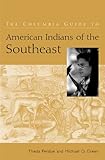
Theda Perdue, Michael D. Green. The Columbia Guide to American Indians of the Southeast. New York: Columbia University Press, 2001. xv + 305 pp. $45.00 (cloth), ISBN 978-0-231-11570-4; $49.50 (cloth). ISBN 0-231-11570-9. $24.50 (paper), ISBN 978-0-231-11571-1.
Reviewed by Melissa A. Stock (Department of History, University of West Georgia)
Published on H-Florida (December, 2006)
A Comprehensive Resource for Scholars of the Southern Indians
The Columbia Guide to American Indians of the Southeast is a concise synthesis of scholarship related to the Native American tribes of southeastern North America, and a comprehensive reference tool for researchers. Theda Perdue and Michael Green intended the volume to be useful both to novices and specialists in the field of the Southern Indians. They have succeeded admirably in fulfilling their stated purpose by organizing the book into four parts, "which are connected conceptually to each other but may be used independently" (p. xi). Part 1, comprising seven chapters that represent about half of the volume, is an overview of the history of the southeastern Indians. Parts 2-4 are reference apparatuses that complement the history in part 1, provide more detailed information, and direct scholars to additional resources. It is refreshing to find this additional information organized integrally into the book, rather than buried in appendices and notes. The primary conceptual connection among the four parts, aside from the geography, history, and culture of the southeastern tribes themselves, is the theme of tribal sovereignty, although that theme might have been more precisely termed territorial use and control. The authors assert that "when the Europeans who claimed the South as their own found that wealth lay in the soil, Native people became obstacles to the exploitation of the land" (p. xi). Europeans, of course, did not "find" that the land was valuable; the British in particular arrived in the New World steeped in the idea that the proper use of land was its cultivation, and that the produce of the land is what gave the land value. That idea was a major root of misunderstanding and conflict between European and Native cultures, and the authors describe the impacts of that conflict on the Indians, from the point of contact (or "European invasion," in the popular usage) until removal, and into the nineteenth and twentieth centuries.
Part 1 of The Columbia Guide provides a concise history in seven chapters of the Indians of southeastern North America. Especially valuable is the first chapter, which describes the research challenges inherent to studying Native Americans, particularly prior to contact with Europeans, and provides a broad survey of historical and anthropological scholarship related to the Southern Indians. What becomes clear is the imperative for a multidisciplinary approach, one that includes not only the study of written documents, but also consideration of archeological evidence and inclusion of oral tradition when necessary. Perdue and Green advocate an "ethnohistorical" approach, one that asks "anthropological questions of historical sources" (p. 12), as a way to counteract the biases of written documents, most of which were produced by Europeans, as well as to construct a history before contact. Their analysis of the scholarship is even-handed and expert, as one would expect from two scholars whose reputations are so well established in their respective fields of Cherokee and Creek history, and the history of the Southern Indians generally.
Chapters 2 through 5 examine the history of the Southern Indians from prehistoric times until removal in the 1830s. Perdue and Green describe succinctly what the anthropological record suggests about the origins of the various Southern Indian tribes and their cultures, and they are careful to discuss not only the "five tribes" (Choctaw, Chickasaw, Cherokee, Creek, and Seminole), but also some of the myriad smaller groups that populated the southeast. The Cherokees and Creeks receive the most attention, which is no doubt a factor both of the historical prominence of the Cherokees and Creeks in the southeast and of the research interests of the authors. Subscribers to H-Florida who may be studying the Seminole and Miccosukee Indians or earlier native groups in Florida, however, will probably want to consult the works of Jerald T. Milanich, Brent Weisman, Patsy West, J. Leitch Wright, and others for a more complete picture of the Indians in Florida.[1]
While Perdue and Green do not understate the impact of European colonization on the Indians of southeastern North America, they are careful also to point out the enduring quality of many tribal institutions and customs in the face of tremendous pressure to change. The reader cannot help but be impressed by the adaptive skills of the Southern Indians as they contended with colonial European powers whose political and social structures were so different from their own. As the authors point out, the Southern Indians were neither pawns nor bystanders in the European competition for territory in the southeast. The Indians' general support of the European monarchies, however, rendered them vulnerable in the wake of the American War for Independence, after which many Americans considered the Indians to have "lost the war just as England had" (p. 73). Whatever territorial control the Indians had enjoyed under the suzerainty of Great Britain was eroded steadily under the United States federal government, leading to removal in the 1830s, followed by decades of ever more restrictive and exploitative policies.
Chapter 6 looks at the history of the Southern Indian tribes in Oklahoma, covering both the nineteenth and twentieth centuries. The authors describe the myriad problems of resettlement in the new territory, the reorganization of tribal governments, and the establishment of tribal constitutions. The United States continued to exert pressure on the tribes, chipping away at tribal reservations and abrogating their rights by often scurrilous means (e.g., land allotments and termination), gradually bringing the Indians under stronger federal authority. In the twentieth century, the Indians responded by drafting new constitutions and asserting certain tribal rights via state and federal agencies or the U.S. court system. Chapter 7 gives an account of the remnants of the Southern Indians who remained in Mississippi, Alabama, North Carolina, Georgia, and Florida.
Part 2 of the book, "People, Places, and Events, A to Z," comprises an encyclopedic list of terms that scholars will find useful for basic information or elucidation. The list includes references that span all of the historical periods covered in part 1, complementing it well. Most helpfully, the terms are cross-referenced throughout the book by the use of bold-faced type. Important people are profiled, and concepts such as allotment, kinship, redistribution, and termination are defined and explained more fully and generally within context. Historical periods, such as the Mississippian or the Archaic, and certain ceremonies and traditions also are identified and described. Additionally, many relevant legislative acts, treaties, and court cases are listed and summarized. Unfortunately, sovereignty, which figures so prominently as a theme in part 1, is not defined in this section.
Part 3 is a short chronology of events, beginning with the prehistoric exposure of the Bering land bridge and ending with a 1996 court case involving the Seminole Tribe of Florida. Part 4, "Resources," will be the most useful to advanced scholars and specialists studying the Southern Indians. This exhaustive list is organized thematically and includes both historical and contemporary resources. The reader will find contact information for tribal agencies, for tribes recognized by state and federal governments, and for tribes who remain unrecognized for various reasons. There is a lengthy list of published primary sources, published bibliographies and finding aids, printed versions of oral literature, and archeological studies. Also included is a generous catalog of secondary sources organized by tribe, and a unique feature is the inclusion of certain works of fiction and film. Finally, there is a list of museums and historical sites organized by state, and a list of internet resources.
The most problematic issue in this otherwise outstanding volume is the authors' treatment of the idea of sovereignty. Perdue and Green want "to give readers a view of Native people not only as members of sovereign tribes but also as Southerners and as Americans" (p. xv), but their discussion is hampered by their failure to define precisely what they mean by sovereignty. Neither do they discuss what sovereignty meant to Europeans and how its meaning may have evolved from the eighteenth to the twentieth centuries. The authors imply that sovereignty was essentially the control of territory, but it was much more than that. Sovereignty was a purely European concept that was closely related to their own ideas of legal authority, political hierarchy, and even divine will. The European colonial powers never viewed Indians as sovereign, though they usually acceded that the Indians enjoyed certain natural rights within their territories. The Southern Indians, therefore, must be admired for their attempts to assert sovereignty once they began to understand its meaning (as early as the eighteenth century, notably by Mary Musgrove and Alexander McGillivray). Later, the Americans were averse even to acknowledging Indian territorial rights, much less sovereignty. The term "retained sovereignty" (p. 218) that Perdue and Green describe as deriving from Worcester v. Georgia in 1832 is essentially another way of stating that the Southern Indian nations have been found to exist under the suzerain authority of the United States. That is, the Indians retain certain rights of self-governance within their reservations, but they have no authority to conduct foreign affairs, as foreign affairs remain the sole purview of the United States federal government. The problem of defining sovereignty is not unique to this volume. Rather, it is an area that requires further research and thought among the many scholars who tackle these issues. A good place to start is Stuart Banner's recent study of property rights and sovereignty among the North American Indians.[2]
The Columbia Guide to American Indians of the Southeast is a volume whose strength is its comprehensiveness, evident in scope of the history it presents, in the inclusiveness of its supplementary material, and in the integration of its parts. Theda Perdue and Michael D. Green have succeeded in creating a volume that scholars of all levels will want to consult. For those new to the field of the Southern Indians, it will provide a solid historical foundation and a good starting point for research. More experienced scholars will find that it serves as a handy reference and sheds light on new avenues and ideas for research.
Notes
[1]. Jerald T. Milanich, Florida's Indians from Ancient Times to the Present (Gainesville: University Press of Florida, 1998); Brent Richards Weisman, Unconquered People: Florida's Seminole and Miccosukee Indians (Gainesville: University Press of Florida, 1999); Patsy West, The Enduring Seminoles: From Alligator Wrestling to Ecotourism (Gainesville: University Press of Florida, 1998); J. Leitch Wright, Jr., Creeks and Seminoles: The Destruction and Regeneration of the Muscogulge People (Lincoln: University of Nebraska Press, 1986).
[2]. Stuart Banner, How the Indians Lost Their Land: Law and Power on the Frontier (Cambridge: Harvard University Press, 2005).
If there is additional discussion of this review, you may access it through the network, at: https://networks.h-net.org/h-florida.
Citation:
Melissa A. Stock. Review of Perdue, Theda; Green, Michael D., The Columbia Guide to American Indians of the Southeast.
H-Florida, H-Net Reviews.
December, 2006.
URL: http://www.h-net.org/reviews/showrev.php?id=12614
Copyright © 2006 by H-Net, all rights reserved. H-Net permits the redistribution and reprinting of this work for nonprofit, educational purposes, with full and accurate attribution to the author, web location, date of publication, originating list, and H-Net: Humanities & Social Sciences Online. For any other proposed use, contact the Reviews editorial staff at hbooks@mail.h-net.org.

