



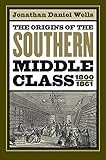
Jonathan Daniel Wells. The Origins of the Southern Middle Class, 1800-1861. Chapel Hill: University of North Carolina Press, 2004. xv + 321 pp. $27.50 (paper), ISBN 978-0-8078-5553-9; $70.00 (cloth), ISBN 978-0-8078-2882-3.
Reviewed by A. James Fuller (Department of History, University of Indianapolis)
Published on H-South (December, 2006)
A Provocative, Problematic Analysis of the Old South
A photograph in The Origins of the Southern Middle Class, 1800-1861 aptly illustrates both the power of and the problems with Jonathan Daniel Wells's provocative book (p. 195). It is a picture of the cover of the pamphlet containing the published address delivered at the first meeting of the South Carolina Institute, an organization created to promote industry in the South. This is clearly an indication of Southerners hoping to modernize their region through economic development. Wells argues that such activities were the product of a Southern middle class hitherto unknown to historians. But a close look at the photograph belies the book's thesis, because the author of the pamphlet was none other than James Henry Hammond, the South Carolina planter famous for declaring, "Cotton is King." Perhaps Wells overstates the case for a Southern middle class and the planters actually led the push for change in the years before the Civil War.
This is an important and controversial book. If Wells is correct, our understanding of the antebellum South must be revised. While historians have noted the presence of the so-called yeoman farmers and have recognized that there were people of the middling sort living in the towns and cities of the South, the conventional wisdom has held that there was no full-blown middle class in the region until after the Civil War. Roots could be found in the antebellum era, but class formation did not come until later. Wells seeks to change the chronology and significance of the rise of the middle class in the South, arguing that the middle class emerged by the 1850s and that its power helped exacerbate the sectional tensions that led to the Civil War.
In the first part of the volume, Wells argues that the nascent Southern middle class was created through the development of an ideology taken from its Northern counterpart. He spends a great deal of time establishing the existence of strong relationships between Northerners and Southerners, especially those preachers, merchants, attorneys, doctors, and educators who made up the middle class. Americans traveled to and from their sections of the country, wrote letters to one another, read newspapers and journals from other places, and created a bond that allowed them to share ideas as well as facilitate business and politics. In the process, the Southern middle class was able to adopt much of Northern culture, including ideas about progress and improvement, notions of family structure, plans for education, and a devotion to economic development. Like the Northern middle class, these Southerners merged these ideas with Evangelical Christianity to create an ideology that served as the foundation for class consciousness. The result was similar in many ways to what historians have examined in the Northeastern states. As the middle class formed, it became active in reform, pushing for an end to dueling, calling for improvements in education, and supporting temperance. As in the North, Southern middle-class women played a crucial role in this Age of Reform, as they talked about "separate spheres" while working for change through churches and benevolent organizations. This challenges the notion that Southern women were not part of the women's rights movement because they were restricted within the bounds of patriarchal authority.
The new Southern middle class understood its distinctive place in Southern society and concluded that "the planter class was antagonistic to its goals" (p. 200). They did not blindly follow the planters, but forcefully asserted their own rights and interests. They also differentiated themselves from the lower classes. In this case, "ironically, it was the issue of slavery that most helped draw great distinctions between the middle class and the whites who labored on the economic scale below them" (p. 179). Clearly, the free labor ideology that the imbued the Northern middle class was not adopted in the South. Instead, the Southern middle class supported the peculiar institution. Indeed, they believed that slavery gave them an economic advantage over the North. When labor unrest threatened Southern manufacturing, the middle-class industrialists simply brought in slaves to break the strikes. At the Norfolk Dry Dock in 1830-31 and in the strike at the Tredegar Iron Works in 1847, slave labor broke down the strength of white workers. These events were potent examples of what the Southern middle class perceived as their advantage when competing with capitalists who relied on free labor. In their minds, slavery was another means by which they could modernize.
In a sense, the Southern middle class was a victim of its own success. Their bold support of both economic development and slavery during the economic prosperity of the 1850s caught the attention of Northerners. Southern success in using slavery in industry frightened Northern capitalists and workers alike. The expansion of slavery was such a divisive issue because Northerners were afraid that slavery would not only extend into new territories but into industry as well. Thus, Northerners became more rigorous in their opposition to slavery and many, including those in the new Republican Party, used the threat of industrial slavery to build support for free labor ideology. Interestingly, Wells argues that the Southern middle class largely withdrew from politics and allowed the planter class to take the lead. They had tried to wield political influence through the Whig Party and through their various voluntary organizations, but by the 1850s, at the very time when their economic power was threatening the North, they became disillusioned with politics and deferred to the increasingly militant planters.
Thus, the Southern middle class helped cause the Civil War by frightening the North with their growing economic prowess and by not exerting their influence to avert the conflict at the moment of crisis. As sectional ties broke down, the middle-class connections between North and South also weakened. Some continued to correspond and hope for continued peace and compromise even into the early months of the war itself. The war dashed the hopes of those middle-class Southerners who believed that progress would bind the nation together. Instead, according to Wells, "it had driven them apart" (p. 233). In the postwar era, the middle class that became the driving force behind the New South was "in no mood to remember the past" (p. 235). Middle-class Southerners wanted to forget about war, defeat, and the cotton economy. They did not want to consider that they had been part of the problem. In their postwar quest to promote a new vision of progress and harmony with the North, the Southern middle class again met frustration. Southern agrarians resisted capitalism and Northern "acquiescence to an institutionalized racial hierarchy in the South would permit the rise" of segregation, a system that "would lead southerners of both races into a long night of disfranchisement and reaction" (p. 237).
Wells's interpretation of these matters is interesting and thought-provoking. Certainly, his analysis will attract attention from other scholars. He is right in pointing out many of the similarities between North and South and in recognizing how strongly connected the two sections were. But Southerners were not just part of a cultural web spun across the country. As Michael O'Brien has shown, they were part of a modern transatlantic culture that spanned oceans and international borders.[1] Wells may be too quick to claim that Southerners borrowed so many ideas from the North alone. Furthermore, his assertion that the Southern middle class adopted their ideas from external sources begs further analysis. Was it not possible that Southerners did more than react? Could they not have developed some ideas on their own?
Other problems arise from his use of terms like "modernization." Wells says that the "term 'modernization' used here will connote a desire on the part of middling southerners to experience the new trends in technology and culture that they admired in the North and parts of Europe" (p. 244 n. 21). What connected those trends in the minds of Southerners is not explained. Wells is wise to acknowledge that class formation was based on culture rather than just on economic terms. But where those cultural developments derived from and how they were forged into an ethical system is not clear.
Evangelical Christianity was an important part of Southern culture, but Wells is too quick to claim that the revivals and reform activities of the churches were part of a middle-class culture. He notes that some churches--such as the Anti-mission Baptists--became part of a rural resistance to modernization. But his overall assertion that Evangelical Christianity was fused with Northern values to create a middle class ideology is problematic. He argues that the churches led the fight against the culture of honor on moral grounds, a battle that the middle class fought because they saw it as a remnant of an embarrassing tradition. But as Bertram Wyatt-Brown has shown, while honor and Evangelicalism were sometimes in conflict, they could also be brought into harmony. Notions of honor fit very well with the Calvinist concept of duty, for example.[2]
Another issue is the matter of scope. It is not clear just who was in the Southern middle class and who was not. Some of the individuals that Wells calls middle class might very well be classified differently. He does not really indicate how big or small this class was. Then there is the matter of self-identity. Wells claims that widespread use of the term "middle class" by the 1850s indicates class consciousness. But does reference to the term sixty-five times in three periodicals over ten years really show a class identity (p. 201)?
Finally, there is the problem illustrated by the photograph of the pamphlet mentioned above (p. 195). What if the attempts to modernize the South were not led by a middle class, but by the planters? This is the interpretation of Chad Morgan's new work on Georgia, which asserts that the planter class borrowed the Prussian model of modernization and adopted it to fit their own circumstances by pushing for state funding and support rather than paying for industrialization themselves.[3] Certainly the leadership of men like James Henry Hammond in the South Carolina Institute indicates planter involvement, a fact that Wells acknowledges. But that involvement begs the question of whether or not the middle class was really as well-formed and powerful as he argues.
No one can expect a single book to cover all of the questions raised by Wells's controversial argument. But his book cannot be ignored and will certainly change our thinking about many of the most important issues in Southern history. Whether or not he should be credited with finding a middle class that most historians did not think existed remains to be seen. Wells has thrown down a gauntlet for others to take up.
Notes
[1]. Michael O'Brien, Conjectures of Order: Intellectual Life and the American South, 1810-1860 (Chapel Hill: University of North Carolina Press, 2004).
[2]. Bertram Wyatt-Brown, Southern Honor: Ethics and Behavior in the Old South (New York: Oxford University Press, 1982).
[3]. Chad Morgan. Planters' Progress: Modernizing Confederate Georgia (Gainesville: University Press of Florida, 2005).
If there is additional discussion of this review, you may access it through the network, at: https://networks.h-net.org/h-south.
Citation:
A. James Fuller. Review of Wells, Jonathan Daniel, The Origins of the Southern Middle Class, 1800-1861.
H-South, H-Net Reviews.
December, 2006.
URL: http://www.h-net.org/reviews/showrev.php?id=12607
Copyright © 2006 by H-Net, all rights reserved. H-Net permits the redistribution and reprinting of this work for nonprofit, educational purposes, with full and accurate attribution to the author, web location, date of publication, originating list, and H-Net: Humanities & Social Sciences Online. For any other proposed use, contact the Reviews editorial staff at hbooks@mail.h-net.org.

