



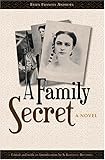
Eliza Frances Andrews. A Family Secret. Kittrell Rushing. Knoxville: University of Tennessee Press, 2005. xxi + 433 pp. $40.00 (cloth), ISBN 978-1-57233-439-7.
Reviewed by Anne Sarah Rubin (Department of History, University of Maryland, Baltimore County)
Published on H-CivWar (December, 2006)
A Surprising Secret
Eliza Frances (Fanny) Andrews is best known today for her Civil War Wartime Journal of a Georgia Girl, and for her Reconstruction-era Journal of a Georgia Woman. But Andrews wrote more than just diary entries--she was also an extraordinarily successful novelist and author of essays and social commentaries. Throughout the 1860s and 1870s, Andrews wrote short pieces for publications ranging from the Augusta Chronicle to Scott's Monthly Magazine to the New York World. Her first novel, A Family Secret was published in 1876 to critical acclaim and became the best-selling novel of the year. Now the University of Tennessee Press has re-issued the book in a new edition, along with a helpful introduction and annotations by S. Kittrell Rushing.
Part conventional nineteenth-century romance, part portrait of the South in the final months of the Civil War, A Family Secret is richly plotted and engagingly written. The story opens in the 1850s when handsome army officer, Audley Malvern, has a brief but meaningful encounter with young Ruth Harfleur, a motherless girl on her way to a convent in New Orleans. Skip ahead ten years to the fall of 1864, and Malvern, now an officer in the Confederate army, encounters a beautiful and mysterious young woman on a Georgia train. It is none other than Ruth Harfleur, and the secret of the title surrounds her father and the story of her birth. Malvern accompanies her to her family's plantations and quickly becomes part of the vast and vividly drawn cast of characters: Ruth's kindly uncle; her rakish cousin George; her beautiful half-sister Claude; her crippled half-brother Bruen; her cruel stepfather, Julian Harfleur; the odious Reverand Aeneas Tadpole (what a name!); the kindly free black Aunt Chloe; and a host of assorted hangers-on and guests. Add in a couple of mysterious strangers, an antique ring, and a variety of vividly drawn episodes like balls and jousting tournaments, and the reader is easily drawn into Andrews's world. The war seems far off for much of the novel. Though the bulk of the action takes place in Georgia, it is far away from the ravages of Sherman's march. Audley Malvern and his companions do travel to Andersonville Prison, and Andrews's descriptions of that horrible place come straight from her diaries. The last section of the novel also has Malvern and his fellow officers on the trail of a band of Confederate deserters, interestingly helped in that quest by a group of Yankee soldiers. One has to believe that Andrews minimized the conflict between Union and Confederacy on purpose, perhaps as a strategy to make her novel more appealing to Northern readers. Certainly one has to look hard to find any real anger towards Northerners or resentment about the outcome of the Civil War. Certainly A Family Secret is an artifact of its times. Andrews's poor whites are almost uniformly corrupt or comical, described as coarse residents of squalid hovels. Her African American characters are painted in similarly broad strokes, though the figure of Aunt Chloe, an elderly free black woman, is an affectionate one. In this way the novel is useful for describing the crosscurrents of race and class that cut across the nineteenth-century South. S. Kittrell Rushing's introduction helps to place the novel in the context of Andrews other writings, and fleshes out the book's reception in 1876. Rushing also helpfully points out sections in the novel that correspond to sections from Andrews's other writings. One wishes, in fact, that the introduction had been more extensive and had included a lengthier biographical sketch of Andrews. Even without that, however, A Family Secret proves itself to be much more than a simple tale of love and romance, and one with much to say to scholars of the nineteenth-century South.
If there is additional discussion of this review, you may access it through the network, at: https://networks.h-net.org/h-civwar.
Citation:
Anne Sarah Rubin. Review of Andrews, Eliza Frances, A Family Secret.
H-CivWar, H-Net Reviews.
December, 2006.
URL: http://www.h-net.org/reviews/showrev.php?id=12605
Copyright © 2006 by H-Net, all rights reserved. H-Net permits the redistribution and reprinting of this work for nonprofit, educational purposes, with full and accurate attribution to the author, web location, date of publication, originating list, and H-Net: Humanities & Social Sciences Online. For any other proposed use, contact the Reviews editorial staff at hbooks@mail.h-net.org.

