



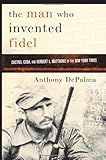
Anthony DePalma. The Man Who Invented Fidel: Castro, Cuba, and Herbert L. _ New York: PublicAffairs, 2006. 308 pp. $26.95 (cloth), ISBN 978-1-58648-332-6.
Reviewed by Linda Lumsden (University of Arizona)
Published on Jhistory (December, 2006)
In the chill early hours of December 17, 1957, New York Times reporter Herbert L. Matthews interviewed rebel leader Fidel Castro in a clearing in the Sierra Maestra. The regime of Cuban President Fulgencio Batista claimed to have killed the bearded insurgent in a skirmish the previous year, so Matthews's scoop resurrected Castro from the dead. Indeed, many claim that Matthews' romanticized portrait of the rebel leader made possible Castro's unlikely rise to power. As Mathhews described it in his three-part series that began on the front page of the newspaper's February 24, 1958 edition, the rebel's vision for a new Cuba was "radical, democratic and therefore anti-Communist" (p. 87).
Matthews spent the rest of his life defending his work as Castro revealed his true colors as a Communist dictator. The FBI spied on him, Congress investigated him, the Times isolated him, fellow journalists ridiculed him, and Cuban exiles threatened him.
In this book, current Times reporter Anthony DePalma has written a riveting narrative about Matthews' controversial career. DePalma's insights into the Cold War paranoia that brewed Matthews' shoddy treatment are relevant to current debates on whether critical coverage of the "war on terror" is unpatriotic, and his book poses provocative questions about truth, objectivity, and the imperfect nature of journalism.
It also dishes a backstage peek into Times editorial operations, such as a terse 1962 memo from publisher Orvil E. Dryfoos ordering editorial board director John B. Oakes to keep Matthews out of the news columns.
I couldn't put it down.
Matthews was a scholarly type who had thrilled as a boy to the swashbuckling tales of journalist Richard Harding Davis. Matthews first ran into trouble with his editors at the Times over the lack of objectivity in his impassioned accounts of the defeated Loyalists in the Spanish Civil War in the late 1930s. He later distinguished himself reporting from the European theater in World War II. After a heart attack in 1949 hobbled his globe-trotting, he persuaded Times publisher Arthur Hays Sulzberger to create for him an unprecedented hybrid position as a reporter and editorial writer focusing on Latin America. The double duty would prove problematic. Matthews proved his daring in 1955 when he went undercover in an Argentinian prison to expose that President Juan Peron secretly held more than one hundred student dissidents, a prelude to his ouster a few months later. Matthews also had been paying close attention to the percolating dissent in Cuba for more than a year before he flew to Havana, where young Fidelistas snuck him past roadblocks into the Sierra.
Matthews never was shy about proclaiming the historic proportions of his encounter; he referred to himself as the "inventor of Castro" (p. 128). And reaction to the series was indeed electric in both the United States and Cuba, where it was smuggled in. Matthews became a hero to Cubans and was dubbed a friend of the revolution by Castro.
But Matthews' journalistic coup soured during a visit to New York City when Castro, the newly elected president, humiliated the reporter by claiming in a speech to the Overseas Press Club that he had fooled the reporter into believing he commanded hundreds of guerillas by repeatedly marching a handful around him. The claim that Castro had fooled Matthews, which the reporter denied, was key because his report of a robust rebel force revived the battered anti-Bastista movement. Even Castro asserted that the Cuba revolution could not have occurred without Matthews and the Times. Things became worse for Matthews in 1961 when Castro admitted he always had been a Communist. (Matthews had maintained Castro was neither a member of the Communist Party nor taking orders from Moscow.) Critics excoriated the journalist: Did he conspire with Fidel to fool the world? Or was he so naïve and incompetent that Castro had fooled him?
DePalma aptly counters both charges, deftly demonstrating how various facets of Matthews' character and professional ethos both made him vulnerable to criticism and steeled him to ignore it. During the Spanish Civil War, Matthews cast himself as a martyr for truth to endure the criticism rained on him, the inevitable result of "convincing people of truths that they do not want to believe," as DePalma quotes him (p. 53). His abhorrence of dictators made him too easy on young Castro, while his distaste for U.S. colonialism gave him excessive faith in Latin American radicals. Matthews' status as messenger of the Cuban revolution stoked his ego, but DePalma claims Matthews' biggest mistake was seeing Castro as purely heroic. "He was insufficiently critical of Castro's ruthlessness and blind to the flaws in his character," he writes (p. 177).
Yet DePalma concludes that much of Matthews' reporting on the Cuban revolution hit the mark, and he certainly didn't cause the revolution. Until his death in 1977, Matthews unsuccessfully fought off criticism by trying to explain the revolution's complexities. (He was the author of several books on the subject.) And De Palma contends that while Matthews may have been a willing tool in Castro's calculated public relations campaign, he never was an apologist for el jefe. Indeed, DePalma shows that although the Times preferred the detached reportage of Homer Bigart, whom it dispatched to Cuba in 1958 to offset the perceived bias of Matthews' accounts, even that famed journalist could still get the story (as well as many facts) wrong. Bigart wrote in 1958, "The days of Fidel Castro are numbered … "(p. 136).
DePalma aims for a general audience with his lively narrative and lack of theory. The book is highly readable despite occasional clichés such as this description of Matthews: "in his chest beat the more sedate heart of a scholar" (p. 41). It offers a case study on reporters' fallibility when faced with charismatic subjects as well as a chilling look at the Cold War's censorious mentality. It also offers instructive anecdotes about related journalistic events, such as how Matthews' perceived bias influenced the Times's coverage of the Bay of Pigs invasion; the decade-long "newsroom witch hunts" (p. 218) for Communists conducted by Sen. James O. Eastland (D-Miss.); and the frustrations faced by Havana correspondent R. (Ruby) Hart Phillips, one of the Times's few female reporters in the Fifties. Two decades after she had replaced her husband, James Phillips, on the job when he died in 1937, the Times still thought of her "as a contact stringer who could call in tips and write routine stories but who would need reinforcing if the story ever got big again" (p. 164).
DePalma is weakest when pondering the unattainable ideal of objectivity in journalism. He ignores scholarly literature on the subject, which would have strengthened his analysis by examining journalistic bias in an institutional framework instead of as Matthews' personal quirk. He seems surprised that Matthews placed himself at the center of his Castro interviews, although war correspondents frequently have done just that at least as far back as the Civil War. Scholars will be most dismayed by the author's sketchy notes--a scant paragraph per chapter--even though he mined a host of primary sources, including Matthews' voluminous personal correspondence, memos from the Times archives, and previously secret FBI files. Some quotes are not attributed, and he neglects to document significant claims, such as that Matthews briefly was considered as a candidate to be U.S. ambassador to Cuba (p. 145).
As the octogenarian Castro nears the end of his reign, however, DePalma's riveting look back at its beginning offers a timely lesson in journalism history. Students would enjoy this book, which, coupled with a look at Matthews' three 1957 articles, could stimulate lively discussions on the role and responsibility of journalists in shaping global affairs.
If there is additional discussion of this review, you may access it through the network, at: https://networks.h-net.org/jhistory.
Citation:
Linda Lumsden. Review of DePalma, Anthony, The Man Who Invented Fidel: Castro, Cuba, and Herbert L.
Jhistory, H-Net Reviews.
December, 2006.
URL: http://www.h-net.org/reviews/showrev.php?id=12600
Copyright © 2006 by H-Net, all rights reserved. H-Net permits the redistribution and reprinting of this work for nonprofit, educational purposes, with full and accurate attribution to the author, web location, date of publication, originating list, and H-Net: Humanities & Social Sciences Online. For any other proposed use, contact the Reviews editorial staff at hbooks@mail.h-net.org.

