



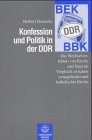
Herbert Heinecke. Konfession und Politik in der DDR: Das Wechselverhältnis von Kirche und Staat im Vergleich zwischen evangelischer und katholischer Kirche. Leipzig: Evangelische Verlagsanstalt, 2002. 508 S. (broschiert), ISBN 978-3-374-01960-1.
Herbert Heinecke. Konfession und Politik in der DDR: Das WechselverhÖ¤ltnis von Kirche und Staat im Vergleich zwischen evangelischer und katholischer Kirche. Leipzig: Evangelische Verlagsanstalt, 2002. 508 pp.
Reviewed by Benjamin C. Pearson (Department of History, Tusculum College)
Published on H-German (November, 2006)
Catholics and Protestants in the GDR: Comparison and Synthesis
Since the collapse of the German Democratic Republic (GDR) in 1989-90 a veritable explosion of studies has occurred treating the churches, and especially the Protestant churches, in East German society.[1] Given the role played in this collapse by "social ethical groups" operating under the umbrella of the Protestant churches, this development is hardly surprising. Indeed, some have gone so far as to dub the events of 1989 a "Protestant Revolution."[2] This book, Herbert Heinecke's 2001 doctoral dissertation in Staatswissenschaft at the University of Magdeburg, is less interested in adding to this copious literature than in synthesizing the findings of other scholars in order to draw comparisons between the Catholic and Protestant churches.
As Heinecke admits in his foreword, this study is not historical enough to satisfy historians, theological enough to satisfy theologians, nor sociological enough to satisfy scholars in the sociology of religion fully (p. 5). Instead, in a series of thematically organized chapters, Heinecke draws extensively on existing literature in these fields to describe the church policies of the ruling Socialist Unity Party (SED) and the functioning of both churches in the GDR. As a matrix for comparison, he examines developments within each church in each of the following areas: history and tradition, church membership, organizational structure, self-understanding and social activity. He also looks at the limited cooperation between the two churches, which culminated in the late 1980s in rare joint ventures.
In these sections, and most clearly in his comparative chapter at the end, Heinecke, argues that the Protestant churches changed and adapted far more than their Catholic counterpart over the course of the GDR's history. While both churches adopted initially confrontational postures toward the establishment of SED rule, differences in their own histories and traditions, social positions and self-understandings led them to respond very differently to changing circumstances in the GDR. These differences became especially clear after the mid-to-late-1950s, when the relaxation of state anti-church activities made room for more nuanced church-state relations. They culminated in the late 1980s in the central role played by the Protestant churches in the emergence of East German civil society at a time when the Catholic church was still only beginning to come to terms with its place in the GDR.
The East German Catholic church, acutely aware of its status as a double minority, in relation to both Protestantism and the official atheism of the SED, responded by circling the wagons, withdrawing into itself and avoiding active engagement with surrounding society. Heinecke offers several reasons for these developments. Ideological opposition to communism was much stronger in the Catholic church than in the Protestant churches following World War II. As a historical minority in Germany since the Imperial era, Catholics were more easily drawn to passive models of the church in society, explaining their social role by way of such metaphors as "hibernation" or sharing an apartment house with hostile strangers (pp. 222-226). Most important, according to Heinecke, was the destruction of Catholic associational life by the National Socialists. Unable to rebuild their vibrant prewar lay movement in the postwar GDR, East German Catholics adopted a thoroughly hierarchical and institutional perspective. These tendencies were reinforced during the nearly twenty-year tenure (1961-79) of Alfred Bengsch as Bishop of Berlin. As the leader of Catholics in the GDR, Bengsch sought accommodation with the GDR state through a model of complete abstinence from politics. Only in the 1980s were East German Catholics afforded the freedom to explore other ways of relating to society.
By contrast, East German Protestants, encompassing more than 80 percent of the GDR's citizens in 1950 and nearly 40 percent in 1987, expected to play a leading social and political role (pp. 275-276). While the internal diversity of the East German Protestant churches made them vulnerable to the wedge-politics of the SED, this quality also fostered greater dynamism. No single Protestant model of church-state relations emerged, leaving room for multiple models to develop. Most Protestant activity avoided the extremes of total opposition, modeled by Otto Dibelius (Bishop of Berlin from 1948 to 1967) and complete accommodation, modeled by Moritz Mitzenheim (Bishop of Thuringia from 1945 to 1970). Instead, Protestants constantly sought out new forms of political and social engagement. Since the Protestant churches in East and West Germany were formally united in the Evangelische Kirche in Deutschland (EKD) until 1969, Protestant activities until that time were dominated by the desire to affirm German unity. With the establishment of a separate East German church in 1969, the Bund der Evangelischen Kirchen (BEK), this focus began to change. Thereafter, East German Protestants began to seek out new models for their activity in the GDR. These models, such as "A Church for Others" and "A Church within Socialism," represented attempts at partial accommodation with the SED, but they also represented a continuing claim to social relevance. This accommodation led, by the 1980s, to circumstances in which "social ethical groups" interested in peace, the environment and human rights could operate relatively unmolested under the aegis of the Protestant churches. These groups were to play an instrumental role in the ultimate collapse of SED rule.
Although it is not based on original archival research, the volume presents an effective synthesis of existing literature on the churches in the GDR. This presentation is especially helpful since this body of literature has grown so large in recent years. The book's comparative structure and thematic organization also make it useful as a reference for those seeking information on specific aspects of church life in the GDR, such as membership patterns, organizational structure and the like. The book's thematic structure and lack of a clear narrative, however, constitute barriers to its overall readability. While Heinecke's conclusions regarding the differences in Catholic and Protestant developments seem sound, they do not necessarily break much new ground. Instead, this book is most useful as a summary of the current state of research.
Notes
[1]. To mention just a few titles: Robert F. Goeckel, The Lutheran Church and the East German State: Political Conflict and Change under Ulbricht and Honecker (Ithaca: Cornell, 1990); Gerhard Besier, Der SED-Staat und die Kirche. Der Weg in die Anpassung (Munich: Bertelsmann, 1993); Gerhard Besier, Der SED-Staat und die Kirche. Hohenflug und Absturz (Frankfurt/Main: Propyläen, 1995); Detlef Pollack, Kirche in der Organisationsgesellschaft. Zum Wandel der gesellschaftlichen Lage der evangelischen Kirchen in der DDR (Stuttgart: Kohlhammer, 1994); Bernd Schaefer, Staat und katholische Kirche in der DDR (Cologne: Böhlau, 1998); Ute Haese, Katholische Kirche in der DDR. Geschichte einer politischen Abstinenz (Dusseldorf: Patmos, 1998); and Stephanie Gerlach, Staat und Kirche in der DDR. War die DDR ein totalitäres System? (Frankfurt/Main: Lang, 1999).
[2]. See Gerhard Rein, ed., Die Protestantische Revolution, 1987-1990. Ein deutsches Lesebuch (Berlin: Wichern, 1990) and Erhardt Neubert, "Eine protestantische Revolution," Deutschland Archiv 23 (1990): pp. 704-713; for a critical evaluation of this term, see Trutz Rendtorff, ed., Protestantische Revolution? Kirche und Theologie in der DDR: Ekklesiologische Voraussetzungen, politischer Kontext, theologische und historische Kriterien (Göttingen: Vandenhoeck and Ruprecht, 1993).
If there is additional discussion of this review, you may access it through the network, at: https://networks.h-net.org/h-german.
Citation:
Benjamin C. Pearson. Review of Heinecke, Herbert, Konfession und Politik in der DDR: Das Wechselverhältnis von Kirche und Staat im Vergleich zwischen evangelischer und katholischer Kirche and
Herbert Heinecke, Konfession und Politik in der DDR: Das WechselverhÖ¤ltnis von Kirche und Staat im Vergleich zwischen evangelischer und katholischer Kirche.
H-German, H-Net Reviews.
November, 2006.
URL: http://www.h-net.org/reviews/showrev.php?id=12562
Copyright © 2006 by H-Net, all rights reserved. H-Net permits the redistribution and reprinting of this work for nonprofit, educational purposes, with full and accurate attribution to the author, web location, date of publication, originating list, and H-Net: Humanities & Social Sciences Online. For any other proposed use, contact the Reviews editorial staff at hbooks@mail.h-net.org.

