



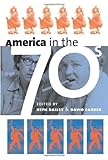
Beth Bailey, David Farber, eds. America in the 1970s. Lawrence: University Press of Kansas, 2004. 246 pp. $29.95 (cloth), ISBN 978-0-7006-1327-4.
Reviewed by Brooks Flippen (Department of Social Sciences, Southeastern Oklahoma State University)
Published on H-USA (November, 2006)
Uncertain Times
It makes perfect sense that Beth Bailey and David Farber would collaborate in editing a book on the culture of the 1970s. The two have worked together before on a similar book on the 1960s and this new book fills a void in the literature. They are correct at the outset when they note that the turbulent 1960s tend to overshadow the 1970s. In addition, with Watergate and the ill fated presidency of Jimmy Carter, political history tends to dominate the literature that does exist. This compilation of nine essays, including one each by the editors, does not ignore politics but is unique in tying the frustrations of a declining economy and political trouble to the American psyche. "It was during the 1970s," the editors write in their introduction, "in the backwash of political and economic crisis, that American dealt with a productive uncertainty about the meanings of happiness, success, patriotism, and national identity" (p. 2).
Bailey and Farber identify three major themes. The first, the transformation from traditional manufacturing industries to a more technological and global economy, set the stage. In the long run this was a positive and inevitable evolution but, during the 1970s, it was disorienting and frightening. The reconfiguration of gender, race, ethnicity, sexuality, and class identity, the second major theme, took place within the context of this shrinking economic pie. Friction was inevitable because people now assumed that prosperity was not. Adding to this anxiety was cultural experimentation, the third major theme. Uncertainty and the freedoms wrought by the previous decade produced an array of attempts at ordering one's life, at reaching self fulfillment. These ranged from drug use to a new fundamentalist Protestantism. In the end, as Bailey and Farber write in a bit of an understatement, the 1970s were clearly not staid.
Individual essays explore such topics as the popular distrust in government, the dynamic concept of patriotism, and the emerging self help movement. Two of the most interesting essays are by Peter Braunstein and Timothy Moy. The former's essay, provocatively entitled "Adults Only," explains how the overt sexual freedoms of New York City engendered widely different reactions, from an embrace of the liberation to a reactionary condemnation. New York had become both a positive and negative symbol. The latter essay explores the rising "cultural stock of [computer] geeks" (p. 224). Often derided as "nerds," they saw opportunity when others only wallowed in disappointment and malaise. In one sense, their new world allowed for only a tenuous bond with others, while in another, contradictory sense, it allowed for communication uninhibited by barriers of race, gender, and class.
There are certainly omissions, most notably any in depth discussion of environmentalism. This "green decade" is, ironically enough, one of the most well explored aspects of the 1970s culture. Taken together, however, these essays are valuable in explaining the genesis of modern cultural conservatism. The 1970s may seem like yesterday to many professors, but to their undergraduate students it is as distant as the Civil War. Reading this book will help show them continuity in history; they will see themselves, and reflections of the way they live, in the decade. While they may find Jefferson Cowie's essay, "The Crosscurrents of Working Class America in the 1970s," a bit heavy, the book's emphasis on sex, music, films, drugs, and the like is sure to stimulate discussion.
This is not only an excellent book for an upper level course on contemporary United States or American social cultural history, but also a freshman level survey. If nothing else, the cover--which includes Edith and Archie Bunker and smaller pictures of Farrah Fawcett on roller skates and John Travolta in his famous disco stance--will have students curious. Oddly, given the subject and apparent market, there are no further pictures or illustrations. The narratives, however, should be more than enough to keep the pages turning.
If there is additional discussion of this review, you may access it through the network, at: https://networks.h-net.org/h-usa.
Citation:
Brooks Flippen. Review of Bailey, Beth; Farber, David, eds., America in the 1970s.
H-USA, H-Net Reviews.
November, 2006.
URL: http://www.h-net.org/reviews/showrev.php?id=12550
Copyright © 2006 by H-Net, all rights reserved. H-Net permits the redistribution and reprinting of this work for nonprofit, educational purposes, with full and accurate attribution to the author, web location, date of publication, originating list, and H-Net: Humanities & Social Sciences Online. For any other proposed use, contact the Reviews editorial staff at hbooks@mail.h-net.org.

