



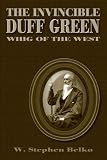
W. Stephen Belko. The Invincible Duff Green, Whig of the West. Columbia and London: University of Missouri Press, 2006. ix + 483 pp. $44.95 (cloth), ISBN 978-0-8262-1647-2.
Reviewed by Susanna Delfino (University of Genoa, Italy)
Published on H-Southern-Industry (November, 2006)
The Two Souls of Duff Green, Man of the (South)west
Historians of Jacksonian America and of the antebellum South have long wondered why Duff Green, the boisterous, eclectic personality at the center of the major political events of the age and whose name was known in every American household, had not obtained the undivided attention of scholars. Being among their number, I can only applaud Stephen Belko's achievement of this impressive feat.
Carving a coherent portrait of such a controversial figure from the turbulent Age of Jackson is no easy task. Belko succeeds in this undertaking, however, skillfully veering between the public and the private dimensions of Green's life to carry home his major point: that Duff Green was not the opportunistic, pro-southern, pro-slavery lackey of John C. Calhoun that conventional wisdom holds. Rather, he was more accurately a Westerner and a moderate; in short, "the quintessential Jacksonian American," Belko argues, "innovative, dynamic, industrious" (p. 296).
As Belko demonstrates, it was not so much Green's arrogant, presumptuous, and self-righteous character that won him so many enemies during the course of his life. Instead, it was the coupling of these traits with a fierce spirit of independence and an unfaltering adherence to some basic principles: the nation and its interests, and the Constitution according to what he believed was the original spirit of its framers. Green was firmly convinced that the Revolution "sought to establish American liberty," while the Union was created "to preserve it" (p. 270). Consequently, his lifelong commitment was, as he repeatedly wrote, "to maintain the rights of the people" and to make sure that their public servants did the same (p. 72).[1]
As described by Belko, Green was an intellectually honest man, consistent in his ideas; an ill-adapted subscriber to the factional strife and the unscrupulous behavior that characterized the politics of the nascent second-party system. Despite his influence among Jackson's entourage, Green's steadfastness in upholding his principles increasingly put him at odds with the Democrats, to the point that he came to be perceived as anti-Jackson at a time when he was still supporting Jackson's candidacy for a second term. Green was an independent spirit. Freedom of thought and expression was his religion, and his inflexibility eventually caused his estrangement from national politics.
Green represented the spirit of the Age of Jackson in more profound ways, Belko adds, especially when displaying his business mentality and entrepreneurial dynamism that qualified him as a Westerner. But was this sort of mentality and economic behavior typically "western," as Belko implies? Yes and no. In the first few decades of Green's life, and at least until the Missouri Compromise, much of the West was also the South. Furthermore, entrepreneurs who indefatigably invested in a variety of economic ventures (from land speculation to planting, from commerce to manufacturing) and experimented with new technologies and methods of production had abounded in the economic panorama of the post-Revolutionary South. Did they not also manifest entrepreneurial dynamism? The same spirit prompted Southerners participating in the successive waves of westward expansion to undertake a range of economic activities in the Southwest. Their economic outlook and scope of action, however, were enhanced by the new institutional context and the opportunities offered by a number of developments (in agriculture, commerce, manufacturing, finance, transportation).[2]
This heritage must have left a mark on the cultural and ideological formation of Duff Green, whose family had participated in the early westward movement from Virginia into Kentucky. The same could be said about John C. Calhoun, whose family had figured prominently in the settlement of the South Carolina interior. Thus, the two men shared important background traits, and this must have mattered a lot in strengthening the bonds of their lifelong friendship.
A better appreciation of the continuities existing between the post-Revolutionary South and the regions beyond the Appalachians is important not only for reassessing southern economic culture, but also for a more inclusive interpretation of the history of antebellum America. Because Belko's book concentrates on Green's life during the Jacksonian era, it largely ends at 1850 when he was definitely out of politics and had become a full-time businessman and industrialist. Consequently, the author devotes only the concluding chapter of his work to Green's entrepreneurial activities from the late 1840s, when they became increasingly based in the South.
The two souls of Duff Green--the western and the southern--had begun to reconcile by the time of the nullification crisis. Of this, Belko provides a very insightful and convincing account. However, there seems to be a missing link in his book, which affects the author's ability to explain why Green became an industrialist, and more generally an entrepreneur, in the South from the late 1840s.[3] How did such a shrewd businessman resolve to concentrate his activities in a region that, according to both northern contemporaries and legions of later historians, was economically backward and devoid of a healthy spirit of enterprise?
Belko's book is impressive in providing a new, stimulating perspective on Jacksonian politics, and in effectively re-evaluating the figure of Duff Green. However, his insistence in connoting him as a Westerner tout court tends to reinforce, rather than challenge traditional views of interregional contraposition that have long underscored the South's isolation--ideological, cultural, and economic--from the mainstream of American history. It would be a shame if Belko, with his vast knowledge of Green's life and thought, didn't seize the opportunity and cover the last few decades of his existence in the South.
Notes
[1]. A similar statement can be found in Green to General Samuel Jones, 1 Nov. 1862, Duff Green Papers, Southern Historical Collection, University of North Carolina.
[2]. On the capitalistic mentality and behavior of eighteenth-century Virginia elites, an illuminating perspective is offered by Aubrey C. Land, "Economic Behavior in a Planting Society: The Eighteenth-Century Chesapeake," Journal of Southern History 33 (Nov. 1967): 469-485. For South Carolina, see Peter A. Coclanis, The Shadow of a Dream: Economic Life and Death in the South Carolina Low Country, 1670-1920 (New York and Oxford: Oxford University Press, 1989); and the recent book by Tom Downey, Planting a Capitalist South: Masters, Merchants, and Manufacturers in the Southern Interior, 1790-1860 (Baton Rouge: Louisiana State University Press, 2006).
[3]. In 1848, Green formed a business partnership with Franklin H. Elmore, president of the South Carolina Nesbitt Manufacturing Company and future successor of John C. Calhoun in Congress. K. G. Gillespie to Green and Elmore, 10 July 1848 and W. W. Wood to Elmore, 26 July, 3 Aug. 1848, Green Papers, SHC-UNC. In 1850, Green participated in the founding of the Hiwassee Manufacturing Company near Chattanooga, Tennessee. "An Act to Incorporate the Hiwassee Manufacturing Company," February 1850, Acts Passed by the General Assembly of the State of Tennessee (Nashville, 1850).
If there is additional discussion of this review, you may access it through the network, at: https://networks.h-net.org/h-southern-industry.
Citation:
Susanna Delfino. Review of Belko, W. Stephen, The Invincible Duff Green, Whig of the West.
H-Southern-Industry, H-Net Reviews.
November, 2006.
URL: http://www.h-net.org/reviews/showrev.php?id=12541
Copyright © 2006 by H-Net, all rights reserved. H-Net permits the redistribution and reprinting of this work for nonprofit, educational purposes, with full and accurate attribution to the author, web location, date of publication, originating list, and H-Net: Humanities & Social Sciences Online. For any other proposed use, contact the Reviews editorial staff at hbooks@mail.h-net.org.

