

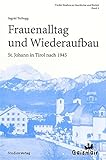
Ingrid Tschugg. Frauenalltag und Wiederaufbau: St. Johann in Tirol nach 1945. Innsbruck: StudienVerlag, 2005. 161 pp. $24.00 (paper), ISBN 978-3-7065-1707-2.
Reviewed by Timothy Dowling (Department of History, Virginia Military Institute)
Published on H-German (November, 2006)
A Small Town in Austria
Ingrid Tschugg's work on the postwar years in St. Johann, Austria, is both more and less than it appears to be at first glance. The subtitle and title present it as both a local history and a history of gender. Yet the story Tschugg tells is often regional, sometimes national, and rarely explicitly gendered. It is supposed to be a work of oral history, but the stories she relates are vaguely disembodied and Tschugg, the historian, is a central figure. The book has a decided air of memoir about it. The author goes to some lengths to set up a theoretical framework, but invokes it irregularly and unevenly. In the end, the book is most useful as a descriptive work, as Tschugg notes in introducing her work: "Thema dieser Studie ist die Organisation und der Alltag des Überlebens in den Jahren unmittelbar nach dem Ende des Zweiten Weltkrieges" (p. 29). There isn't much more to it.
The picture Tschugg paints will be familiar to almost any reader. The colors and forms are those of postwar life throughout Europe: hunger, rubble and hard work; the uncertain fate of men, the community of women, and the difficulties of occupation: "Hamstern, Tauchern, Schleichhandeln" (p. 147). The war reached St. Johann, a small farming community in the Kitzbühel Valley near Innsbruck, mostly in indirect ways. Men went off to fight, leaving the women to fend for themselves. A few prisoners of war were sent as forced labor to assist with the farm work. There were a few air raids. Otherwise, life was "normal," a trend that continued after the war.
The photographs of St. Johann that Tschugg includes, mostly from the 1950s, show a charming, quaint, picturesque town that could have served as the background for Heidi (1937, 1952) or The Sound of Music (1965). A photograph of the German Wehrmacht assembled in the central square is included; to demonstrate the damages of war Tschugg includes pictures and discussion of the rubble in Innsbruck (pp. 89 and 63-68). Stories of Trummerfrauen are well known and Tschugg includes a few, but they have an interesting local twist. Just who should be forced to clean up the bomb damage, it seems, was a matter of serious local debate. Were former NSDAP members responsible for the damage, or was it a communal responsibility (pp. 70-71)? Fortunately for those interested in Austrian history or women's history, a few notable passages like this are found scattered through the work.
Drawing on the recollections of twelve women and one man, all acquaintances of her mother, who arranged and sat in at many of the interviews, as well as her own memories, Tschugg does an acceptable job of showing the daily lives of the women who lived in and rebuilt St. Johann after the war. While their husbands were missing or interned, they worked the land as best they could or took whatever jobs they could find in order to make ends meet. Everyone worked hard, and they helped each other when they could. No one, however, seems to have had anything. Life was difficult, to say the least. Women were expected not only to work, but also to maintain the household and raise the children. Some sought new husbands, while others continued to wait. First Americans and then French soldiers occupied the town. Debates took place about "liberators" versus "occupiers," and people's war histories were subject to scrutiny. A few women took jobs with the occupation authorities, but that was often a double-edged sword.
All of these rubrics are naturally ripe with nuances and contradictions, but Tschugg never really engages any of them in this slim volume. The moral dilemma posed about clearing rubble in the town is described, but never resolved or analyzed. In the section on the occupying authorities, Tschugg offers some views of the French and the Americans and mentions that one of her interview subjects had a negative impression of the Russians (pp. 93-94). Many of the women seemed to fear the French Moroccan soldiers in particular and one of Tschugg's interviewees talks about "die Strasse im Dorf als ein Raum, in dem sich Frauen nicht immer so frei und sicher bewegten konnten" (p. 96). Tschugg also notes that many of her interview partners were critical of local women who took jobs with or had relations with the occupying authorities, and the interviewees describe some encounters, but in all these cases the description is the end of the discussion; there is neither a critical nor a theoretical exploration of the issue (p. 97).
Theory is a particularly annoying afterthought in the book--not because theory is inherently irksome, but because it is so poorly utilized. Tschugg spends some time discussing theory as it relates to women's history in the early stages of the book and setting up a frame of reference, but it all seems rushed and superficial. Method and historiography appear throughout the text, but they are sporadic, inconsistent and usually appear to be an afterthought instead of truly serving as an organizational or critical framework. In the chapter dealing with the absence of men in St. Johann, for example, Tschugg blithely quotes a colleague to the effect that: "Ein Mann als Haushaltsvorstand galt wieder als soziale Norm" and then goes on to describe how almost all of her interview partners had to live alone for many years (p. 60). The contradiction is never considered; presumably the footnotes exist for those who wish to explore such topics, and the theory surrounding them, in-depth. The notes and bibliography are rich in those types of sources, but the evidence of their use is slight.
At no point does Tschugg seem to have thought through her approach thoroughly. When talking about the theory of women's history, she warns against the dangers of "heroizing" women in the postwar world for their work (p. 30). Earlier, however, Tschugg herself states that "Das Ziel dieses Buches besteht darin, der Arbeit von Frauen und ihrem Optimismus, mit dem sie auf diesen Zeitraum und die sehr hohen Arbeitsanforderungen in unseren Gespräch zurückblickten, in der Geschichtsschreibung einen Raum zu geben" (p. 17). In one section, Tschugg shies away from listing the victims of the war because to do so would create a hierarchy; a few pages earlier, however, she has no such difficulty listing the immigrants and refugees who ended up in Tirol after the war (pp. 50-51, 54).
All in all, Frauenalltag und Wiederaufbau. St. Johann in Tirol nach 1945 is a rather confusing and frustrating work. The interviewees are briefly and incompletely introduced. Their stories never come to life, and Tschugg never attempts to evaluate their memories in a critical light. Their words are connected by a series of unexplored truisms like: "Verändert hatten sich aber auch die Frauen während der Jahre der Trennung" (p. 56) and "Unternährung betraf Frauen und Männer nicht im gleichen Masse" (p. 114). The work introduces many topics, and provides the kernel of stories that relate to them, yet it never engages as a history. Tschugg's work is merely a record of what a few of her mother's acquaintances remember of the postwar years in a small town in Austria. As such, it might be a useful building block for a larger study of women's roles and attitudes in rural areas during the postwar years--at least that is one of Tschugg's declared aims for the work--but as a stand-alone history, it is of little more than local interest (p. 33).
If there is additional discussion of this review, you may access it through the network, at: https://networks.h-net.org/h-german.
Citation:
Timothy Dowling. Review of Tschugg, Ingrid, Frauenalltag und Wiederaufbau: St. Johann in Tirol nach 1945.
H-German, H-Net Reviews.
November, 2006.
URL: http://www.h-net.org/reviews/showrev.php?id=12535
Copyright © 2006 by H-Net, all rights reserved. H-Net permits the redistribution and reprinting of this work for nonprofit, educational purposes, with full and accurate attribution to the author, web location, date of publication, originating list, and H-Net: Humanities & Social Sciences Online. For any other proposed use, contact the Reviews editorial staff at hbooks@mail.h-net.org.

