



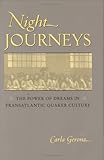
Carla Gerona. Night Journeys: The Power of Dreams in Transatlantic Quaker Culture. Charlottesville and London: University Press of Virginia, 2004. x + 290 pp. $35.00 (cloth), ISBN 978-0-8139-2310-9.
Reviewed by Michael J. Galgano (James Madison University)
Published on H-Atlantic (November, 2006)
The Worlds of Quaker Dreams
What did early modern people dream about, and what roles did their dreams play in the formation and evolution of culture? Carla Gerona seeks answers to these and other questions by exploring the worlds of Quaker dreams and the ways they were interpreted and passed on between the mid-seventeenth and early nineteenth centuries in England and America. Her study adds appreciably to our understanding of a fascinating intersection between Quaker, British, and colonial American histories in a new and creative way. Beginning with a clear explanation of dream theory, she then systematically explains the similarities and differences between dreams and their uses among various groups of contemporaries in the Atlantic world. Her principal focus throughout, however, is the Quakers who spread their dreams in their meetinghouses and beyond.
Quakers believed that God communicated with them directly through their dreams, and the sect gradually evolved a unique system of dream interpretation, labeled "dreamwork" by the author. Dreams therefore not only helped individual Quakers become more self-conscious, they also facilitated the construction of group identity. By sharing, retelling, and recording their dreams with others in their community, Quakers helped one another map future courses, especially as they came to grips with an increasingly pluralistic society at home and in America. For them, "dreams like maps, and sometimes even in place of maps, helped Quakers get where they were going" (p. 4). According to the author, Quakers were distinctive among their contemporaries for the power they assigned to dreams. This aspect became increasingly important by the 1680s as the community became more dispersed geographically.
To construct her argument, Gerona analyzes nearly three hundred prophetic dreams located in archives in Philadelphia and the London Friends House. Her selections are excellent and reveal the evolutionary process of dreamwork among men and women. She records its origins and early development in the mid-seventeenth century, then shows how early Quakers used dreams to confront and challenge English political and ecclesiastical institutions, particularly the Crown and the Church of England. A more detailed explanation of some of the principles of Quaker beliefs, including the place of the "inner light," would perhaps enhance this part of her analysis. The ways in which Quaker dreamers responded to the post-1659 domestic realities and increased persecution, as discussed by Barry Reay, might also be useful. In the ensuing generation, Friends began to employ dream interpretation to envision a new world that paralleled state imperialism while justifying colonization. Through their dreams, they began to map strategies to bring their religious vision beyond the shores of the British Isles.
The establishment of Pennsylvania introduced new complications and opportunities for English Quakers. The community was now more widely dispersed, and leaders used common dream experiences to instruct a divided community in self-discipline, and to resolve personal and communal conflicts in an increasingly multicultural world. At the same time, experiences in Pennsylvania and elsewhere in colonial America brought Friends face to face with the cultures of Native Americans and African slaves.
One of the most original contributions of this study is the analysis of the role of Quaker dreams in the context of the Great Awakening. The chapter effectively explains the ways Quakers used dreams to aid their own religious revival and dispels traditional notions of quietism. Dream interpretation continued to shape Quaker ideals and ultimately formed such sectarian views as emphasizing simplicity in daily life and advocating pacifism and an end to slavery. Gerona's treatment of dreams and their interpretation in this section is extremely powerful.
Throughout, the study is well organized, clearly argued, and effectively written. Gerona has identified the correct sources and used them to document her claims. Her arguments are fully documented, and she constructs a compelling case for the central role of dreams in defining a developing Quaker culture in the period. She is conscious of the ways in which Friends related to the broader society while preserving their own distinctive identity. She also links Quaker thought and society to the great issues of the times that influenced its evolution, such as the Restoration, the Glorious Revolution, the Great Awakening, and the Atlantic slave trade. While underscoring how dreams helped unite the members of the Society of Friends, she does not ignore the tensions, struggles and differences always present within the community.
In short, this is an instructive study that has much to offer scholars and students of British and colonial American history. It presents well-balanced insights into the Quaker experience and the place of dreams in early modern culture and raises significant questions about the use of new types of evidence. Scholars have long accepted the idea that Quakers' influence far exceeded their numbers. Carla Gerona's work extends that argument to the world of dreams and visions that formed a fundamental part of Quaker thought.
If there is additional discussion of this review, you may access it through the network, at: https://networks.h-net.org/h-atlantic.
Citation:
Michael J. Galgano. Review of Gerona, Carla, Night Journeys: The Power of Dreams in Transatlantic Quaker Culture.
H-Atlantic, H-Net Reviews.
November, 2006.
URL: http://www.h-net.org/reviews/showrev.php?id=12481
Copyright © 2006 by H-Net, all rights reserved. H-Net permits the redistribution and reprinting of this work for nonprofit, educational purposes, with full and accurate attribution to the author, web location, date of publication, originating list, and H-Net: Humanities & Social Sciences Online. For any other proposed use, contact the Reviews editorial staff at hbooks@mail.h-net.org.

