



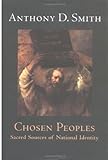
Anthony D. Smith. Chosen Peoples: Sacred Sources of National Identity. Oxford: Oxford University Press, 2003. x + 330 pp. $29.95 (cloth), ISBN 978-0-19-210017-7.
Reviewed by Irving Hexham (Department of Religious Studies, University of Calgary)
Published on H-SAfrica (October, 2006)
Two types of book are particularly hard to review: those with which one strongly disagrees and those with which one strongly agrees. This book falls in the latter category. Anthony D. Smith is Emeritus Professor in Ethnicity and Nationalism at the London School of Economics and a former student of Ernst Gellner who developed his own theory of ethnosymbolism to understand the dynamics between traditional views of nationalism and modern interpretations. Smith's first book, Theories of Nationalism (1971), laid the foundation that he has elaborated on in numerous other publications.
Smith's latest work, Chosen Peoples, is a tour de force that brings together the results of almost forty years' reflection on the complex relationships between ethnicity, nationalism, and religion. The book has nine tightly written chapters: "Nationalism and Religion"; "The Nation as a Sacred Communion"; "Election and Covenant"; "Peoples of the Covenant"; "Missionary Peoples"; "Sacred Homelands"; "Ethnohistory and the Golden Age"; "Nationalism and Golden Ages"; and "The Glorious Dead." They are preceded by a lively introduction and end with an excellent conclusion.
To establish his case Smith uses a wide array of carefully chosen examples. The countries he discusses include Armenia, England, Scotland and Wales, Egypt, Ethiopia, France, Germany, Greece, Mexico, Turkey, and the United States of America. In each instance he uses well-chosen secondary sources that provide strong evidence to support his argument. The well-thought-out chapter structure reinforces his case by approaching his topic from a variety of mutually supportive angles. Consequently, the reader is left with the feeling that Smith is a master of his trade who is providing a summary of his life's work in an easily digestible form.
There are some weaknesses in this approach, however. For example, on page 81, after an excellent discussion of the dynamics of Afrikaner Nationalism in South Africa he writes: "It was here, of course, that another myth came into play, that of the genealogy of Ham, which legitimated the servitude of the non-white 'heathen' to the Judeo-Christian children of Shem."
In all my time in South Africa I have never heard an Afrikaner Nationalist use this type of argument or even hint at it. More importantly, although I examined Afrikaans archival documents, printed books, magazines, and newspapers for almost eighteen months, I did not find a single example of an Afrikaner using this type of argument. The only example of the Ham theory that I found was in a pamphlet published in the United States by British Israelites. This was in a private collection shown to me by an opponent of Afrikaner Nationalism. On another occasion an English-speaking member of the Plymouth Brethren put forward the Ham theory as a Biblical defense of segregation even though he claimed to reject apartheid and despise Afrikaner Nationalists.
The book also seems to assume that Christian Nationalisms are nourished by covenant theologies that develop from preachers concentrating on Old Testament themes (pp. 41, 80). Although the idea of a covenant is rooted in the Old Testament, the idea that Afrikaner Nationalism was created by an overemphasis on the Old Testament to the neglect of the New, as some writers explicitly state and as Smith implies, is mistaken. An examination of collections of sermons published by leading Afrikaner Nationalist theologians show that the New Testament, not the Old, dominated their thinking. Therefore, there is a need to examine the role of the New Testament more carefully to find in it sources of Christian Nationalism.
Another issue that Smith and other writers on this topic overlook is the direct influence of Jewish converts to Christianity on the development of Christian Nationalism in the nineteenth century. In both the Netherlands and South Africa converted Jews wrote highly nationalistic poetry and polemic works that saw their newly adopted nations as a "new Israel." For example, in the Netherlands both Abraham Capadosa (1795-1874) and Isaac de Costa (1798-1860) were key figures in creating the Christian Nationalism of the neo-Calvinist movement. Similarly, in South Africa another Jewish convert, Jan Lion Cachte (1838-1912), was a key figure in the early Nationalist movement.
Probably the most exciting chapter in the book is the ninth, "The Glorious Dead," which opens a whole range of possibilities for future research. One of the most overlooked aspects of modern nationalism is its curious link to forms of ancestor veneration that seem to have intellectual links to the theories of Ludwig Feuerbach. Although Smith does not explore this aspect of ancestor cults he does draw attention to their importance to nationalist movements, a fact that invites further investigation.
Overall this is an excellent book that ought to be in all university libraries. It will also make a fine text for senior undergraduate courses in a variety of disciplines from history and political science to religious studies.
If there is additional discussion of this review, you may access it through the network, at: https://networks.h-net.org/h-safrica.
Citation:
Irving Hexham. Review of Smith, Anthony D., Chosen Peoples: Sacred Sources of National Identity.
H-SAfrica, H-Net Reviews.
October, 2006.
URL: http://www.h-net.org/reviews/showrev.php?id=12450
Copyright © 2006 by H-Net, all rights reserved. H-Net permits the redistribution and reprinting of this work for nonprofit, educational purposes, with full and accurate attribution to the author, web location, date of publication, originating list, and H-Net: Humanities & Social Sciences Online. For any other proposed use, contact the Reviews editorial staff at hbooks@mail.h-net.org.

