



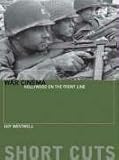
Guy Westwell. War Cinema: Hollywood on the Front Line. London: Wallflower Press, 2006. 133 pp. $20.00 (paper), ISBN 978-1-904764-54-0.
Reviewed by Lisa Mundey (U.S. Army Center of Military History)
Published on H-War (October, 2006)
A Militant Hollywood
War Cinema is part of the Short Cuts Series, a sequence of compact introductory survey texts for various aspects of film studies. Guy Westwell, Senior Lecturer in Film Studies at London Metropolitan University, provides a well-researched survey of contemporary war film scholarship, particularly focused on American cinema. It is primarily geared toward students of film studies and popular culture. Given the target audience, Westwell assumes the reader is familiar with such ideas as Benedict Anderson's "imagined communities," Antonio Gramsci's theory on hegemony, and other critical discourses. He also presumes that the readers have a basic knowledge of film terminology and concepts, such as "genre" and "auteur," and American history. Nevertheless, the text is not overly laden with jargon, so a non-expert can understand it.
Westwell rejects the idea that war films are entertainment and argues that cinema and audiences have a complex relationship, which he describes as a cultural imagination about war. In War Cinema, Westwell constructs a history of twentieth-century film cycles, capturing Hollywood's changing cultural imagination about war. Reflecting the overall state of film scholarship and his own predisposition, Westwell critiques Hollywood for its tendency to mythologize, construct myopic nationalistic interpretations, and produce pro-war films.
Westwell organizes his survey of war cinema chronologically around several distinct film cycles based on changing ideological interpretations of war. The earliest war cinema cycle provided nationalistic and propagandistic interpretations of war, as demonstrated in the film Tearing Down the Spanish Flag (1898) about the Spanish-American War. Subsequent films featured the American Civil War and the American conquest of the west, which showed manifest destiny coming to fruition through war. The World War I film cycle initially retained the propagandistic flair of the first war films, with an additional glorification of the air war. In the aftermath of the war's destruction, the dominant ideology shifted to reject the romantic version of World War I. Reflecting this new cultural interpretation of war, Hollywood produced films that revealed disillusionment, culminating in All Quiet on the Western Front (1930).
World War II produced new film cycles as American attitudes toward the war changed over time. Prewar films focused on self-sacrifice and prepared American audiences for eventual intervention. During the war, the Office of War Information worked closely with Hollywood to produce films with particular messages for American audiences. As Westwell explains, the emerging cultural imagination of war was "predicated on a powerful sense of an integrated America constructed as victim that perceives military action to be a just and necessary response to unwarranted aggression" (p. 43). He argues that this construct became a template for war films created later in the twentieth century, such as Saving Private Ryan (1998). Post-World War II films largely celebrated American victory, a tendency also repeated in World War II films created at the end of the twentieth century.
Westwell credits the Korean War film cycle for taking cinema into new directions of cynicism and conformity. In line with other film scholars, Westwell presents the low-budget The Steel Helmet (1951) as the exemplar of the Korean War film. He demonstrates how this film reflects the prevailing cultural imagination of war by its incorporation of cynicism, racism, and anti-communism. If films convey a cultural imagination of war, then there must be some interaction with the audience. While The Steel Helmet transmits key attitudes and messages, it did not attract many moviegoers. Perhaps a more appropriate film to analyze for a cultural imagination of war based on the Korean film cycle would be The Bridges at Tokro-Ri (1954), a successful film based on a bestselling novel and magazine serial, which reached a far wider audience.
According to Westwell, a patriotic film cycle, which includes the film autobiography of World War II hero Audie Murphy To Hell and Back (1955) and the star-studded epic recreation of D-Day The Longest Day (1962), created a mythological World War II based on a "vision of self-confident military effectiveness as a brave, disciplined, civilian army heroically defeated the Nazis" (p. 55). This vision reflected the dominant liberal consensus, best articulated by President John F. Kennedy. Westwell explains that this mythological past presented an alarming disconnect with the emerging conflict in Southeast Asia during the 1960s. As a result, Hollywood avoided setting films directly in Vietnam. An exception is John Wayne's The Green Berets(1968), which Westwell dismisses as a World War II film set in Vietnam. Instead, he finds Vietnam subtexts in a series of films that fellow film scholar Jeanine Basinger, author of The World War II Combat Film: Anatomy of a Genre (2003), dubs the "dirty group" films: The Dirty Dozen (1967), The Devil's Brigade (1968), and Kelly's Heroes (1970).
Much film scholarship focuses on the emergence and evolution of the Vietnam War films, and Westwell reflects this work in his evaluation of the cultural imagination of the Vietnam War. Scholars detect in the initial Vietnam cycle of films, such as The Deer Hunter (1978) and Apocalypse Now (1979), issues of trauma, psychological duress, and personal and national fallibility. Scholars view the second cycle of films, which include the Rambo films, through the prism of gender theory. Rambo, for instance, is the prime example of hyper-masculinity. The subsequent realist cycle of Vietnam films presents the suffering veteran as the victim of war. These films include Platoon (1986), Hamburger Hill (1987), and Born on the Fourth of July (1989). Westwell argues that these Hollywood films recast Vietnam into a moral victory. As a consequence, the American cultural imagination of war accepted the Vietnam experience as something of value rather than a dark chapter in the nation's history.
As a result of the Cold War's collapse and the rise of American hegemony, Westwell asserts that the American cultural imagination of war shifted in favor of pro-war interpretations. Westwell believes that Saving Private Ryan, along with such blockbusters as Pearl Harbor (2001), We Were Soldiers (2002), and the television mini-series Band of Brothers (2001), have "reclaimed the idea of war as progressive, necessary and ennobling" (p. 104). In addition, recent war films reflect an inclination to fight wars for humanitarian reasons, seen in such films as Black Hawk Down (2001) and Behind Enemy Lines_ (2001).
Westwell posits that the contemporary cultural imagination of war is understood through four basic concepts: point of view, identity, morality, and memory. He explains that many contemporary war films take the veteran's point of view, focusing on a narrow personal narrative. This point of view privileges the male experience. Westwell states that American identity in war films centers on the threat of a dangerous and alien enemy "other." In the morality of war films, America fights only when gravely wronged. Americans fight for survival and virtue in a black-and-white moral universe, which pits the forces of good against evil. Westwell believes this cultural construct severely limits the ability to examine complex moral, economic, political, and historic issues with regard to war. In conjunction with the limits of the morality construct, he asserts that America's cultural memory of war rests on military romanticism. At the end of the volume, Westwell explains his fear that this myopic view of the past, the nationalistic construct of otherness, "a reconstructed masculine capability," and this profound nostalgia for a mythological World War II "has become justification for war in the present" (p. 115).
War Cinema is an accurate survey and synthesis of current film scholarship. Readers can benefit from this updated overview of war films, and it is a good starting place to launch further study. It must be kept in mind, however, that film scholars overwhelmingly focus on the militaristic aspects of Hollywood's war films, detecting either propaganda, the heavy hand of the Pentagon, or martial tendencies within American culture. Although Westwell advances several cultural imaginations of war, he does so through the images on screen rather than through a systematic analysis of audience responses. By doing so, he does not address those audience members who view Hollywood as a bastion of liberals who produce anti-military, anti-war films. Other scholars may attempt to bridge the gap between film scholarship and audience response.
If there is additional discussion of this review, you may access it through the network, at: https://networks.h-net.org/h-war.
Citation:
Lisa Mundey. Review of Westwell, Guy, War Cinema: Hollywood on the Front Line.
H-War, H-Net Reviews.
October, 2006.
URL: http://www.h-net.org/reviews/showrev.php?id=12443
Copyright © 2006 by H-Net, all rights reserved. H-Net permits the redistribution and reprinting of this work for nonprofit, educational purposes, with full and accurate attribution to the author, web location, date of publication, originating list, and H-Net: Humanities & Social Sciences Online. For any other proposed use, contact the Reviews editorial staff at hbooks@mail.h-net.org.

