



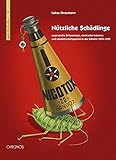
Lukas Straumann. NÖ¼tzliche SchÖ¤dlinge: Angewandte Entomologie, chemische Industrie und Landwirtschaftspolitik in der Schweiz, 1874-1952. Zurich: Chronos Verlag, 2005. 392 pp. EUR 32.00 (paper), ISBN 978-3-0340-0695-8.
Reviewed by Mark Finlay (Department of History, Armstrong Atlantic State University)
Published on H-German (October, 2006)
The War on Pests in a Peaceful Nation
On June 20, 1942, two Swiss entomologists died in an unexplained automobile accident on the German autobahn near Heidelberg. The details are unclear and apparently were covered up, but it seems likely that Karl Roos and Gérard Défago came to Germany on a clandestine mission to share information on a tremendously effective new pesticide, dichlorodiphenyltrichloroethane, also known as DDT. DDT offered crucial support for the Nazis' fight against the potato beetle, part of a broader strategy of national self-sufficiency in food production. In addition, Germans evidently feared that the Allies might use potato beetles as a weapon of biological warfare, and it is possible that the Swiss entomologists learned something that day about Germany's own plans for biological warfare. Whatever really happened that day, research on DDT continued apace. Buttressed by rich sources from corporate and government archives, agricultural and scientific journals and solid work in the secondary sources, Lukas Straumann presents a well-integrated treatment of the interplay over the development and employment of pesticides among farmers, entomologists and chemical industry leaders.
By the end of 1942, the Swiss chemical firm Geigy signed licensing agreements with both Germany and the United States, and DDT emerged as one of the war's most significant technological breakthroughs. Geigy's pesticide sales increased eight-fold during the war, the majority of which were exports to warring countries. For military and civilian leaders on both sides, DDT seemed a godsend. While Germans made effective use of DDT against pests that threatened agricultural productivity, the Allies had even more significant success by employing the chemical in war theatres where typhus, malaria and other insect-borne diseases previously had killed thousands of soldiers. Unsurprisingly, Geigy's chemist Paul Müller received the Nobel Prize for Medicine or Physiology in 1948.
In this fine study, Straumann explains how the Swiss pesticide industry reached such prominence. The story begins in the 1870s, when the devastating Phylloxera louse threatened the Swiss wine industry. Previous privately funded initiatives to fight insect pests had been only intermittently effective; officials thus called for a broader, state-funded effort. In this context, Swiss government officials and agricultural leaders expanded their funding for agricultural experiment stations, began testing pesticides and promoted their use among farmers. As subsequent infestations of harmful moths, beetles, nematodes and fungi attacked Swiss agriculture, an emerging nexus of professional entomologists, agricultural chemical merchants and government regulators collaborated to develop strategies to combat them.
The Swiss pesticide industry reached a stable footing after World War I. Straumann focuses especially on the Maag company, a small family business that rose to prominence between the wars. Recognizing that fruit and potato farming were expanding in Switzerland as the wine industry lagged, Maag developed chemical preparations effective against a variety of pests that threatened a wide range of crops. With an extensive sales organization, an efficient system of delivering chemical advice to practicing farmers and healthy relationships with academic entomologists, experiment station scientists and government regulators, Maag took command of the Swiss market.
By the beginning of World War II, circumstances were ripe for larger chemical firms to enter the market. With the coal tar dye industry under pressure, Swiss chemical giants Geigy, Ciba and Sandoz began to dabble in pesticides; Müller, originally assigned to a project involving tanning chemicals, moved into insecticide research by 1935. As large chemical firms hired ever more entomologists and other scientists to develop new products, the use of agricultural chemicals became increasingly embedded into Swiss agricultural practice. The Swiss government also pushed a "battle for production" that called for national self-sufficiency in agricultural production through greatly expanded acreage, more machinery, more fertilizers and more pesticides. Wartime circumstances also meant that synthetic organic pesticides were preferable to inorganic types that required imported raw materials such as copper. Chemical manufacturers also helped this effort, for they were willing to reduce product lines and profit margins in exchange for the prospect of greater sales. New government organizations distributed new spraying technologies, held training sessions for small farmers and employed a rhetoric that spoke of "great offensives" against "armies" of insects. In sum, war was catalyst for technological change, even in neutral Switzerland.
Yet troubles emerged soon after the war. Geigy scientists encountered DDT-resistant pests as early as 1945. The wartime consensus about agricultural production at any cost broke down. Tensions arose between scientists employed in private industry, who found only positive aspects of pesticide use, and government regulators and academic scientists, who became increasingly concerned about pesticides' environmental risks. Ecological interest groups that called for biological rather than chemical control of agricultural pests rose in influence. Straumann closes his study in the year 1952, when new laws that called for greater governmental oversight took effect, symbolic of the breakdown of the previous alliances.
The author's analysis dabbles with the "social shaping of technology" framework, as he shows that scientists' desire for professional status, government authorities' drive for modernization and the agricultural chemical industry's competition for sales and profits all worked together in the case of Swiss pesticides. Straumann also effectively develops analysis regarding the national character of Switzerland. Particularly in sections on the world wars, Straumann shows how neutral Switzerland charted its own course in ways that legitimized new technologies. As fighting pests shifted from a private matter to state policy, it becomes clear why certain pesticides were used and why less dangerous alternatives were not. Switzerland's neutrality also fostered its entomologists' ability to take leading roles in international pesticide research.
Nützliche Schädlinge is a well-crafted, thoroughly researched, and surprisingly engaging study of the significance of the Swiss pesticide industry. Although it is unlikely to be a trendsetter in the literature, it is highly recommended, particularly as a model for those interested in the development of science in small or neutral nations.
If there is additional discussion of this review, you may access it through the network, at: https://networks.h-net.org/h-german.
Citation:
Mark Finlay. Review of Straumann, Lukas, NÖ¼tzliche SchÖ¤dlinge: Angewandte Entomologie, chemische Industrie und Landwirtschaftspolitik in der Schweiz, 1874-1952.
H-German, H-Net Reviews.
October, 2006.
URL: http://www.h-net.org/reviews/showrev.php?id=12435
Copyright © 2006 by H-Net, all rights reserved. H-Net permits the redistribution and reprinting of this work for nonprofit, educational purposes, with full and accurate attribution to the author, web location, date of publication, originating list, and H-Net: Humanities & Social Sciences Online. For any other proposed use, contact the Reviews editorial staff at hbooks@mail.h-net.org.

