



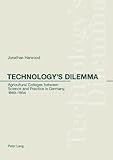
Jonathan Harwood. Technology's Dilemma: Agricultural Colleges between Science and Practice in Germany, 1860-1934. Peter Lang: Bern, 2005. 288 pp. $49.95 (paper), ISBN 978-3-03910-299-0.
Reviewed by Simone De Santiago Ramos (Department of History, University of North Texas)
Published on H-German (October, 2006)
Institutional Dynamics of German Agricultural Schools
"Pure" vs. applied education in academia is the underlying theme of Jonathan Harwood's monograph. Harwood considers how these differences in orientation came about, how they were able to exist side-by-side in the case of German agricultural education and why practical institutions have drifted closer to the scholarly pole over time (p. 13). The book is not a history of agricultural colleges, but rather an attempt to write a history of agricultural education that bridges in its analysis the gap between "pure" science and its practical applications.
The introduction acquaints the reader with the wide range of variation among agricultural institutions in Germany. Harwood examines these schools' curricula in the nineteenth and early twentieth centuries and considers how and why the "education pendulum" swung between science and practice (p. 33) Harwood focuses on Munich and Weihenstephan (both located in Bavaria) over a period of roughly fifty years. Because higher agricultural education was never uniform in Germany, it would have been difficult to write a straightforward chronology. Instead, Harwood highlights several major universities and academies and concentrates on education about plant-breeding. Harwood's background in biology provides him with a thorough understanding of science and science education. His larger goal is to consider educational policies in other fields--particular medicine and engineering--and to see how the conflict between science and practical education has affected institutions not just in Germany but also other European countries and even the United States. In order to understand institutional dynamics he introduces the reader to a model loosely based upon Bourdieu's concept of the field (p. 67), which he divides into geographic, academic and political-economic areas.
The source basis of the research is solid; Harwood consulted holdings at the Bayerische Hauptstaatsarchiv and the Geheime Staatsarchiv Preußischer Kulturbesitz as well as university archives in Gießen, Munich, Halle, Hohenheim and Weihenstephan. Additionally, he reviewed agricultural trade journals; announcements of agricultural societies and associations; and the by-laws of the Agricultural Academy Bonn. He cites the relevant secondary literature, including the works of the most influential German agronomists like Friedrich Aeroboe, Gustav Froehlich, Carl Fruhwirth and Kurt von Ruemker.
Agricultural education overlaps with other fields--such as engineering, biology, management, economics, food technology and environmental studies; thus, during the early part of the nineteenth century, most agriculture schools were founded based on the need of supplying state mines or domains with managers trained not only in administrative matters but also a basic understanding of engineering or biology. At the same time these courses were taught by professors trained in law, theology or philosophy with little science background (p. 78). Harwood, while looking at his agricultural model of scholarly versus applied education, compares the history of engineering, medical and management education to that of agriculture (p. 234).
In the book's first section, the author examines the ivory tower of German academia in general with a detailed consideration of institutional dynamics and degree requirements. His insight and analysis of these attitudes (combined with a prose style that enlivens what might otherwise have been a rather dry subject) adds to our understanding of German universities at the turn of the century. Interspersed throughout the text are insights into the elitist thinking of college professors and the manner in which they often followed their own personal agendas instead of furthering the interests of their institutions or students. Throughout, Harwood reveals his mastery of the complex and often confusing topic of agricultural education within the different German states. In Berlin, for example, pure science research was conducted, but, as Harwood shows, Berlin slowly shifted in "a more practical direction" (p. 120). Halle followed this example around 1909, while Bonn was more practice-oriented from the start (and also a lower-tier institution). The University of Breslau, located in the easternmost part of Germany, struggled for acceptance, but was able, through a practical curriculum, to become a "center for innovative work" (p. 145). Harwood is able to show a shift in agricultural education in the Weimar Republic (p. 104). He summarizes his findings at the end of each chapter to highlight his major points and concerns. While he covers the range of traditional university institutions well, however, Harwood might have considered here the short-lived Deutsche Kolonial Schule as well, founded in 1898 exclusively to educate and prepare future farmers for overseas agricultural endeavors. Colonialism was, after all, a important theme of the Wilhelmine era and a thorough report on this school, including its curriculum, might shed additional light on the careers of some its more prominent alumni.
The second part of the book looks at plant-breeding at universities and academies. Harwood divides the professors into pro-Mendelians (those who embraced Johan Gregor Mendel's theory of genetics) and his skeptics. Scholarly institutions employed pro-Mendelians, while skeptics worked predominantly at practical schools. This section is well researched and presents the majority of Harwood's primary research but reads as a modification of the work of other researchers rather than unique results of his own research, particularly as it deals with the failure of the so-called green revolution (the introduction of science-based plant breeding to promote high-yield cereal variety). Some readers may find that the comparisons with other disciplines push agricultural education to far into the background.
The dilemma of practical scientists caught between two powerful groups occupied with the questions "what can we learn from the basic disciplines" and "how can we devise solutions to practical problems" is the overaching theme in Jonathan Harwood’s book (p. 19). With the example of Munich and Weihenstephan, he shows readers how the differences in "pure" vs. applied agricultural education came about and why practically-oriented institutions have moved closer to the scholarly curriculum over time. Although Harwood's intended audience is historians of agricultural science, he believes that the book will also be of interest to other circles. In recent years, the appearance of food safety concerns and BSE made it clear that such crises are a product of western industrial agriculture--precisely the ideals promoted by the more scholarly institutions. While the implications of his themes for the reform of scholarly vs. applied education around the world can not be summed up in one monograph, Harwood agrees that his model will hardly be the last word on the dynamics of institutional change in agricultural education.
If there is additional discussion of this review, you may access it through the network, at: https://networks.h-net.org/h-german.
Citation:
Simone De Santiago Ramos. Review of Harwood, Jonathan, Technology's Dilemma: Agricultural Colleges between Science and Practice in Germany, 1860-1934.
H-German, H-Net Reviews.
October, 2006.
URL: http://www.h-net.org/reviews/showrev.php?id=12434
Copyright © 2006 by H-Net, all rights reserved. H-Net permits the redistribution and reprinting of this work for nonprofit, educational purposes, with full and accurate attribution to the author, web location, date of publication, originating list, and H-Net: Humanities & Social Sciences Online. For any other proposed use, contact the Reviews editorial staff at hbooks@mail.h-net.org.

