



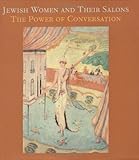
Emily D. Bilski, Emily Braun. Jewish Women and Their Salons: The Power of Conversation. New York and New Haven: Yale University Press, 2005. xiii + 266 pp. $50.00 (cloth), ISBN 978-0-300-10385-4.
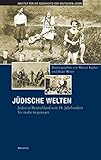
Marion Kaplan, Beate Meyer. Jüdische Welten: Juden in Deutschland vom 18. Jahrhundert bis in die Gegenwart. Göttingen: Wallstein Verlag, 2005. 492 S. EUR 38.00 (cloth), ISBN 978-3-89244-888-4.
Reviewed by Jay Howard Geller (Department of History, University of Tulsa)
Published on H-German (October, 2006)
Voices or Echoes
Asked to review two essay collections, I received a catalog and a Festschrift. Consequently, their relationship to their purported objects--one, an exhibition; the other, a career--is at best complementary, if not merely tangential. More significantly, contributions to these anthological genres are not usually subject to prepublication review and often written by friends enjoined by the editors to contribute. Both genres tend toward the occasional or the recuperative, the remainder or the reminder, the overview or the microanalysis; rarely does a slice from cutting edge revision of scholarship make its way between the covers. While the Festschrift generally fulfills its promise, although not without providing interesting reading and spurs to possible research, the catalog does take the reader or the exhibit visitor to sites not normally associated with its subject matter, such as the political and the Italian. Before providing an overview of Jüdische Welten, the Festschrift for Monika Richarz, however, I have several comments to make about Jewish Women and Their Salons, the work that accompanied the 2005 exhibition "The Power of Conversation" at New York's Jewish Museum (and later at Boston College's McMullen Museum of Art), curated by Emily D. Bilski and Emily Braun.
The Jewish salonnières of the early Romantic period, whether represented in terms of the exceptional Jewish woman or the Jewish woman as exception, have long been an object of interest in Jewish, gentile, and feminist circles. For some their salons together represented a liminal space, for others the frontier where identities were negotiated, and for still others the site of betrayal. These concerns are not alien to this exhibition, but I am grateful in this exhibition and catalog for not only the provision of additional ways of conceptualizing these spaces, their "hostesses," and their "guests," but also an expanded look into the history and geography of this phenomenon, whether the fin-de-siècle Paris and London of Geneviève Strauss and Ada Leverson respectively, or the bicoastal twentieth-century America of Florine Stettheimer and Salka Viertel, or even more strikingly for being less well known on these shores, the futurist Italy of Margherita Sarfatti.
First, I should attend to the obvious: the marvelous irony of entitling an exhibition of paintings, photographs, the occasional piece of furniture and a few letters and postcards, "The Power of Conversation." How does one convey visually "recollections of things that were never there" (p. 147; a final Rahel Varnhagen citation with which the curators conclude their monograph-length introduction)? Can one exhibit that most ephemeral, private and gendered of--dare I say--arts: conversation? (For future reference: how will the text messaging, IMing, chatrooms and blogs of today be represented?) Is the significance of conversation in its anticipation of performance art? Or is its value derivative: a consequence of the music, art, romans à clef and utopian dreams that were supported by the sites of the conversations, the salons?
The latter certainly are easier to represent, as Bilski and Braun both acknowledge. And yet, the curators and the other contributors to the volume--Leon Botstein, Shira Brisman, Barbara Hahn, and Lucia Re--suggest that we should not allow the limits of representation to limit similarly the significance of the Jewish salonnières to mere formal causes of cultural productions. That social conditions and power relations limited both the possibilities for and the valuations of the creative work of Jewish women does not mean that we should share in the marginalization and deny the agency of Amalie Beer, Fanny Hensel, Henriette Hertz, Anna Kuliscioff, Leverson, Sarfatti, Gertrude Stein, Stettheimer, Strauss, Rahel Levin Varnhagen von Ense, Viertel, and Berta Zuckerkandl. Instead, the curators and their fellow essayists endeavor to find traces of the self-creation as well as the group-creation undertaken by these "conscious pariahs" (p. 146) strewn about the exhibition space and its accompanying volume. They seek to provide a sounding board for each of these Jewish women, "whose voice[s have] never been heard quite rightly" (p. 157).
Jüdische Welten also resounds with voices that have not always been heard quite rightly. This Festschrift, with its particular honoree and particular subject matter, brings to the fore two objects that historically had been marginalized, (not only) in the Germanophone university: the female academic and the everyday lives of Jews in Germany. That both are no longer hugging the periphery is in part due to the labors of Monika Richarz, as co-editor Beate Meyer delineates in her opening account of the peregrinations of "a pioneer in German-Jewish historiography" (p. 9). The collection draws upon the necessary interdisciplinary and international resources that Richarz brought to a field that was not yet so defined: a study of German Jewry that would be dictated neither by its virtual extinction in Auschwitz nor by the familiarity of intellectual history. This interdisciplinarity is further reflected in the sections into which the twenty-four contributions are divided: "Juden auf dem Lande," "Weiblichkeit und Männlichkeit," "Biographische Miniaturen," "Der Holocaust und seine Folgen" and "Erinnerungskultur und Historiographie." The contributors explore Yiddish language and literature, memoir literature, the history of Jewish-Christian relations, women's and family history, gender analysis, and the history of Jewish communities as well as the more established disciplines of social, economic, cultural, and religious history and historiography, and they suggest future directions for research. The studies range in the first section from Steven Loewenstein's opening foray into rural residential patterns, through Robert Liberles' employing the disputes over a burial site to highlight both the difficulties of rural Jewish life as well as the tensions between urban and rural Jewish communities, to Stefi Jersch-Wenzel's exploration of the impact of late-eighteenth-century demographic policies on rural Jewish distillers and distributors of alcoholic beverages.
The next section begins with Deborah Hertz turning the focus toward the interconnection of Jewish-Gentile relationships, dueling, citizenship and gender from its usual site during the post-emancipation period to the cusp of emancipation in the early nineteenth century. Through an analysis of "love" letters exchanged by a betrothed couple in 1803/4, co-editor Marion Kaplan portrays a Jewry in transition as it begins to adopt the sentiments, familial arrangements, and gender identities of the German gentile bourgeoisie. Andreas Brämer chronicles the obstacles that gender and religious identification presented young Jewish women who sought a teaching career in the Prussian primary schools of the long nineteenth century. Stefanie Schüler-Springorum explores how, unlike other Jewish groups, the mainstream German-Jewish youth movement structurally reproduced the tensions and divisions over the place of young women in the movement that marked gentile youth groups.
Without irony, Robert Jütte opens the series of brief biographies by staging a medical- and social-historical performance of Moses Mendelssohn's mysterious, yet anything but imaginary illness, which he suffered for the last fifteen years of his life. Daniel Jütte and Anat Feinberg combine to relate the life of the Stuttgart-based violinist Edmund Singer (1830-1912), who, unlike many of his contemporary Jewish virtuosos, enjoyed a long and successful career without converting. Michael A. Meyer continues the recollection of now overlooked Jewish notables in an essay on the author of the first history of Jewish women in English, the Bavarian-born scholar and professional failure, Heinrich Zirndorf. In a rather personal contribution Hermann Simon displays a "piece of [his thirty-years-in-the-making] mosaic" (p. 225) of the life of N. O. Body, the pseudonym under which Karl née Martha Baer published the story of his childhood of mistaken gender identity. Monika Richarz facilitated the recovery of Theodor Zlocisti's poem "Das Judenkind" (1903), which Body transformed into his autobiography's poetic dedication. Continuing the Richarz-inspired recovery of the lives of "the little people" of German Jewish history, here quite literally at 163 cm, Konrad Kwiet shares his conversations with Bully Salem Schott, bantamweight boxer and Auschwitz escapee. No less significant to German-Jewish history are the lives of righteous gentiles like Otto Busse, as explored by Avraham Barkai, who discusses how their lives intersected with (in this case), Jewish women partisans in Bialystock.
The last two glimpses into individual lives during and after the Holocaust are complemented by more general studies of the Holocaust and its consequences in the next section. Mitchell Ash examines the relationship among the experiences of émigré social scientists, the new institutional and social cultures which they found themselves in and the studies on persecution which emerged, as well as the effects this potent combination had on subsequent work. From the last letters, as opposed to social scientific studies, of those who were unable to emigrate, Walter Bacharach attempts to draw other conclusions about the perception of persecution. Henry Friedlander then wades into the morass of the question of who made the decision to conclude the history of German Jewry, when it was made and its relationship to the euthanasia programs and the murder of Gypsies by distinguishing between Hitler's "fundamental decision" and the subsequent "implementation decisions." The last two chapters of this section, by Atina Grossmann and Ina Lorenz, address life in Germany after liberation for those Jews who survived. Where Lorenz provides an institutional history of Jewish orphanages in postwar Germany, Grossmann details the ironies of life for the survivors, who returned to Berlin only to discover that "who is a Jew?" remained an operative question and that "who is a victim" was not the answer.
Many of the last chapters address questions of identity and its shifting determinants. Yfaat Weiss employs a fragment from the poet Dan Pagis's autobiography to examine how the meaning of identity has changed. Frank Bajohr explores both the incorporation of anti-Jewish stereotypes in the musical comedy routines of the Jewish "Gebrüder Wolf" and the dangers of the uncritical recuperation of pre-Shoah popular cultural productions of German Jews in contemporary Germany. Whether the surge of museum exhibitions of German-Jewish history up to and including the Shoah conveys the impression that German-Jewish history is over is a question addressed by Sabine Offe. Sibylle Quack shifts the location of memorialization from museum exhibits to street names and questions whether the memory of the lives of such Jewish women as Cora Berlin, Gertrude Kolmar, and Hannah Arendt will be obscured by the location of the streets that bear their names: the memorial for Europe's murdered Jews. The final essays in the Festschrift are devoted to recent historiography. Arnold Paucker and Shulamit Volkov describe, respectively, the revaluation of earlier paradigms of Jewish (especially German-Jewish) responses to the Third Reich's predations and of the growing international mediation of the diametrically opposed intentionalist and functionalist paradigms of Holocaust historiography.
In sum, these two collections endeavor to exceed their generic limitations to record long marginal voices--or at least their echoes.
If there is additional discussion of this review, you may access it through the network, at: https://networks.h-net.org/h-german.
Citation:
Jay Howard Geller. Review of Bilski, Emily D.; Braun, Emily, Jewish Women and Their Salons: The Power of Conversation and
Kaplan, Marion; Meyer, Beate, Jüdische Welten: Juden in Deutschland vom 18. Jahrhundert bis in die Gegenwart.
H-German, H-Net Reviews.
October, 2006.
URL: http://www.h-net.org/reviews/showrev.php?id=12416
Copyright © 2006 by H-Net, all rights reserved. H-Net permits the redistribution and reprinting of this work for nonprofit, educational purposes, with full and accurate attribution to the author, web location, date of publication, originating list, and H-Net: Humanities & Social Sciences Online. For any other proposed use, contact the Reviews editorial staff at hbooks@mail.h-net.org.

