



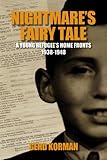
Gerd Korman. Nightmare's Fairy Tale: A Young Refugee's Home Fronts 1938-1948. Madison: University of Wisconsin Press, 2005. x + 186 pp. $19.95 (cloth), ISBN 978-0-299-21080-9.
Reviewed by Kimberly Redding (Carroll University)
Published on H-German (October, 2006)
More Than a Memoir
Nightmare's Fairy Tale recounts the coming-of-age experiences of two young Jewish brothers during World War II. Thanks to the combined efforts of their parents, the American Jewish Joint Distribution Committee, distant relatives and others, Gerd Korman and his brother Manfred became stateless refugees--not camp inmates--after being expelled from Germany in 1938. Sent via Kindertransport to England, the boys spent the war years struggling to preserve their cultural, familial and religious identity, before being reunited with their parents in New York City. This account is more than a thoughtful memoir by one of the relatively few child survivors of the Holocaust. The book stands out from a growing body of survivor narratives because Korman, professor emeritus of American history at Cornell, interweaves a compelling story with astute observations on memory and collective identity. The author situates his childhood experiences within multiple historiographical traditions, thereby creating a work with both general and scholarly appeal.
The book has four sections, the first of which focuses on the geography of memory. Having "made it" in American society, Korman--like many an immigrant before him--revisits sites of remembrance from his early childhood, at once experiencing and analyzing his own sometimes visceral reactions to long-lost people, places and events. Through this reflective travelogue, Korman also explores the long-lasting repercussions of trauma, the malleable nature of both memory and identity and--perhaps of particular interest to historians of Germany--the evolving nature of public memorials.
Parts 2 and 3 follow a more conventional memoir format. Korman delves only lightly into his earliest years, thereby drawing attention to the year 1938, when he and his family were expelled from their home in Hamburg to Zbaszyn, Poland. Relying not only on his own memories, but also letters, journal entries and conversations with family members, Korman reconstructs both his own experiences and those of his father (interned in Westerbork) and mother (who immigrated to New York City) through the family's reunification in the mid-1940s. Central themes echo those found in other works on the history of youth, particularly those dealing with youth in wartime. For example, Korman places considerable emphasis on the responsibilities that fell to him as the eldest of the two brothers and describes the magnified importance of cultural traditions during times of sociopolitical upheaval. Students of World War II will also recognize the stubborn, yet understandable silences that separated parents and children in the postwar era.
Korman's considerable experience as a professional historian is particularly apparent when he confronts the occasional dearth of reliable information. He forthrightly acknowledges gaps in his memory and sources and allows the narrative to be guided by the not always chronological thread of memory, as opposed to a structure dictated by political or military history. Korman also recognizes that, although his perspective is uniquely shaped by antisemitism and the Holocaust, he nonetheless shares much in common with millions of non-Jewish immigrants who have sought refuge and opportunity in the United States.
The conclusion of the book returns to a more analytical consideration of memory and identity. Korman suggests that the reunification of his family, along with the public airing of a radio play based on their wartime experience, marked the "end of the beginning." Like others of his generation--Jewish or otherwise--he looked to the future, striving for "normalcy" and the mantle of the successful immigrant, before turning to reconsider the events of his childhood. A brief epilogue further contextualizes Korman's narrative by situating it within a historiographical overview of Holocaust scholarship on both sides of the Atlantic.
Among a growing number of memoirs written by the WWII generation, Korman's book stands out as a bridge between genres. He understands himself at once as a Zionist Jew, a member of a broader (international) cohort of youth displaced by war and one of countless refugees seeking better lives in safer environs. As a historian, Korman uses his own youth to explore mid-century urban subcultures and reflect on issues of collective memory and identity. Undergraduates will undoubtedly be drawn in by Korman's ability to recreate the actions and emotions of a youth coming of age in turbulent surroundings, while more advanced audiences will appreciate the scaffolding of more theoretical questions on which this story is constructed. By simultaneously explaining, analyzing and contextualizing his own experiences, Korman offers an accessible, thoughtful work that defies pigeonholing as either personal narrative or professional history. Nightmare's Fairy Tale, it turns out, is both.
If there is additional discussion of this review, you may access it through the network, at: https://networks.h-net.org/h-german.
Citation:
Kimberly Redding. Review of Korman, Gerd, Nightmare's Fairy Tale: A Young Refugee's Home Fronts 1938-1948.
H-German, H-Net Reviews.
October, 2006.
URL: http://www.h-net.org/reviews/showrev.php?id=12393
Copyright © 2006 by H-Net, all rights reserved. H-Net permits the redistribution and reprinting of this work for nonprofit, educational purposes, with full and accurate attribution to the author, web location, date of publication, originating list, and H-Net: Humanities & Social Sciences Online. For any other proposed use, contact the Reviews editorial staff at hbooks@mail.h-net.org.

