



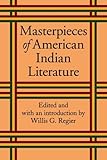
Willis G. Regier. Masterpieces of American Indian Literature. Lincoln: University of Nebraska Press, 2005. xv + 623 pp. $17.95 (paper), ISBN 978-0-8032-8997-0.
Reviewed by Elizabeth Archuleta (Department of English, University of New Mexico)
Published on H-AmIndian (October, 2006)
"Masterpieces" or Works of Political and Social Significance?
In Masterpieces of American Indian Literature, Willis G. Regier brings together five important American Indian texts from the late nineteenth and early twentieth centuries. His anthology includes the complete and unabridged texts of well-known figures George Copway, Charles Eastman, Zitkala-Sa, Mourning Dove, and Black Elk. He opens the anthology with a succinct biographical and contextualizing introduction for each writer. The works the anthology offers consist of Copway's The Life of Kah-ge-ga-gah-bowh (1847), Eastman's The Soul of the Indian (1911), Zitkala-Sa's American Indian Stories (1921), Mourning Dove's Coyote Stories (1934), and Black Elk's Black Elk Speaks (1932). At the end, he includes a "further reading" section that provides a brief list of primary and secondary materials for each writer beyond those that form the anthology. Additionally, he provides the names of four research centers that house American Indian materials. While Regier's stated purpose is "to restore balance and perspective" with this anthology, he also states that "it is meant to begin a library, not complete one" (p. vii). The anthology's significance lies in this act of having brought together several early important texts.
This anthology would be most useful in an introductory classroom. The anthology's five texts concentrate on a specific time period and all present particular issues that would allow instructors to easily shape the class in several ways. One could arrange the class by contextualizing the anthology selections through significant historical events that influenced and shaped one or more of the authors, such as the Wounded Knee Massacre; the boarding school experience; the United States expanded westward movement, which resulted in the displacement and dispossession of large numbers of tribes; the end of the treaty making period; the professionalization of anthropology, which led to numerous "as-told-to" American Indian autobiographies collected and edited by ethnographers, and the theft of human remains and cultural products by anthropologists and ethnographers; and the ethics of academic research methods and practices that have relied on American Indians as objects of study.
Likewise, fruitful discussions based on the readings could be centered on issues in which current American Indian studies scholarship has furthered readers' knowledge about and understanding of American Indians as well as the authors in the anthology. Some of the issues that we find if we read between the lines of Eastman, Zitkala-Sa, or Black Elk, for example, include either the effects of historical trauma brought on by massacres, the consequences of physical and sexual violence that took place in boarding schools, as well as the shock of being removed from one's home and seeing one's former way of life irrevocably change due to assimilationist efforts designed to incorporate American Indians into mainstream culture. Tribes also felt the loss of sovereignty after the United States ceased making treaties with tribes and the sting of being more fully perceived as "domestic dependents" than in the past. Seeing the loss of power and cultural heritage, all of the authors in Masterpieces of American Indian Literature wrote down or narrated stories about ways of life they felt were vanishing. Their stories were also meant to validate and honor worldviews and lifeways that mainstream Americans deemed "primitive" or "uncivilized." Each of the authors relate stories written during a time of great change for American Indians, which often resulted in what many scholars talk about as fractured identities or lives lived on the margins of white and American Indian cultures. Yet, such claims deny the power and influence each of these figures yielded then and now.
While the texts are important and deserve to be placed together in one book, Regier's very brief preface and introduction leave little for the novice in this subject area to understand the larger and more important issues that underlie the texts' production. Therefore, there is a chance that uninformed readers would leave the anthology with romanticized ideas about American Indians long stereotyped in popular culture, or they would perceive American Indians as merely tragic victims, not realizing the important political work in which some of these authors engaged. On the other hand, one could perceive this apparent weakness as one of the anthology's strengths. Little editorial intrusion leaves readers or teachers with the responsibility of learning more on their own. There is much to be said for students becoming actively involved with texts through outside research rather than remaining passively engaged as a reader, and Regier's introductory headnotes provide starting points for students to begin further research.
If Regier's stated purpose to begin a library is also the aim of his readers, then, in this he has succeeded. However, his anthology leaves one important question unanswered: by defining these works as "masterpieces," do we risk the chance of neglecting work not yet categorized in the same way? Scholars of American Indian literatures have tried to avoid creating a canon, and recent efforts to research and write on little-known or neglected authors are apparent in conference calls for papers. Our responsibility as scholars to ask and answer such questions is necessary if we are to engage and challenge Western ways of producing knowledge, and Regier's anthology presents us with an opportunity to do this.
If there is additional discussion of this review, you may access it through the network, at: https://networks.h-net.org/h-amindian.
Citation:
Elizabeth Archuleta. Review of Regier, Willis G., Masterpieces of American Indian Literature.
H-AmIndian, H-Net Reviews.
October, 2006.
URL: http://www.h-net.org/reviews/showrev.php?id=12367
Copyright © 2006 by H-Net, all rights reserved. H-Net permits the redistribution and reprinting of this work for nonprofit, educational purposes, with full and accurate attribution to the author, web location, date of publication, originating list, and H-Net: Humanities & Social Sciences Online. For any other proposed use, contact the Reviews editorial staff at hbooks@mail.h-net.org.

