

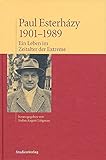
Stefan A. Lütgenau. Paul Esterházy 1901-1989: Ein Leben im Zeitalter der Extreme. Innsbruck: StudienVerlag, 2005. 196 S. EUR 19.00 (cloth), ISBN 978-3-7065-4127-5.
Reviewed by Katherine Arens (Department of Germanic Studies, University of Texas at Austin)
Published on H-German (September, 2006)
An Estate and a Life
The subject of this volume is Pál (Paul Maria Aloys Anton) Esterházy de Galantha (1901-89), Hungarian magnate and last ruling prince and heir to eminent, but now lapsed, titles of the Austro-Hungarian Empire. That story is, however, mainly the legal history of the estates accompanying those titles, whose legacy is Esterházy's own. Five contributors each take on a stage of Esterházy's life as it intersected with the great movements in twentieth-century history. We see a picture of an often nondescript man who worked to preserve a legacy, not necessarily for his own sake, but in a sense of stewardship for the historical destiny of great landholding families. In his actions and against the backdrop of events, we see how that stewardship forced changes of identity on someone who unmistakably retained a sense of mission and self as he continued to serve his estates with dignity. The results of his labors are visible today in the shape of a corporate trust holding Burg Forchtenstein and its treasures, as well as other enterprises and properties in the Burgenland and Schloss Esterházy in Eisenstadt, which are now preserved for the good of all concerned parties (for more details, see < http://www.esterhazy.at/de >).
The story told is principally legal history rather than personal history; the book's subtitle refers to Eric Hobsbawm's description of the twentieth century. Stefan August Lütgenau (who also edited the volume), Peter Haber, Lászlo Karsai and Jenö Gergely each offer part of that legal history as a key to the fate of an individual who, while not a public figure in the ordinary sense, nevertheless stepped up to his responsibilities, as his family had done since the seventeenth century. Esterházy saw the bulk of his inheritance intact through the end of the Habsburg monarchy, the end of the First World War, Béla Kun's and Horthy's regimes in Hungary, the German occupation of Hungary, Stalinist repression and the 1956 Revolution, which brought him into exile in Switzerland. He was the architect of the eventual legal protection of a legacy which no longer belonged to a single family.
Lütgenau's first chapter is a brief, five-page overview of Esterházy's biography. Thereafter, he fills in the history of Burgenland's Jewish population, whose fate had been intertwined with this family since the seventeenth century, when they were offered refuge. His third contribution addresses this population in the Nazi era. Esterházy had kept Hungarian citizenship after World War I, as his dealings with family holdings split between Burgenland and Hungary began in earnest, marking a new era in his work. Despite his preference for a low political profile (he never took the seat in the Hungarian House of Lords to which he was entitled, for example), he was naturally an object of interest to the National Socialists as their occupied regions were cleared of their Jewish populations and plans for Hungarian expatriations were made. Ultimately, Esterházy had to deal not only with the Nazis, but also with the Hungarian successor state and with postwar Austria, a valuable pawn in the geopolitics of Central Europe.
Haber fills in the Nazi era story of Esterházy and his holdings. Most notably, during the war, he offered the Swiss Embassy in Buda the use of his palace, which enabled them to keep up operations issuing passports that saved a number of Hungary's Jewish citizens. Yet his motivations were not clear--he was no Wallenberg using his status for particular ends. Karsai traces the region's deportations, adding detail about the era's even more confused legal negotiations. Perhaps the most interesting chapter is Gergely's discussion of Esterházy's role in the show trial of József Mindszenty, one-time archbishop of Ezstergom (a family dependency). The prince was arrested in 1949 as part of this investigation, then tried and sentenced to fifteen years' prison for foreign currency violations. He was granted early release during the 1956 rising. By that time a ruined man, he avoided publicity.
Lütgenau returns to write the last chapter of this story, discussing the Esterházy holdings in Austria after 1945. 44,000 hectares of Burgenland had been part of a family trust, repeatedly threatened with "land reform" and expropriation. When Esterházy fled to Switzerland after his release, he began to lose a propaganda war and hopes for reclamation. He was the target of an Austrian government media campaign in the 1960s because it was unwilling to return that much land to a single family. A small parcel was reinstated in 1962 (p. 174). By the 1990s, the mechanism of a public trust rescued a large section of the Esterházy properties intact, for the good of the family and the public alike.
The consistent theme tying these chapters together is the legal history of land ownership. Critical moments in law-making reveal the motivations and planning of the various governments involved--the nuts and bolts of practical politics--and show how state interests interfere with individual rights, history and cultural heritage. Against this background, Esterházy may or may not be credited with actual acts of resistance. A truer assessment might be that this is a many-chaptered saga of a high-profile individual who dealt with politics principally by trying whenever possible to move below the official radar and to avoid making waves. He was perhaps opportunistic in any help he offered to the outside; he did not exchange property for lives, but sought instead to keep his family legacy intact. Esterházy did not manage to remain private in this "age of extremes," but he did bring his legacy through and return it to Austria as cultural patrimony, albeit in a form marked with his family's legacy.
The volume is not perfect, in no small measure because of what is left out: personal contacts, more disclosure of the extended Esterházy networks and sketching of other players in the trusts and corporations (who were the lawyers involved?) and comparisons to parallel cases of property nationalized and reclaimed. The Habsburg family fortune, also held in a family trust, was being manipulated by governments during the same time, for example, and any parallels would have been particularly revealing of Austrian politics in the 1960s.
Nonetheless, this is an altogether fascinating book, less a personal biography than the story of an aristocratic disposition and its associated mission. It is worthwhile reading for legal history, and shows how law-making and its implementation in eras of national realignment need to be scrutinized. As a moral parable, it shows that "legal" and "illegal" are malleable terms in times of trouble.
If there is additional discussion of this review, you may access it through the network, at: https://networks.h-net.org/h-german.
Citation:
Katherine Arens. Review of Lütgenau, Stefan A., Paul Esterházy 1901-1989: Ein Leben im Zeitalter der Extreme.
H-German, H-Net Reviews.
September, 2006.
URL: http://www.h-net.org/reviews/showrev.php?id=12226
Copyright © 2006 by H-Net, all rights reserved. H-Net permits the redistribution and reprinting of this work for nonprofit, educational purposes, with full and accurate attribution to the author, web location, date of publication, originating list, and H-Net: Humanities & Social Sciences Online. For any other proposed use, contact the Reviews editorial staff at hbooks@mail.h-net.org.

