



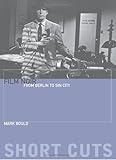
Mark Bould. Film Noir: From Berlin to Sin City. London and New York: Wallflower Press, 2005. 144 pp. $20.00 (paper), ISBN 978-1-904764-50-2.
Reviewed by Cary Nathenson (Northwestern University, School of Continuing Studies)
Published on H-German (September, 2006)
Noir Among Us: Everywhere!
Film Noir opens with a brash gesture. A paragraph-long "Note on Terminology" considers the distinctions among narrative systems built on determinism, causality, fatalism and predictability. This dense and clever half-page, it turns out, is less an academic "note" than a teaser. "The point of all this will become clear," reads the last sentence (p. i). As befits a book on film studies, Mark Bould has chosen to open with a trailer rather than a traditional preface. And herein lie the fundamental strengths and weaknesses of this study. It is witty and challenging, but its purpose is vague and its arguments more coy than conclusive. In the end, the "point of all this" does not become much clearer at all, though the reader is no worse for having read on.
The series in which this book appears exists ostensibly to provide introductory works to "the full spectrum of Film Studies," according to the publisher's blurb on the back cover. Thus, the book's sub-title, "From Berlin to Sin City," makes sense if one expects a survey of the genre from its (arguable) roots in German expressionism through to contemporary, "neo-noir" films like Sin City (2005). And Bould does deliver most of the elements of such an introduction: a discussion of what "noir" is, is not and might mean, a review of the various and international influences and a closing chapter on noir's afterlife.
Still, Bould has not crafted a traditional introduction to a genre or movement. Starting with his cryptically entertaining opening statement, Film Noir interweaves a discussion of determinism and narrative strategy; other sub-plots, such as gender identity, make cameo appearances later in the book. The text is peppered with bits of narrative theory, such as when a section that seems to be about the American road movie takes an abrupt turn in order to contrast determinism with cause-and-effect (p. 58f). Rather than complementing and expanding a novice's exposure to noir, however, these moments tend to distract and confuse. The reader who wants a more theoretical approach to the genre will be no more satisfied, as Bould abandons these discussions as fast as he starts them, leaving behind dense and interesting but ultimately orphaned sentences. It might have been more fruitful to build an introductory text around a theoretical core. As it is, the theory floats awkwardly on the surface of very general comments and lengthy plot summaries.
German Studies scholars will no doubt mainly be interested in the chapter on early noir and Weimar cinema. Here, Bould is competent but not engaging. The review of Weimar expressionism is very brief, only ten pages, and the material has been well covered elsewhere. Bould really does not leave himself much room to make a thorough argument that noir derives, at least in part, from the German Strassenfilm and other dark portrayals of the Weimar cityscape. Bould claims that in the exiled Fritz Lang's Scarlet Street (1945), one can see Weimar film meeting the American crime story, revealing a "palimpsest" of film noir in the making (p. 32f). But while commonalities between the two genres and periods abound, Bould seems uninterested in the important differences between, for example, postwar (the first one) German society and the postwar (the second one) American context, two very different places that produced very different films.
Bould is consistent in this way. He claims for noir myriad influences and definitions, styles, plots and themes. His reluctance to label film noir narrowly is a useful instinct. Bould goes too far in the other direction, however, and leaves noir so indistinct as to be an almost meaningless category. The absence of a clear direction for this study is apparent again here. Had Bould exploited a crisper focus and more forthright objectives, I suspect, we would have benefited from his wit and insight more fully.
If there is additional discussion of this review, you may access it through the network, at: https://networks.h-net.org/h-german.
Citation:
Cary Nathenson. Review of Bould, Mark, Film Noir: From Berlin to Sin City.
H-German, H-Net Reviews.
September, 2006.
URL: http://www.h-net.org/reviews/showrev.php?id=12220
Copyright © 2006 by H-Net, all rights reserved. H-Net permits the redistribution and reprinting of this work for nonprofit, educational purposes, with full and accurate attribution to the author, web location, date of publication, originating list, and H-Net: Humanities & Social Sciences Online. For any other proposed use, contact the Reviews editorial staff at hbooks@mail.h-net.org.

