



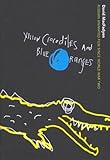
David MacFadyen. Yellow Crocodiles and Blue Oranges: Russian Animated Films since World War Two. Montreal and Kingston: McGill-Queen's University Press, 2005. xx + 256 pp. $75.00 (cloth), ISBN 978-0-7735-2871-0.
Reviewed by Denise J. Youngblood (Department of History, University of Vermont)
Published on H-Russia (September, 2006)
"Emotional" Art in a Socialist Society, Part V
Since 2001, David MacFadyen has achieved an enviable publishing record with McGill-Queens University Press. Yellow Crocodiles and Blue Oranges is the fifth title in a series of scholarly monographs exploring "emotion" as an analytical construct for Russian and Soviet popular culture, following Red Stars: Personality and the Soviet Popular Song, 1955-1991(2001), Songs for Fat People: Affect, Emotion, and Celebrity in the Russian Popular Song, 1900-1955 (2002), Estrada?!: Grand Narratives and the Philosophy of the Russian Popular Song since Perestroika (2002), and The Sad Comedy of El'dar Riazanov (2004). In this volume, he turns his attention to Soviet and post-Soviet animation, traditionally viewed as the weakest aspect of the storied Soviet film industry. (Soviet animation's most famous icon is the big-headed, big-eared furry Cheburashka, now world-famous since it was adopted by the Russian Olympic team in Athens as their mascot.) Given that this is the first book in English devoted to any aspect of Soviet animation, it bears the weight of high expectations.
MacFadyen's approach to the material is theoretical and philosophical, rather than historical or critical. Although the subtitle suggests that the book might be a survey of Russian animation over the past sixty years, it is not, nor is it, as a jacket blurb claims, "a key reference text for university courses in Russian film studies and animation courses in general." On the contrary, Yellow Crocodiles is an extremely difficult text that requires a highly specialized reader, one who is not only well acquainted with the vast literature on Soviet culture, the Soviet film industry, and Soviet cultural politics, but is also well versed in phenomenology and other "-ologies" and "-isms." The author seeks to apply phenomenological principles to Soviet animation to demonstrate that it was an emotional art that operated largely outside political constraints.
The book is divided into three sections. Part 1, "The Philosophy and Socialist Status of the Animated Epoché," discusses the similarities that MacFadyen sees in Husserl's and Marxism's "dialectical essence," an essence "that reduces our view(s) of subjectivity in order that we understand inter-subjectivity" (p. 12). He then moves on to a detailed analysis of the reception of Husserl's, Heidegger's, and Sartre's ideas in the USSR. Part 2, "The Provenance of Animated Phenomenology," is multifaceted: an idiosyncratic attempt to provide a historical overview; a review of Soviet critiques of their own animation; and an exploration of the influence of Disney Studio cartoons on their Soviet counterparts. In the final section, "Journalism and the Vox Populi," MacFadyen turns to the dynamics of reception and cultural change, primarily in the post-Soviet period. In this final section, which is more concrete than the two preceding it, readers who have never seen a Russian cartoon can visualize it as entertainment that was fantastical, humorous, and fun.
The chief strength of this book is MacFadyen's effort to bring new theoretical and analytical paradigms to bear on the study of Soviet cinema, which has heretofore been dominated by historical, socio-political, and literary approaches. In this sense it is pathbreaking. As an "old school" socio-cultural historian, I must admit that I found much of Yellow Crocodiles to be close to incomprehensible. To a certain extent, this reflects a wholly natural generational shift, as a new cohort of intellectual revolutionaries moves to the forefront of film scholarship. My confusion also, however, results from the stream-of-consciousness abstraction that characterizes the book's organization and prose style, apart from occasional forays into alliterative whimsy. This passage, referring to the disarray in the film industries as the USSR came to an end, is comparatively clear:
"This state of liberation, of dissolving or dissipation, it was felt, had begun many years ago, thus making the supposedly monumental, wholly political changes of perestroika less eventful, if not meaningless. Changes of equal consequence had taken place long ago in the field, within its 'emotional stimulators' and prompted the development of films that were now based upon investigations of post-dogmatic social 'experience or sympathy.' The 'No' of politics had become the socializing 'Yes' of a centrifugal non-judgmental art form" (p. 96).
I do not disagree with what I assume to be the meaning of these lines (although the idea that perestroika was "meaningless" or even "wholly political" is farfetched). Over the past three decades, the strict political determinism that dominated the study of Soviet history and culture from the mid-forties to the mid-seventies has been decisively rejected. Nor do I disagree with what I take to be MacFadyen's major conclusions: that Soviet animation was no more and no less constrained by the authoritarian state than was any other aspect of Soviet cinema--and that it did not develop sui generis. (After all, the inostranshchina [foreign influence] has been both the blessing and bane of Russian cinema since 1896.) Therefore, Yellow Crocodiles must be counted as an addition to the growing body of critical and historical work that demonstrates the range of possibilities for cinematic expression in the darkest hours of the Stalin era or the dullest years of the Stagnation.
But I would like to suggest that MacFadyen's rhetorical style, which seems to have become the norm in cultural studies, obfuscates (rather than reveals) his knowledge of the subject and his novel ideas about interpretation. In my view, this mode of presentation renders Yellow Crocodiles a much less significant work than it might have been. As a result, this book will be of primary relevance to specialists in the theory and philosophy of cultural production and reception, rather than the much broader audience of Russianists and cinephiles that the first English-language study of Soviet animation deserves.
If there is additional discussion of this review, you may access it through the network, at: https://networks.h-net.org/h-russia.
Citation:
Denise J. Youngblood. Review of MacFadyen, David, Yellow Crocodiles and Blue Oranges: Russian Animated Films since World War Two.
H-Russia, H-Net Reviews.
September, 2006.
URL: http://www.h-net.org/reviews/showrev.php?id=12217
Copyright © 2006 by H-Net, all rights reserved. H-Net permits the redistribution and reprinting of this work for nonprofit, educational purposes, with full and accurate attribution to the author, web location, date of publication, originating list, and H-Net: Humanities & Social Sciences Online. For any other proposed use, contact the Reviews editorial staff at hbooks@mail.h-net.org.

