



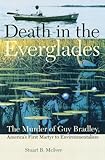
Stuart B. McIver. Death in the Everglades: The Murder of Guy Bradley, America's First Martyr to Environmentalism. Gainesville: University Press of Florida, 2003. xviii + 187 pp. $24.95 (cloth), ISBN 978-0-8130-2671-8.
Reviewed by Jeanine A. Clark Bremer (Department of History, Northern Illinois University)
Published on H-Florida (September, 2006)
Frontier, Feathers, and a Feud
Stuart McIver takes on a rather large task in this deceptively small book. Death in the Everglades: The Murder of Guy Bradley, America's First Martyr to Environmentalism is a descriptive narrative of not only the life of Guy Bradley but also the ramifications of living during a precarious juncture in American history. The text tells of the intersection of Gilded Age consumer consumption, Progressive Era idealism, and frontier living in Flamingo, Florida. Because of this unique crossroads, McIver covers everything from weapons, fashions, and ornithology, to the origins of the Audubon Society as well as the basics of frontier living. In addition, he introduces the reader to early Florida politics.
For someone familiar with the period and the location, following McIver's piece would not prove difficult. For the individual who is just journeying into this topic, it might prove a little dense. McIver writes about so much more than just an environmentally conscious individual. He writes a great deal about Florida history and incorporates many different people throughout the book. The opening introduces the reader to high fashion in New York City (p. 2), which sets the stage for understanding the expansion of and the need to halt plume hunting. However, also covered are interesting chapters on the evolution of the Barefoot Mailman (chapter 5) and the introduction of Henry Flagler's regional influence due to his railroad. To one not familiar with this juxtaposition of locomotive technology and barefoot deliveries not uncommon within this region, tying all of it together may become a bit confusing as one tries to determine how one chapter leads into the next. This is but a miniscule issue in this intricately laid-out text. McIver does bring it to a close brilliantly in his final chapters and the picture is complete for the novice and the expert.
Using myriad sources, McIver delivers all of the pertinent aspects surrounding the environmental issue at hand: how to stop the extinction of birds for the millinery trade. The root causes, hat ornamentation as well as being a fairly lucrative means to support a family in Flamingo, are fully explored and discussed and are sufficiently balanced so that the reader comprehends that more was at play than just conspicuous consumption. The first step towards protection, "An Act for the Protection of Birds and Their Nests and Eggs, and Prescribing a Penalty for any Violation Thereof" passed in 1901 through remarkable lobbying on behalf of the Audubon Society and the support of Senator Harris. The act, while a good start, failed to provide for any means of law enforcement. Thus enters Abbott Thayer, the wildlife painter, who donated funds to employ a game warden through the Florida chapter of the Audubon Society (pp. 110-112). A complex system was set up that allowed Bradley to be paid through Audubon and deputized in Key West to permit him to make arrests. Bradley was named game warden and deputy sheriff in June 1902 (pp. 113-114).
Bradley spent approximately three years as game warden and deputy sheriff before his fateful meeting with Walter Smith (p. 155). His approach to the position included visiting rookeries, posting signs, arresting plume poachers, and delivering talks to the locals about the preservation laws and the reasons for saving the birds. When Bradley's reappointment came about, he encountered opposition by Smith who had strong political allies in Key West. Smith argued that he would protect the famous Cuthbert Rookery better than Bradley, but failed to usurp the position due to it being an appointment made by the governor on the advice of Audubon and not a decision made by the politicos in Key West (p. 145). It was this very rookery that brought about Bradley's demise. In the winter of 1904, the rookery was completely decimated by hunters and Smith accused Bradley of taking a payoff and allowing the atrocity to occur (p. 140). This feather and blood bonanza added to a growing family feud between Walter Smith and Steve Roberts, as Smith's claim implicated Roberts as the hunter who paid off Bradley. No arrests were made and Bradley was found to be innocent; but the flames of hatred were smoldering (p. 141). In the spring of 1905, Smith's home was fired upon and he firmly believed that it was Roberts and declared that Roberts's family and close friends, including Bradley, were blood enemies (p. 151).
On July 8, 1905, Smith and his boys were out shooting in the rookery at Oyster Keys, which was about two miles out from Bradley's house. In accordance with the law, Bradley went out to stop the Smiths. Words ensued, Bradley wanted to arrest Smith's son who was carrying dead cormorants, and Smith refused to relinquish the boy. Smith also refused to put down his gun on the grounds that he believed Bradley was present when Roberts shot out Smith's home and he felt he needed to protect himself. A brief gun fight ensued, resulting in Bradley's death. Smith turned himself in for murdering him (pp. 152-153). In an interesting display of politics, the grand jury returned a verdict of "no true bill" on December 8, 1905, and Smith was freed (p. 160). Bradley was the first warden to be murdered, but would not be the last warden to meet that fate in Monroe County.
One cannot help but think about Frederick Jackson Turner's 1893 thesis when reading McIver's book. The idea of isolated pockets of frontier cannot be ignored with regards to Flamingo, nor can the obvious issues faced in this area when it comes into contact with settled America. Guy Bradley was definitely a martyr for environmentalism, but the Plume Wars located in frontier Florida, accompanied by family feuds, also lend to the rich story of what was Guy Bradley's life. Frontiersman and feather hunter turned game warden, Bradley died in the line of duty and serves as a reminder to all of the multifaceted issues surrounding any environmental cause.
If there is additional discussion of this review, you may access it through the network, at: https://networks.h-net.org/h-florida.
Citation:
Jeanine A. Clark Bremer. Review of McIver, Stuart B., Death in the Everglades: The Murder of Guy Bradley, America's First Martyr to Environmentalism.
H-Florida, H-Net Reviews.
September, 2006.
URL: http://www.h-net.org/reviews/showrev.php?id=12212
Copyright © 2006 by H-Net, all rights reserved. H-Net permits the redistribution and reprinting of this work for nonprofit, educational purposes, with full and accurate attribution to the author, web location, date of publication, originating list, and H-Net: Humanities & Social Sciences Online. For any other proposed use, contact the Reviews editorial staff at hbooks@mail.h-net.org.

