



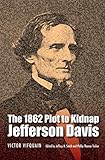
Victor Vifquain. The 1862 Plot to Kidnap Jefferson Davis. Lincoln: University of Nebraska Press, 2005. xxxiv + 198 pp. $22.00 (paper), ISBN 978-0-8032-9630-5.
Reviewed by Lewie Reece (Anderson College)
Published on H-CivWar (September, 2006)
The Four Musketeers in the Confederacy
The personal narrative remains one of the more important resources for understanding the Civil War as experienced by individuals. Even some one hundred and forty years after the war, new works appear to give added dimension to what the war was like for a diverse group of individuals. The quality of these narratives can vary considerably, but they do represent an attempt to describe in witnesses' own words what the war meant to them. As most personal narratives were written after the guns had grown silent, they also were part of an effort for veterans to remember and bear witness.
Victor Vifquain, the author of The 1862 Plot to Kidnap Jefferson Davis, had a long and colorful life. Born in Belgium of French parents, his family lived for a time in Louisiana and Missouri, before Vifquain made his own home in Nebraska. As Jeffrey Smith suggests in the introduction, Vifquain's Civil War experiences were but part of a full life: pioneer, newspaper editor, Democratic politician, advocate of Irish independence, and finally soldier in the Spanish-American War. Nevertheless, it was the Civil War years that stayed with Vifquain, and in 1901 he wrote a memoir of his wartime experience. Vifquain's memoir remained in his family's hands and only now has it been published by the University of Nebraska Press.
Vifquain's purpose in composing his memoir is understandable, an old man wishing to remember lost friends. But his narrative is a bit confusing. His account makes it appear that a young French immigrant composed the story from notes provided by Vifquain. Equally confusing is Vifquain's decision to write the story as though composing a novel. Moreover, Vifquain refers to the participants not by their actual names, but by the characters in Alexandre Dumas' Three Musketeers--Athos (Alfred Cipriani), Aramis (Maurice de Beaumont), Porthos (Armond Duclos), and D'Artagnan (Vifquain).
The story told by Vifquain recounts the four men's attempt to capture President Jefferson Davis in the spring of 1862. All four were French immigrants who served in the 53rd New York. When their unit was disbanded the four resolved to attempt to capture Davis, hoping to bring the war to a speedier conclusion. Vifquain's story is what happened to them along the way, their travels to Richmond, their attempts to seize Davis, and finally their return to Union Army lines. Their plan for Davis' capture was always problematic at best, as plans dependent on a series of contingencies easily fail. For Civil War historians what will make this work especially valuable are Vifquain's observations of Richmond in the spring of 1862. Extensive discussion provides a clear description of both Richmond's urban geography, and the public's attitude, as General George B. McClellan was gearing up for the coming offensive. While the fact that they were unable to capture Davis was not a surprise, what was remarkable about their journey was the ease with which they eluded detection. While they were briefly detained in Richmond, within a short period of time they were able to move about the city freely. Moreover, Vifquain and his companions were very quickly embraced by the upper echelons of Richmond society and became intimate with high Confederate officials.
The editors have done an excellent job preparing the manuscript for publication and have effective notes that expand on elements of Vifquain's account. Several photographs and an excellent map also help to convey the scene and their journey. In many ways, personal narratives have certain limitations, mainly being dependent on what the author wishes to share. At times this can grow frustrating as the author fails to expand on obvious points one might wish were discussed. The reader will learn little about what motivated these men as individuals, the immigrant experience in Civil War America, or even the military situation in 1862. However, this was Vifquain's story as he wished to tell it, and needs to be accepted on those terms. While historians of the Confederate South may not find all of Vifquain's account of interest, they will find information about Richmond that is quite valuable.
If there is additional discussion of this review, you may access it through the network, at: https://networks.h-net.org/h-civwar.
Citation:
Lewie Reece. Review of Vifquain, Victor, The 1862 Plot to Kidnap Jefferson Davis.
H-CivWar, H-Net Reviews.
September, 2006.
URL: http://www.h-net.org/reviews/showrev.php?id=12210
Copyright © 2006 by H-Net, all rights reserved. H-Net permits the redistribution and reprinting of this work for nonprofit, educational purposes, with full and accurate attribution to the author, web location, date of publication, originating list, and H-Net: Humanities & Social Sciences Online. For any other proposed use, contact the Reviews editorial staff at hbooks@mail.h-net.org.

