



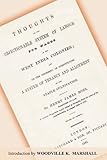
Henry James Ross. Thoughts on the Objectionable System of Labour for Wages in the West India Colonies and of the Necessity of Substituting a System of Tenancy and Allotment of the Staple Cultivation. Kingston: Ian Randle Publishers, 2005. 124 pp. $20.00 (paper), ISBN 978-976-637-226-2.
Reviewed by Rita Pemberton (Department of History, The University of the West Indies, St Augustine, Trinidad and Tobago)
Published on H-Caribbean (August, 2006)
Revisiting the Post-Emancipation Caribbean
Woodville Marshall's republication of Henry Ross's Thoughts on the Objectionable System of Labour for Wages in the West Indian Colonies is both useful and timely. Beyond its value as an important addition to the accessible pool of source material on the history of the British colonies in the Caribbean, it is also a significant resource for those scholars engaged in the discourse on plantation management.
More than simply a treatise on sharecropping, Ross's pamphlet offers insight into differences in planter responses to the post-emancipation situation. Planter reaction to emancipation has been typified as hostility to the freedom of their workers, a refusal to perceive of plantation operations without enslaved labor and an unwillingness to relinquish the vestiges of the slave system. Ross's description of his operation on Plaisance Estate in Grenada outlines a departure from the expected response of a post-emancipation planter. This pamphlet, therefore, alerts scholars to the need to pay greater attention to the issue of planter response to emancipation with a view to determining the extent to which some planters, who saw ways in which they could secure advantages, were prepared to work with the system. That Ross's system was used on a cocoa and coffee estate in Grenada increases the value of this publication, for while the existing literature on the post-emancipation Caribbean abounds with information on the experiences of sugar planters, little is known about those estates which cultivated other crops. Through Ross's descriptions, we are privileged to have some glimpses into the development of other plantation crops on those estates which found sugar to be no longer viable. Hence we are reminded of the need to pay attention to the evolution of those societies where sugar cultivation was not the dominant activity. In addition, Ross's treatise provides important information on the post-emancipation situation in Grenada. Marshall is to be commended for bringing this information into the academic arena because, in so doing, he has assisted in addressing the imbalance in the available historical information which is heavily biased to specific territories in the region.
Lest Ross be perceived as a liberal plantation owner, Marshall's perceptive introduction provides an assessment of the man which reveals the biases and prejudices which governed his operations. Ross was a typical planter type in his determination to maintain the distance between his superior self and that of his inferior workers, and in his conviction that he could and should manipulate his workers to ensure benefits to himself. His justification was based on his prejudiced psychoanalysis of the African. Moreover, Ross believed that he understood Africans and that they were happy with the benefits that Ross determined to be appropriate. Marshall provides a discussion of the times in which Ross was operating when there was a prevailing concern with the post-emancipation labor trauma in the region. Ross, Marshall asserts, sought to contribute to the ensuing debate and possibly influence the policy decisions on the matter. He provides readers with a detailed biography of Ross and his relations with Caribbean plantations and society; of the Plaisance estate in particular; an assessment of the content of the pamphlet; and a discussion of regional and metropolitan responses and its impact on the British Caribbean. He also provides a discussion on the manipulative strategies Ross employed to control his workers.
Ross was certainly a manager who was determined to make a profit out of his plantation in an era when plantations were recording reduced profits or even none at all. In this respect, he does not fit into the popular portrayal of the typical West Indian planter as one who rode on the tide of profitability that swept the region in the best of times only to sink into hopeless despair and desperation, begging for imperial assistance while presiding over a crumbling economic system in the worst of times. Hence one of the issues stimulated by the Ross pamphlet is that of plantation management. Researchers have given attention to this issue and have raised the importance of management, both in good and bad times. Among the topics raised are the qualities of good management. David Watts has argued that individual management styles were important factors in plantation operations, but successful management went beyond the realm of being a good planter for it also involved being a skilled manufacturer, technician and businessman who paid attention to coordination and timing.[1] Ross was undoubtedly a business man. He was concerned about reducing the costs of operation and returning a profit. He certainly was not prepared to spend any more than was absolutely necessary to produce his crops, he paid close attention to the coordination of his estate's operations and he launched his system when he perceived the time was right.
Ross also displayed other desirable qualities for effective management. Heather Cateau has argued that "change is one of the essential components of any good managerial style."[2] From his descriptions, it is clear that Ross was willing to make changes to adjust to the times in which he was operating. Moved by his determination to make his business profitable and his understanding of the psyche of his workers, Ross laid out a strategy that worked with, rather than sought to defy, the times. On the surface, his descriptions do not betray an intent to oppose freedom. Having observed the demands of free workers for land allotments and noting the willingness of the African to work for himself, he sought to function in a worker-friendly environment of sharecropping, providing workers with an element of satisfaction and management with the opportunity to escape the "evils of freedom." This meant that planters ought to redirect the "misdirected" industry of the workers to their benefit. Ross made it work for him. Thus the provision ground, generally viewed as a means to independence in the post-emancipation period, was used by Ross to formulate his system of managerial control.
As Marshal has indicated, there is a need to examine the historical development of sharecropping in the region and assess its true contribution to the development of cultivation practices associated with all the major plantation crops, metayage (a kind of sharecropping), cane farming and the contract system. In addition there is also a need to determine the extent to which the formulation of these systems was carried from the Ross experiment to other territories of the region. What is also essential is the need to determine the extent to which these systems were based on the demand by workers as occurred on the Plaisance Estate in Grenada.
Notes
[1]. David Watts, The West Indies: Patterns of Development, Culture and Environmental Change since 1492 (Cambridge: Cambridge University Press, 1987), pp. 321-322.
[2]. Heather Cateau, "Management and the Sugar Industry in the British West Indies, 1750-1810" (Ph.D. diss., The University of the West Indies, St. Augustine, Trinidad and Tobago, 1994), p. 122.
If there is additional discussion of this review, you may access it through the network, at: https://networks.h-net.org/h-caribbean.
Citation:
Rita Pemberton. Review of Ross, Henry James, Thoughts on the Objectionable System of Labour for Wages in the West India Colonies and of the Necessity of Substituting a System of Tenancy and Allotment of the Staple Cultivation.
H-Caribbean, H-Net Reviews.
August, 2006.
URL: http://www.h-net.org/reviews/showrev.php?id=12133
Copyright © 2006 by H-Net, all rights reserved. H-Net permits the redistribution and reprinting of this work for nonprofit, educational purposes, with full and accurate attribution to the author, web location, date of publication, originating list, and H-Net: Humanities & Social Sciences Online. For any other proposed use, contact the Reviews editorial staff at hbooks@mail.h-net.org.

