



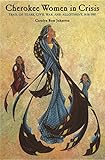
Carolyn Ross Johnston. Cherokee Women in Crisis: Trail of Tears, Civil War, and Allotment 1838-1907. Tuscaloosa: University of Alabama Press, 2003. ix + 227 pp. $53.00 (cloth), ISBN 978-0-8173-1332-6; $29.95 (paper), ISBN 978-0-8173-5056-7.
Reviewed by Christina Finley (Department of American Culture, University of Michigan)
Published on H-AmIndian (August, 2006)
Cherokee Women and Cultural Change
Carolyn Ross Johnston discusses the cultural persistence and survival of Cherokee women despite major historical disruptions to traditional Cherokee gender roles in the nineteenth century. Johnston uses the lenses of gender and indigeneity to view the ways Cherokees negotiated radical changes to their social structures caused by displacement, an approach that sheds new light on the gendered effects the westward expansion of the United States had on the Cherokee Nation. She writes, "By analyzing three major crises--removal, the Civil War, and allotment--one is able to better understand how and why [Cherokee] gender systems change in a culture in which women and men have different work, ritual space, and ceremonies" (p. 3). Johnston also shows how Cherokee gender systems were not based on equality, like Western feminist thought, but rather on balance and complementary gender roles between Cherokee women and men. These gender roles were radically altered through the intrusion and adaptation of slavery, patriarchy, missionaries, displacement, and class hierarchies within the Cherokee Nation.
In part 1, "Crisis of Gender," Johnston provides examples of the ways leadership shifted away from matrilocal kinship ties to formalized patriarchal structures solidified in a new articulation of the Cherokee Nation. Johnston gives a gendered articulation of the Trail of Tears and offers a different perspective on the struggles and negotiations Cherokee women and men had to make to survive the treacherous passage to Indian Territory. In part 2, "Crisis of the Civil War and Reconstruction," Johnston reveals the impact of the Civil War and African-American slavery within the Cherokee Nation. She discusses how elite Cherokee women relied upon the enslavement of black women and men, who might also be Cherokee, to maintain their class and gender position. Johnston's account also tells of the devastating consequences and loss of lives caused by the Civil War that are not usually included in other historical narratives on the Civil War or the Reconstruction time periods. Part 3, "Crisis of Allotment," shows how Cherokee women negotiated further cultural disruptions as a result of the encroachment of their lands by the U.S. government.
Chronologically, Johnston's Cherokee Women in Crisis takes up where Theda Perdue's historical narrative, Cherokee Women: Gender and Culture Change, 1700-1835 (1998), leaves off in 1835. Carolyn Ross Johnston does not create a tragic and victimizing Cherokee historical narrative. Instead, she uses the history of Cherokee women as leaders, who were deeply involved in the politics of the Cherokee Nation, to support the trend towards Cherokee women, such as Wilma Mankiller and Joyce Dugan, occupying leadership positions within different Cherokee Nations. Johnston's work is a valuable contribution to the fields of women's history, Cherokee women's history, and Native studies; and it is accessible to those with little background knowledge of Cherokee women's history.
If there is additional discussion of this review, you may access it through the network, at: https://networks.h-net.org/h-amindian.
Citation:
Christina Finley. Review of Johnston, Carolyn Ross, Cherokee Women in Crisis: Trail of Tears, Civil War, and Allotment 1838-1907.
H-AmIndian, H-Net Reviews.
August, 2006.
URL: http://www.h-net.org/reviews/showrev.php?id=12125
Copyright © 2006 by H-Net, all rights reserved. H-Net permits the redistribution and reprinting of this work for nonprofit, educational purposes, with full and accurate attribution to the author, web location, date of publication, originating list, and H-Net: Humanities & Social Sciences Online. For any other proposed use, contact the Reviews editorial staff at hbooks@mail.h-net.org.

