



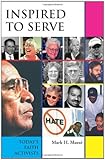
Mark H. Masse. Inspired to Serve: Today's Faith Activists. Bloomington: Indiana University Press, 2004. vii + 230 pp. $19.95 (paper), ISBN 978-0-253-21714-1.
Reviewed by Jill Gill (Department of History, Boise State University)
Published on H-1960s (August, 2006)
Faith Activists in Action
Scholars have noted that faith activists who focus upon doing good works within the broader community often do so behind the scenes without much fanfare or public notice.[1] In Inspired to Serve Mark Masse shines a rare spotlight on thirteen faith activists to illuminate lives deeply devoted to community service, rooted in advancing social justice. Masse's detailed, personal, snap-shot portraits of faith activists provide an intimate and inspiring window into the daily work of people transforming their communities into more livable, just places for the poor, marginalized, and oppressed. However, the book does little more than this. Analysis is thin and context may be too sparse for those seeking an academic treatment of the subject. The book seems targeted to a general popular audience and perhaps other faith activists rather than to religious scholars or social scientists.
This book contains twelve chapters, each focusing upon the life and work of a particular faith activist. (One chapter covers two who operate as a team.) These activists represent a variety of faith traditions (Christian, Jewish, Muslim, Buddhist), races, and genders. The foci of their work includes advocacy for oppressed groups such as farmworkers, sexual minorities, and the poor; urban ministries rooted in community development projects; and protests against government programs and practices that violate human rights. Most of the activists profiled have founded highly successful, holistic service programs and advocacy/protest groups amidst powerful resistance by business and government. Each has forged creative partnerships both with religious and secular organizations in order to fulfill service and advocacy goals.
Masse employs ethnographic methods (and what he calls "immersion journalism") to collect richly descriptive field notes of the daily chores and challenges of his profiled activists. The book gives readers the sense that they are shadowing the activists through their days while providing insights into their dispositions, successes, obstacles, motivations, shaping experiences, goals, and opposition. These lively portraits achieve Masse's goals to "personalize contemporary societal issues, to illuminate the subject of social activism, and to contribute to an enhanced understanding of its impact on the human condition" (p. 1). Their stories illustrate how individuals have tackled complex social problems as well as the costs and commitments required. They reveal the power, courage, sacrifice, and altruism that is motivated by faith values and that drives these activists to work for systemic social change.
Masse clearly admires these individuals for he highlights their heroism, perseverance, vision, hopefulness, and devotion to service. Like those that he profiles, Masse heard the compelling call to activism that galvanized young people in the 1960s, and how many religious communities like his own Catholic Church embraced action for social justice with new fervor. He seeks to show in his book, however, how faith activists have remained involved at the grassroots level since the 1960s in spite of conservative trends that have refocused some religious communities upon spiritual and pastoral nurture rather than making structural changes for social justice.
While this book will likely inspire readers with hope and reassurance that talented people of faith continue to devote their lives to others in creative, expansive, amazing ways (and provides interesting details about their work), it lacks a deep analytical, historical, or contextual framework that would make it more valuable to scholars. It also lacks theoretical content and detailed discussion of religious concepts mentioned in the book, such as "social gospel" or "liberation theology." To his credit, Masse admits that he is a nonfiction story-teller and journalist, not a religious studies scholar (p. 5), and he states accurately that this book is primarily an "anthology of narratives" (p. 6). His focus has been on crafting ones that function like movie vignettes on the written page. Scholars, however, who are seeking new academic insights and the application of these stories to larger themes and questions within the field of religious studies might be disappointed.
Masse's strengths as a journalist will make this book valuable to those who want information about movers and shakers who embody the better angels of our nature. The lives of those he profiles challenge modern-day cynicism that individuals are powerless against the daunting web of complex problems and injustices within our communities. They illustrate the wisdom of Margaret Mead's famous admonition, "Never doubt that a small group of thoughtful committed citizens can change the world. Indeed it's the only thing that ever has."
Note
[1]. See Robert Wuthnow and John H. Evans, eds., The Quiet Hand of God: Faith-Based Activism and the Public Role of Mainline Protestantism (Berkeley: University of California Press, 2002); Nancy Tatom Ammerman, Pillars of Faith: American Congregations and Their Partners (Berkeley: University of California Press, 2005).
If there is additional discussion of this review, you may access it through the network, at: https://networks.h-net.org/h-1960s.
Citation:
Jill Gill. Review of Masse, Mark H., Inspired to Serve: Today's Faith Activists.
H-1960s, H-Net Reviews.
August, 2006.
URL: http://www.h-net.org/reviews/showrev.php?id=12119
Copyright © 2006 by H-Net, all rights reserved. H-Net permits the redistribution and reprinting of this work for nonprofit, educational purposes, with full and accurate attribution to the author, web location, date of publication, originating list, and H-Net: Humanities & Social Sciences Online. For any other proposed use, contact the Reviews editorial staff at hbooks@mail.h-net.org.

