



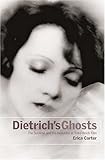
Erica Carter. Dietrich's Ghosts: The Sublime and the Beautiful in Third Reich Film. London: British Film Institute, 2004. 246 pp. $27.95 (paper), ISBN 978-0-85170-883-6.
Reviewed by Erik Tängerstad (Department of History, Gotland University [Sweden])
Published on H-German (July, 2006)
Masses into Volk
After having read Erica Carter's truly inspiring work on the sublime and the beautiful in Third Reich film, one cannot help but say that it is somewhat unfortunate that for an Englis- language audience, Zarah Leander is probably not as well known as Marlene Dietrich. "Leander's Voice" would have been a more poignant title for this book, since it is Leander, not Dietrich, who overshadows its narrative. Actually, in this study Dietrich only appears as a third epitomizing figure, after Leander and Joseph Goebbels. And as the story goes on, she seems to have escaped the entangling web of ghosts rather than being its origin.
It comes as no surprise that Goebbels saw film as part and parcel of his project to shape the specifically Nazi brand of the Volk. However, Carter deepens this picture by demonstrating that Kant's distinction of the beautiful and the sublime can be used to cast new and clarifying light on the matter. More than Kant's own writings, the emergence of neo-Kantianism during the Wilhelmine era provided a terminology that the National Socialist regime later exploited for its purposes. The sublime, that which is elevated above ordinary reality, for instance, arouses a number of associations within early-twentieth-century German-language contexts, associations that probably would not have been made in English-language contexts of the time. Carter convincingly demonstrates that words like "sublime," "genius" and "personality" can be seen as foundational to a certain discourse that cannot immediately be translated from German into English. The German Persönlichkeit, for example, loses some of its implications when translated to the English "personality." While the English "personality" predominately refers to inner qualities of discrete individuals, the German Persönlichkeit is seen rather apart from such discrete individual persons. Persönlichkeit should be seen, instead, as if finite persons are absorbed into an absolute that transcends the individual. It was a version of Persönlichkeit that, in Carter's words, became a "core concept in Nazism's reorganization of cultural discourses and practices at all levels" (p. 26).
On this special notion of "personality," Carter sets up a distinction between the stars of Hollywood and the personalities of Third Reich film. Carter points out that Goebbels apparently nursed the idea that neither societies nor nations were fixed and clear-cut entities. According to him, instead, a society or a nation would be the result of a strong and creative genius that has the power to imprint his (sic!) notion of society or nation upon masses of human beings. Carter quotes a paragraph from Goebbels' 1929 novel Michael, in which Goebbels wrote: "[T]he statesman is also an artist [since for him] the Volk is nothing more nor less than is the stone to the sculptor. Führer and mass: this is no more nor less a problem than is paint to the painter" (p. 32). This logic drew heavily on the modern cult of the genius and an idealist--but not per se Kantian!--notion of the sublime. According to this notion, only the true genius can shape the formless into form. For the sake of clarity, it should be underlined that the sublime here is to be understood as the opposite of the beautiful. There will be reason to come back to this distinction between idealist and Kantian notions of the sublime.
Carter at one and the same time points to what seems to have been Goebbels's core idea, and the basic contradiction within that idea. To Goebbels, the Volk was an "empty" concept, with no inner qualities of its own; hence the Nazis could implant their own meaning into it and thereby create their own Volk. In other words, the Nazis would design their own German people according to their own wants and needs. And just as the concept Volk was "empty," the huge masses of human beings within Central Europe was nothing else but raw matter, literally a mass to be shaped according to the will of the creator. Seen from that perspective, "the German people" of the Third Reich appear as a Nazi invention, molded upon the crude distinction of "us-and-them," "Aryans-and-Jews." If so, the contradiction within Goebbels's project was, of course, that he did not present this notion of Volk as a Nazi-made product, but instead as a natural entity that could be directly derived from biological facts. Thus the Nazis would not present themselves as the creators of the Volk, but instead as its humble servants and guides. Goebbels would then more or less consciously have played according to a set of double standards. On the one hand, he was about to construct a new notion based upon the term Volk, and on the other, he presented this innovation not as his own construct but as a natural entity that preceded any human-made construction. The self-contradictory policy founded upon this double standard was primarily put through by the use of terror and violence, supported by a bureaucratic system fueled by pseudo-intellectual jargon.
The first half of Carter's book is dedicated to a close study of how Goebbels effected this policy. According to the distinction mentioned above between the Hollywood star and the Third Reich film personality, the film actor should not be seen as an individual star, but instead as the incarnation of the "personality" of the Volk. Carter goes into detail by showing how Third Reich film stage sets were differently lit than those of Hollywood. In Hollywood film, the star was always lit so that he/she was easily recognized. In Third Reich film, on the other hand, it was the group and/or the setting that was lit. In Hollywood, film lighting was a means to promote the star, while in Third Reich, film it was an end in itself. Lighting was meant to create visual effects to be perceived according to an idea that Carter calls the "völkisch sublime." As an example of this kind of film Carter presents an analysis of Carl Froelich's comedy Traumulus (1936) with Emil Jannings in the lead role. Froelich, a prominent Third Reich film director, not only made prize-winning features like Heimat (1938)--with Zarah Leander in the lead--but was also one of the most important decision-makers within the Third Reich film industry as a whole. Carter suggests that this film exemplifies Third Reich anti-Hollywood aesthetics.
For his part, in the Third Reich Jannings re-modeled his previous Weimar and Hollywood acting style to become one of the most renowned actors of this "personality" style. In Traumulus, not only did Jannings play a bewildered schoolmaster, but Froelich's stage set and editing made this film into something like an anti-Hollywood equivalent to Sternberg's The Blue Angel (1930), in which Jannings had played a similar role against Marlene Dietrich. This example highlights the complexity of the matter. Throughout the 1930s, and even after she went to Hollywood, Dietrich remained a celebrated German movie star within the Third Reich, while Jannings, one of the best paid Third Reich film actors, paradoxically became a film "personality"--that is, a German movie anti-star/superstar. In that sense, Jannings marked both the division between Hollywood and Third Reich film, and the apex of Hollywood film within the Third Reich. This assertion amounts to a further consideration of the inner contradiction of Third Reich film. As an additional matter, Third Reich cinemas were to be built so that the audience would have the sensation of being one among many, but not so that an individual could hide in the dark. Carter demonstrates in detail (analyzing the architecture of the theatre buildings to the full-length evening program) how both modern cinema and modern cinema audiences were intended to be shaped in Germany of the 1930s. One of Goebbels's dearest projects was the establishment of a German Film Academy. That venture was actually realized in 1938-39, but because of the outbreak of war it was in effect closed down shortly after it had opened. Carter nevertheless dedicates a chapter of her book to reconstructing the layout and ideas behind this film academy.
In the second half of the book, Carter presents her main thesis. Dietrich became the surprise star of The Blue Angel, outshining Jennings, Carter argues, because her acting and her voice were publicly received as a sublime force. After she started her Hollywood career, she deliberately changed her original acting style to one more in line with a beautiful Hollywood star. In any case, her transition first to Hollywood and then to the role of a beautiful movie star left a double void to be filled in Third Reich film. Not only the actor, but also the representation of the sublime, was gone. Goebbels tried to fill this void in different ways and with different actors, but the space was not occupied until the Swedish revue star and stage diva Zarah Leander entered the German film scene around 1936-37. In particular, it was Leander's singing voice that appeared as something of a revelation to German audiences. Carter describes her "unusually rich contralto" as an "(admittedly singular) voice" (p. 182). Almost instantly, Leander's appearance pushed that of Dietrich's into the shadows. What was so special about Leander's voice? How was it possible that this non-German artist, who never exchanged her Swedish passport for a German one, remained the best-paid and most celebrated Third Reich film star--rather than film personality!--until her defection to Sweden in 1943? As a stage diva with a tremendous ego, Leander exercised a profound charisma. And her voice transcended gender boundaries. Instead of being merely beautiful, she appeared as a natural power, or in other words, her appearance was sublime.
It is precisely at this point in the argument that the distinction between the beautiful and the sublime comes into play. In his Critique of Judgment (1790), Kant formulated this distinction in the following way: "The beautiful in nature concerns the form of the object, which consists in limitation; the sublime, by contrast, is to be found in a formless object, in so far as limitlessness is represented in it, or at its instance" (here quoted following Carter, p. 203). It is important to note that the sublime is the opposite of the beautiful in the sense that the sublime is formless, while the beautiful is characterized by its perfect form. To ordinary people, the formless is not accessible, except possibly as an uncanny sensation. Only the genius has the ability to render form to the formless, thereby making it accessible to other people. Hence, the sublime stands in stark contrast to the beautiful, since ordinary people cannot grasp the formless, but they have access to the perfect form, that is, the beautiful. According to Kant, the sublime is strictly a natural phenomenon, which has to be seen apart from art. Here lies the important difference between Kant's notion of the sublime and the post-Kantian idealists' notion. Since the sublime is characterized by its formlessness, according to Kant, men cannot produce anything sublime, since everything man-made will always have some sort of form. According to Kant, in short, art cannot be sublime. Post-Kantian idealism has questioned this verdict and, as is well known, the debate on the sublime in art has never been concluded. One could also bear in mind the post-WWI discussion about whether the front experience in the trenches (the "Storm of Steel"), however man-made, could be understood as a sublime experience in the Kantian sense. It is in that context that any twentieth-century discussion on war and the sublime should be addressed.
Unfortunately, Carter does not distinguish between Kant's writings and their vast and differing receptions. She has the calamitous tendency to mix Kant's own writings on the sublime with idealist notions of the early nineteenth century, neo-Kantian interpretations of the late nineteenth and early twentieth centuries, and the post-WWI re-examination of Kant's philosophy. And when she addresses the theme of war and the sublime--which is crucial to her study--she misses the point and loses herself in a discussion on gender and the "Other." Furthermore, she does not consider Kant's Critique of Judgment in connection with his previous two works, Critique of Pure Knowledge (1781) and Critique of Practical Knowledge (1788). As is well known, in his first critique Kant tackled the problem of what we can know, while he in the second he dealt with the problem of how we shall act. It was to bridge these discussions on knowing and acting that Kant set out to write his Critique of Judgment; his aim was to outline a system upon which a new and better society could be founded. Precisely because he wanted to present a solid foundation for such a society, he wanted it to be based on the reality of which man is part, not on the reality which man has created. Because of this, it was most important to him that the sublime was restricted to nature and that art could never be sublime. When Carter calls Kant a "cultural relativist" (p. 141), she misses key points in Kant's overall argument. Also, one should not mix what Kant wrote during what he himself called "his dogmatic slumber" and the critical project that followed. Nevertheless, Carter has left out Kant's critical project and instead brought his Critique of Judgment together with his early article Observations on the Feeling of the Beautiful and the Sublime (1764). By doing so, Carter unfortunately mixes too many complex issues and misses interesting insights from which her work could have profited.
If Carter had distinguished more carefully between (on the one hand) Kant's notion of the sublime and the following debate on the possibility of sublime art, and (on the other hand) the Third Reich's superficial adoption of the mere terminology, she would have been able to place figures like Dietrich or Leander in a context whose contours she indicates but never really examines. Goebbels obviously promoted the use of any jargon that would further his purposes. It would be interesting to know, for example, how the term sublime was used after it had been detached from its philosophical context. Carter indicates an answer but she stops short of presenting it. What would happen if one were to study the use of Kantian terminology-turned-kitsch through Kant's critical philosophy? The tremendous impact on German society that Leander's voice had shortly before and after the outbreak of war is definitely an interesting topic to explore further. How would one receive a transgressive singing voice like Leander's in a situation where reason within the spoken word had been corrupted? How did the regime deal with Leander's defection in early 1943, or for that matter, the transition to Hollywood of Detlef Sierck (Douglas Sirk) in 1937? (Sierck was the director of Leander's earliest German films.) After having followed Carter's detailed reconstruction of the German Film Academy, the reader is somewhat perplexed to see Carter so easily drop these issues. More surprising still is that, on the last page of the book, Carter loses sight of what appears to be her major contributions. Suddenly Leander is reduced to the status of a star among others, and her exceptional role seems forgotten. Yet Carter has in her study presented statistics that in 1939, Leander was the best-paid film actor in the Third Reich. As a newcomer in the business as well as a foreigner, she was paid RM 150,000 per film compared with (for example) veterans like Emil Jannings, who got RM 125,000 per film, or Hans Alberts, who got RM 120,000--or for that matter Gustav Fröhlich, Willi Frost, Gustav Gründgens, Jenny Jugo, Viktor de Kowa, Pola Negri, Heinz Rühmann or Luis Trenker, all of whom earned more or less half of Leander's price. And one should remember that at this time, a blue-color worker earned around RM 200 pro month (p. 58). But in Carter's concluding remarks not only is Leander reduced to a star among stars, the previous distinction between Hollywood stars and Third Reich personality disappears without a trace. Instead of bringing her study to a conclusion, Carter seems to reverse her own results by reducing Leander to a mere Dietrich substitute. She ends by vaguely invoking new studies on "the Third Reich's will to the creative production ... of the beautiful and the sublime" (p. 216).
An problem in this book that might have provoked its somewhat confusing ending, is that Carter never presents any clear-cut aims for her study. The reader is never informed of what is going to happen, what problems are to be solved or what questions to be answered. Instead, the reader is left to follow in Carter's footsteps, never really knowing where she is going to go next. All the same, Carter offers the reader a fascinating and enriching tour, and closes the book with many new insights and a couple of new questions to address.
If there is additional discussion of this review, you may access it through the network, at: https://networks.h-net.org/h-german.
Citation:
Erik Tängerstad. Review of Carter, Erica, Dietrich's Ghosts: The Sublime and the Beautiful in Third Reich Film.
H-German, H-Net Reviews.
July, 2006.
URL: http://www.h-net.org/reviews/showrev.php?id=12058
Copyright © 2006 by H-Net, all rights reserved. H-Net permits the redistribution and reprinting of this work for nonprofit, educational purposes, with full and accurate attribution to the author, web location, date of publication, originating list, and H-Net: Humanities & Social Sciences Online. For any other proposed use, contact the Reviews editorial staff at hbooks@mail.h-net.org.

