



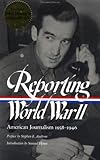
Samuel Hynes, ed. Reporting World War II: American Journalism, 1938-1946. New York: Library of America, 2001. 875 pp. $18.95 (paper), ISBN 978-1-931082-05-1.
Reviewed by Maurine Beasley (University of Maryland-College Park)
Published on Jhistory (July, 2006)
We call World War II "the good war." It was not, as this book makes plain. It was hell, like other wars before and since. This one-volume anthology contains the contents of a two-volume hardcover edition that first appeared in 1995. It is a remarkable work, a one-of-a-kind book that tells the World War II story chronologically by drawing on news reports, magazine articles, radio broadcasts, and selections from books by Americans written from 1938 to 1946. In the preface, Stephen Ambrose writes, "This volume is the best of the best" (p. xv). It is hard to argue otherwise. Where else could readers find a collection of works by more than fifty of the most notable war correspondents and writers of the era, including Edward R. Murrow, William L. Shirer, A. J. Liebling, Ernie Pyle, Margaret Bourke-White, Robert Sherrod, Bill Mauldin, John Steinbeck, Martha Gelhorn, John Steinbeck, and others? Cartoons and text by Bill Mauldin highlight the misery of the average GI Joe as do drawings by Howard Brodie for Yank, a weekly for military personnel. As a bonus feature, the volume includes the entire text of John Hersey's acclaimed Hiroshima (1946), originally a lengthy New Yorker article that described the aftermath of the explosion of the first atomic bomb on Japan by focusing on six survivors.
Most of the major news events of the war are covered in accounts by correspondents who risked their lives to fly on bombing raids over Germany, wade ashore on Pacific Islands in the face of heavy Japanese fire, and sail on ships that were bombed and torpedoed. The names of memorable battles dot these pages: Bataan, Guadalcanal, D-Day, and Iwo Jima. Samuel Hynes points out, in the introduction, that the news stories presented are "immediate, limited, and to be continued"--that they do not in themselves give the "Big-Picture" (p. xx). They lack the "Glory of War," he writes: "Bombs fall on the wrong troops, great ships sink, and men die, and die, and die" (p. xxi). So much so, that it almost seems the pages are permeated with the scent of death. The anthology concentrates on picturing war and its effects on those who wage it. And it is Ernie Pyle, the most beloved of all World War II correspondents and one who lost his own life, who said it best: The front-line soldier "is fighting for his life, and killing now for him is as much a profession as writing is for me" (p. 297).
In an effort to sketch a broader picture, the editors have included a helpful outline of World War II from 1933 to 1945 along with seventeen pages of maps. To their credit, they have added a smattering of articles on the home front including dismaying reports on the infamous camps for Japanese-Americans. Selections from African-American newspapers provide further context as they detail the racism of the period. Biographical notes on the authors, as well as extensive notes on the selections themselves and a glossary of military terms, make this an invaluable reference book.
The most gripping aspect of the work is the literary quality of the selections themselves. The language is clean, sparse and detailed, picturing a conflict in terms of dirt, disease, and human distress. There are press accounts of Auschwitz and Murrow's CBS broadcast in 1945 on his visit to Buchenwald, one of the largest concentration camps where Hitler carried out the Holocaust. After describing stacks of bodies, Murrow told his listeners, "I have reported what I saw and heard, but only part of it. For most of it I have no words" (p. 629).
Perhaps not to intrude on the accounts themselves, Hynes has chosen not to write introductory material for any of the selections. He apparently wants the reports to stand or fall by themselves without interpretation. One can follow this rationale up to a point, but in some instances the reader longs for explanatory introductions along the line of those given in A Treasury of Great Reporting (1962), edited by Louis L. Snyder and Richard B. Morris. Snyder and Morris offer a few of the same selections given in this volume--William L. Laurence's report of the atomic bomb being dropped over Nagasaki, for example--but they also include selections omitted from the current work by such able correspondents as Hal Boyle and Merle Miller. Anyone interested in World War II journalism would be well advised to read both works.
To a degree, the lack of extensive explanatory material limits the utility of Reporting World War II for the journalism historian. There is no overview of the number of correspondents covering World War II or killed in it. The issue of censorship is not raised directly, nor is the topic even listed in the index. The reader encounters it by surprise in a New Yorker article by A. J. Liebling that follows a dispatch from Edward Kennedy (p. 644). This dispatch, taken from The New York Times without attribution to the Associated Press, Kennedy's employer, announces the unconditional surrender of Germany on May 7, 1945. Liebling blasts the Associated Press president who censured Kennedy for allegedly breaking an agreement to withhold news of the surrender in advance of the official release. Liebling's sharpest criticism, however, is reserved for military public relations officers; readers without background in press-military relations may be perplexed to find references to these individuals first cropping up on pages 646-655 in connection with the end of the war in Europe. From the previous selections readers would be likely to reach the erroneous conclusion that the military did not exercise any control over correspondents at all. For a discussion of military-press relations, readers could profitably consult the classic work, American Journalism (1962) by Frank Luther Mott.
Similarly, the editor of Reporting World War II makes no attempt to explain the difficulties confronting women who wished to be war correspondents. The volume contains accounts by several women in addition to Bourke-White and Gelhorn. Readers are not apprised of official efforts to limit the role of women correspondents. One of the finest essays is by Gelhorn, who writes with barely veiled fury on the refusal of ordinary Germans, after the surrender, to admit any previous support for Hitler. More information on the struggles of women to cover the war can be found in Lilya Wagner, Women War Correspondents of World War II (1989).
In spite of the cartoons and drawings that lend a key visual element to the book, it suffers from a lack of photographs, although there is an elegant review of wartime newsreels by James Agee, writing for Life. As Frederick Voss stresses in Reporting the War: The Journalistic Coverage of World War II (1994), "of all the branches of the journalistic profession, none played a more central role in reporting the events of World War II to the American public than photography" (p. 41). A selection of pictures from the old Life magazine would enhance this volume immeasurably.
Nevertheless, Reporting World War II is an outstanding work, one that has the perhaps unintended effect of presenting an anti-war argument. In his review of war newsreels, Agee compared the war films to pornography, writing, "pornography is invariably degrading to anyone who looks at or reads it. If at an incurable distance from participation, hopelessly incapable of reactions adequate to the event, we watch men killing each other, we may be quite as profoundly degrading ourselves" (p. 607).
Reading about war in this sobering volume helps us understand that war itself is a degrading occupation.
If there is additional discussion of this review, you may access it through the network, at: https://networks.h-net.org/jhistory.
Citation:
Maurine Beasley. Review of Hynes, Samuel, ed., Reporting World War II: American Journalism, 1938-1946.
Jhistory, H-Net Reviews.
July, 2006.
URL: http://www.h-net.org/reviews/showrev.php?id=12042
Copyright © 2006 by H-Net, all rights reserved. H-Net permits the redistribution and reprinting of this work for nonprofit, educational purposes, with full and accurate attribution to the author, web location, date of publication, originating list, and H-Net: Humanities & Social Sciences Online. For any other proposed use, contact the Reviews editorial staff at hbooks@mail.h-net.org.

