

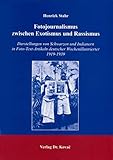
Henrick Stahr. Fotojournalismus zwischen Exotismus und Rassismus: Darstellungen von Schwarzen und Indianern in Foto-Text-Artikeln deutscher Wochenillustrierter 1919-1939. Hamburg: Verlag Dr. Kovač, 2004. 582 S. EUR 128.00 (cloth), ISBN 978-3-8300-1450-8.
Reviewed by Hartmut Krech (Independent Scholar (Bremen))
Published on H-German (July, 2006)
Colonialism without Colonies
The interwar period 1919-39 remains important for an understanding of the emergence of modern German cultural identity or its persistent absence. Inasmuch as self-identity is mediated through a construction of the other, the strategies of "othering," to use a term introduced by Johannes Fabian, deserve particular attention.[1] Having lost its colonies as a consequence of the First World War, Germany readied itself for one of the worst excesses of racial hatred humanity had seen so far. At the same time, new mass media like photographically illustrated magazines and movies tried to forge slowly emerging public opinion in a country that was shaken by economic crises and social unrest.
With these points of reference in mind, Henrick Stahr may expect an increased interest in his voluminous study of German photojournalism in the interwar period, which was accepted as a doctoral dissertation in 2003. The author adequately labels the German attitude towards colored peoples at that time as a "colonialism without colonies" (p. 1).[2] Unfortunately, he does not develop this idea further, nor does he show the interdependence of a generalized colonialist attitude with his two other main concepts, exoticism and racism. The few remarks that he makes with respect to racism (pp. 25-28) and exoticism (pp. 28-29) must be called scanty at best. They do not explain why the author selects Native Americans from North and South America as well as (black) Africans, Afro-Americans and Afro-Germans as the subjects of the feature articles he analyzes.[3] It is far more than a question of lacking political correctness when Stahr lumps these diverse peoples together into the categories of "Blacks" and "Indians" or "Indios."[4] He may quote several professional studies from the field of literary criticism that led the way in doing so, or he may claim the self-referencing of the Black Consciousness movement for his decision (p. 36-37), yet adopting the vernacular and worldview of the subjects of his investigation is totally inappropriate, if he intends "to gain insight into the collective patterns of apprehension and representation" (p. 11) of the producers of the feature articles reviewed.
Stahr applies what he calls "the structural argumentation of rhetorical tropes" (p. 16) to demonstrate the ideological connotations of the hetero-images in the photographically illustrated articles he investigates. It may be granted that this semiotic approach also lends itself to a "subversive reading" of the text and image units, yet only at the expense of historical criticism. The author may have accomplished his objective of understanding "the hetero-images of Blacks and Indians in photo-text articles ... as forms of a linguistic and visual constitution of reality" (p. 11), but little more than the mere factuality of what was published would be adduced in such a strictly photo-rhetorical approach.[5]
Luckily, the author does not restrict his analyses to a semiotic reading. Rather he tries "to clarify the forms (typology), structures and publicistic functions [of the photo-text articles] in the illustrated magazines as well as the professional praxis standing behind the product" (p. 40). Stahr calls these aspects the "production-aesthetic preconditions" that "flow into the thematically specific analysis of articles about Blacks and Indios" (p. 40). It must be noted, however, that he does not approach his subject from the perspective of media anthropology, as his reference to a typological method of rhetorical "tropes" suggests he wishes to do. Had he done so, he would have conceived of the "pragmatic worldviews" of the articles in question as specific strategies of communication that facilitate, corrupt or even prevent the construction of the self and the other in mutual dialogue.[6]
Stahr's extensive bibliography lists about 620 photographically illustrated articles about black Africans, Afro-Americans, Afro-Germans and Native Americans from seven illustrated magazines, attesting to public interest in this subject between 1919 and 1939. Only the Berliner Illustrirte Zeitung was evaluated for the total span of time. Therefore, figures about the quantitative distribution of exotistic and racistic articles can only be approximated (p. 86). The strength of Stahr's study lies in the detailed reading of individual articles that he presents on 387 pages of his book. He arranges these microanalyses geographically, chronologically and thematically, noting a definite development from the topical feature article to the photo-reportage, which is seen both as a "strategy of authentification" and a reflection of the Fremderfahrung of the traveling tourist (pp. 490-491). Regarding the forms of presentation, the photo-text articles increasingly sought to reflect features of the cinematographic syntax, with "the [written] texts guiding the ideological connotations" (p. 490). A "biological frame of reference," which is characteristic of articles about black Africans in particular, generally seems to be absent from articles about Native Americans. Nevertheless, Stahr identifies several "ethnographical articles" about black Africans that loosely fit his category of exoticism (pp. 492-493, 500).[7]
Stahr's comparison between the National Socialist and communist press must be regarded as the highlight of his investigation. Stahr first portrays the Illustrierter Beobachter, founded by the NSDAP in 1926 (pp. 87-91), before he delineates the development of the Arbeiter-Illustrierte-Zeitung from forerunner publications first issued in 1921 (pp. 91-100). The reader may find it puzzling to have to look for statements of the journal editors' photojournalistic intentions in Stahr's chapter on the photo-text article as a subject of contemporary reflection (pp. 73-80). Microanalyses of articles from the fascist and communist press are given on 170 pages of Stahr's study. In his concluding remarks (pp. 489-504), Stahr takes up the initial argument from the beginning of his study that latent colonialist tendencies and manifest anticolonialist policies may have influenced the form, structure and function of the articles reviewed. With respect to the fascist press, he notes "congruences between the commercial, "liberal" illustrated magazines and the Nazi press before 1933 and continuities in reporting before and after 1933" (pp. 489, 495). By contrast, the communist press "almost completely ignored the German antisemitism before its own front door," replacing this problem by an "idealized, distant dream image of the "Negro proletarian," which represents just another version of exoticism, though of a "proletarian" coinage" (p. 500).
The author himself admits the lamentable fact that the collection, arrangement and description of his data from a neglected, voluminous corpus of sources had to take precedence over an extended theoretical discussion (p. 3). Nevertheless, it must be noted with astonishment and regret that so little ascertained information seems to have accrued from the mass of publications on "ethnographical photography" that appeared during the past decade, despite all of the recent attempts to establish a Bild-Anthropologie or Bildwissenschaft.[8] Henrick Stahr must be credited with having accomplished the thankless task of perusing endless, dusty volumes of illustrated magazines for some glimpses of Germany's relationship to the "colored" peoples of the world.
Notes
[1]. Johannes Fabian, "Presence and Representation: The Other and Anthropological Writing," Critical Inquiry 16 (1990): pp. 753-772. "Othering" is usually translated into German as Veranderung (without Umlaut). Hegel's definition of Andersseyn (alterity) describes the "other" as a mediated and mediating element in the construction of self-identity. See his Wissenschaft der Logik, in: Gesammelte Werke, ed. Friedrich Hogemann and Walter Jaeschke (Hamburg: Meiner Verlag, 1978), vol. 11, pp. 60-66; vol. 12, pp. 242, 244-246. In its narrower sense of Fremdstellung or Fremdheitskonstruktion, "othering" denotes either the intentional weakening or even dissolution of the reputation and self-esteem of other social groups or their unrealistic idealization by over-emphasizing their difference to one's own group.
[2]. This catch-phrase was apparently coined by Joachim Peck in Kolonialismus ohne Kolonien. Der deutsche Imperialismus und China 1937 (Berlin: Akademie Verlag, 1961).
[3]. Apparently the author is carried away by his own vagueness in defining the scope of his investigation, as when he also devotes several analyses to "flying reporters" (W. Mittelholzer, W. Ruge, Elly Beinhorn, Inge Stoelting).
[4]. On p. 136 the author takes pains to explain why he includes a feature article about the native population of Madagascar (which is of Polynesian origin) in his analyses of representations of "Blacks."
[5]. For a discussion of the possibility and elements of a photo-rhetorics see Jeanne Boerkey's dissertation Fotorhetorik , electronically published (Tübingen: Online-Publikationsservice TOBIAS-lib, Universitätsbibliothek Tübingen, 2001) ( http://w210.ub.uni-tuebingen.de/dbt/volltexte/2001/407/ ).
[6]. For a recent formulation of a future "image pragmatics" (Bildpragmatik) see Eva Schürmann, "Die Bildlichkeit des Bildes. Bildhandeln am Beispiel des Begriffs Weltbild," Bildwissenschaft zwischen Reflexion und Anwendung, ed. Klaus Sachs-Hombach (Cologne: Halem Verlag, 2004).
[7]. I prefer "biological frame of reference" as a descriptive category to the vague application of the term racism in the context of this study. Racism originally meant the classification of humankind according to its geographical variations with practical social consequences deduced from such a classification. Early in the nineteenth century, racial classification was expanded into a biological typology that could be applied to social groups of the most diverse kinds. To the contrary, the frame of reference of exoticism is social, even where questions of human biology are addressed. Cf. Hartmut Krech, "Lichtbilder vom Menschen. Vom Typenbild zur anthropologischen Fotografie," Fotogeschichte 4 (1984): pp. 3-15 ( http://www1.uni-bremen.de/~kr538/licht.html ).
[8]. Hartmut Krech, Ein Bild der Welt. Die Voraussetzungen der anthropologischen Photographie (Constance: Hartung-Gorre Verlag, 1989; new edition forthcoming); Hans Belting, Bild-Anthropologie. Entwürfe für eine Bildwissenschaft (Munich: Fink Verlag, 2001); Klaus Sachs-Hombach, ed., Bildwissenschaft. Disziplinen, Themen, Methoden (Frankfurt am Main: Suhrkamp Verlag, 2005).
If there is additional discussion of this review, you may access it through the network, at: https://networks.h-net.org/h-german.
Citation:
Hartmut Krech. Review of Stahr, Henrick, Fotojournalismus zwischen Exotismus und Rassismus: Darstellungen von Schwarzen und Indianern in Foto-Text-Artikeln deutscher Wochenillustrierter 1919-1939.
H-German, H-Net Reviews.
July, 2006.
URL: http://www.h-net.org/reviews/showrev.php?id=12036
Copyright © 2006 by H-Net, all rights reserved. H-Net permits the redistribution and reprinting of this work for nonprofit, educational purposes, with full and accurate attribution to the author, web location, date of publication, originating list, and H-Net: Humanities & Social Sciences Online. For any other proposed use, contact the Reviews editorial staff at hbooks@mail.h-net.org.

