



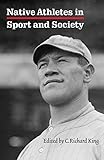
C. Richard King, ed. Native Athletes in Sport and Society: A Reader. Lincoln: University of Nebraska Press, 2005. xxxiii + 264 pp. $26.95 (paper), ISBN 978-0-8032-7828-8.
Reviewed by Wade Davies (Native American Studies Department, University of Montana)
Published on H-AmIndian (July, 2006)
American Indian Athletes: Race, Power, and Identity
C. Richard King and the other authors in this collection correctly contend that Indian athletes, until very recently, have been denied the scholarly attention they deserve. This edited volume offers others interested in this growing field of inquiry a strong introduction to existing scholarship and allows King to propose avenues for future study. In it, he and his selected authors stress themes of agency, power relations and the assertion of racial pride.
Indian participation in football has received more scholarly attention than have other topics in Indian sports history, primarily because of the high-profile accomplishments of the Carlisle Industrial School team and Jim Thorpe. That sport and its players are also featured here. John Bloom honors Grace Thorpe for successfully campaigning to gain recognition for her father as the century's greatest athlete and for fighting the stereotypical imperialistic image of him as a fallen Indian hero. William J. Bauer Jr.'s interesting essay stresses Tommy Yarr's ability to win over Notre Dame football fans because the media stressed his "biethnic identity" as an Indian and Irishman who brought the best qualities of his ancestors to the gridiron. Charles Fruehling Springwood adds a highly theoretical, but less accessible offering in comparison to the other essays. He analyzes the stereotypical portrayal of football's Oorang Indians and the players' responses. Gerald Gems shows ways Indian athletes, and Carlisle's football players in particular, empowered themselves through sport. His use of the "trickster" as a metaphor is interesting but problematic when used in a multi-tribal context. Tricksters have multiple meanings and interpretations within communities and do not hold the same meaning from one tribal culture to another.
Jeffrey Powers-Beck and Daniel P. Barr concentrate on baseball, but stress similar themes as the above-mentioned authors. Barr reconsiders Louis Sockalexis's career, arguing that the debate over the origin of the Cleveland Indians' name should not obscure the player's accomplishments on the field nor the struggle he faced in confronting assimilationist expectations in a racist society. Powers-Beck offers a biography of the lesser-known George Howard Johnson, who successfully asserted and drew strength from his Indian identity as an early-twentieth-century pitcher.
Vicky Paraschak and Ellen J. Staurowsky both argue that Native women have suffered from both racial and gender bias and are therefore undeservedly amongst the lowest profile athletes in American sports history. Paraschak writes that a systematic bias works against women in the patriarchal American sports world. She shows, in a case study of the Six Nations Reserve between 1968 and 1980, that this bias obscures the active involvement and importance of indigenous female athletes. Similarly, Staurowsky refers to a "racialized gender hierarchy" (p. 192) and argues that SuAnne Big Crow was an "Indian hero" (p. 204) who maintained her identity as a Lakota woman. Linda Peavy and Ursula Smith's well-known piece on the Fort Shaw women's basketball team's triumph at the 1904 Louisiana Purchase Exposition has brought Indian women's athletic achievements to broader public attention. The co-authors stress that while Fort Shaw used its athletes for institutional purposes, the players used the tournament to their own advantage.
Arguably the most intriguing inclusion is the essay that does not put forth a central thesis. Ann Cummins, along with co-authors Cecilia Anderson and Georgia Briggs, writes about the Shiprock Cardinals women's basketball team--the two co-authors are former players. Cummins argues that it is easy for scholars writing solo-authored works to inadvertently misrepresent Indian athletes. Rather than risk doing so, the authors offer excerpts from a public discussion about the team's history. Issues of racial identity, gender and negative stereotyping appear in the discussion, but above all the former athletes reveal a fundamental love for sport and competition that we scholars often underestimate. Counter to commonly accepted and overly generalized academic assumptions about "Indian" competitive values (or the lack thereof), the players say that winning was always a, if not the, primary purpose of playing.
The book as a whole has its limitations, but these are more reflective of the nature of current scholarship than any errors on King's part. The articles fit into relatively narrow categories in that they all focus on American Indian involvement in sports introduced by Euro-Americans (especially football, basketball, and baseball). They also center on issues of interracial conflict, colonization, and decolonization. As someone who also writes about these sports (basketball in particular) and issues of assimilation and Indian identity, I am not criticizing these authors for writing what I consider to be thoughtful, interesting and, in some cases, pioneering essays. But the book shows, as King writes in his epilogue, that there is a great deal yet to be done. We need to know more about the importance of sports played by members of one Native community against another and between opponents living in the same community; about the negative effects of athletics (including problems with young Indian student athletes who, like their non-Indian teammates, devote too much of their physical and mental energy to sports); and the continuing importance of tribal sports (only lacrosse has received much academic consideration elsewhere in a modern context). More in-depth research needs to be done on the values expressed through differing tribal sporting traditions, and also the complex and varying intentions of the boarding school faculty and professional coaches who work(ed) with Indian athletes. More attention should also be devoted to less studied but commonly played sports introduced by Euro-Americans (volleyball, for example, was widely played in boarding schools). King's strong article about Notah Begay's battle against racial stereotypes in the modern golf world and his importance to modern Indian communities is the only one in this volume not focusing on one of the big three American sports. We also have to acknowledge that many Indian athletes play sports for reasons, and identify themselves in ways, that do not mesh with present scholarly modes of interpretation. These athletes and their beliefs are also worthy of our attention.
If there is additional discussion of this review, you may access it through the network, at: https://networks.h-net.org/h-amindian.
Citation:
Wade Davies. Review of King, C. Richard, ed., Native Athletes in Sport and Society: A Reader.
H-AmIndian, H-Net Reviews.
July, 2006.
URL: http://www.h-net.org/reviews/showrev.php?id=11981
Copyright © 2006 by H-Net, all rights reserved. H-Net permits the redistribution and reprinting of this work for nonprofit, educational purposes, with full and accurate attribution to the author, web location, date of publication, originating list, and H-Net: Humanities & Social Sciences Online. For any other proposed use, contact the Reviews editorial staff at hbooks@mail.h-net.org.

