



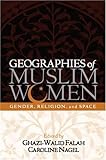
Ghazi-Walid Falah, Caroline Nagel, eds. Geographies of Muslim Women: Gender, Religion and Space. New York: Guildford Press, 2005. viii + 337 pp. $65.00 (cloth), ISBN 978-1-59385-183-5; $32.00 (paper), ISBN 978-1-57230-134-4.
Reviewed by Peter Hopkins (Department of Geography, Lancaster University)
Published on H-HistGeog (July, 2006)
This is, in many ways, an impressive collection, highlighting, as it does, the ways in which religion shapes the experiences of Muslim women and influences their everyday spatiality. The collection is structured around three sections: gender, development and religion; geographies of mobility; and discourse, representation and the contestation of space; and it includes contributions from a range of graduate students, early career researchers and experienced academics. The coverage of this collection and the standard of the various contributions suggest that this is likely to be a landmark collection in human geography. Not only will this book be relevant to researchers working in religion, gender studies and human geography more generally, the various contributions will be invaluable for undergraduate courses exploring connected issues.
There are many aspects of this edited collection that are impressive. First, the editors have brought together a collection of works that embrace a wide range of subfields of geography, including, but not limited to, development studies, demography, economic approaches and gender studies. Moreover, the contributors also adopt a wide range of methods and methodologies, including ethnographic approaches, interviewing and content analysis. Second, and connected to the previous point, the geographical coverage of this collection brings to life the experiences of Muslim women in a variety of contexts, including Asia, Africa, Europe and North America, in a range of urban and rural contexts. Third, I think that one of the key strengths of Geographies of Muslim Women is the way in which it clearly demonstrates how Muslim femininities are constructed in relation to Muslim masculinities as well as the gendered identities of non-Muslims, and so it adopts an open, flexible and relational approach to understandings of gendered identities.
Having read Geographies of Muslim Women, there are four chapters in particular that stand out as being particularly influential in their arguments, original in their approach, and constructively composed and well written. These are the contributions by Sarah Halvorson, Rachel Silvey, Robina Mohammad and Anna Secor, all of which make significant contributions to knowledge and understandings of the everyday gendered experiences of Muslim women in different contexts.
Sarah Halvorson's chapter empirically explores the experiences of girls growing up in Northern Pakistan. By focusing on the lack of scholarship on "children's geographies in Muslim societies" (p. 24), this chapter highlights a number of important issues influencing the gendered experiences of young Muslim women, including the perceived value of having a daughter compared with having a son, the role of the economy in determining young people's experiences, social reproduction and well-being, and the primary role of the family in the lives of young women. Overall, this chapter clearly demonstrates the factors determining the everyday experiences and future trajectories of Muslim girls as they progress towards adulthood.
Equally impressive is Rachel Silvey's chapter about Indonesian domestic workers in Saudi Arabia. Drawing upon work on migration, mobility and transnationalism, this chapter demonstrates the ways in which "people employ religion to reaffirm, challenge or survive the power relations structuring their position in this transnational migration network" (p. 129). Here, Silvey emphasizes the ways in which state policies, household circumstances and gendered migration experiences influence the circumstances of Muslim women, displaying in particular "the multiple meanings of Islam to different actors" (p. 140).
Focusing on the importance of school work and home, Robina Mohammad's contribution to this collection sensitively explores the experiences of young, working-class, British Pakistani Muslim women. This chapter explores issues connected with global discourses, such as those discussed by Silvey; however, I found Mohammad's excavation of the local and embodied experiences of young Muslim women particularly interesting. Emphasizing the importance of Muslim women's embodied purity, this chapter explores the complex ways in which the conduct and behavior of Muslim women is carefully monitored through the gaze of parents, the gendering of the workplace and the reinforcement of women as the "guardians of collective identity" (p. 182).
With the heightening of markers of Muslim identities in recent years, as a result of events such as September 11, 2001 in New York and the London bombing of July 7, 2005, Anna Secor's chapter about the "headscarf issue" (p. 203) is particularly timely. Not only does this chapter clearly highlight the ways in which practices of dress determine embodied everyday experiences, it also shows how such practices influence wider power relations in society. One of the most important factors demonstrated by this chapter is the way in which the women consulted by Secor distinguished their own veiling practices from other women, thereby highlighting that such customs are not fixed and so may be interpreted in a range of different ways.
In the introduction, Caroline Nagel raised a personal concern: "I have ... been acutely aware that this volume may further reify the category of 'Muslim woman,' thereby reducing the identities and experiences of these women to their religious affiliation" (p. 5). Quite to the contrary, Nagel has little to be concerned about, as this collection has successfully demonstrated the range of social, cultural, political and economic factors influencing Muslim women's everyday lives, as well as the ways in which Muslim women construct, resist and contest assumptions and stereotypes about their identities, their appearance and their general behavior and conduct. Furthermore, the collection has firmly established religion as a focus of inquiry in geography. This collection makes it clear that Islam is an important influence in how everyday lives are lived, and an important marker of identity and factor in cultural change.
If there is additional discussion of this review, you may access it through the network, at: https://networks.h-net.org/h-histgeog.
Citation:
Peter Hopkins. Review of Falah, Ghazi-Walid; Nagel, Caroline, eds., Geographies of Muslim Women: Gender, Religion and Space.
H-HistGeog, H-Net Reviews.
July, 2006.
URL: http://www.h-net.org/reviews/showrev.php?id=11968
Copyright © 2006 by H-Net, all rights reserved. H-Net permits the redistribution and reprinting of this work for nonprofit, educational purposes, with full and accurate attribution to the author, web location, date of publication, originating list, and H-Net: Humanities & Social Sciences Online. For any other proposed use, contact the Reviews editorial staff at hbooks@mail.h-net.org.

