



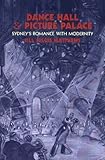
Jill Julius Matthews. Dance Hall and Picture Palace: Sydney's Romance with Modernity. Sydney: Currency Press, 2005. x + 342 pp. No price listed (paper), ISBN 978-0-86819-755-5.
Reviewed by Seamus O'Hanlon (School of Historical Studies, Monash University, Melbourne, Australia)
Published on H-Urban (July, 2006)
The Young Moderns
In an era in which many cities around the world have decided that the solution to their current economic and other problems lie in pursuing leisure, creativity and major events, the publication of this new book on Sydney in the first decades of the last century is timely. Jill Julius Matthews's lively and evocative history of the emergence of a modern service- and entertainment-based economy in Australia's largest city reminds us that debates about what constitutes "real" work and "worthwhile" culture are hardy perennials, historically and geographically. While I have a few concerns about this book which I will detail below, generally it is a fascinating study of a city and a people undergoing transformation from the more formal British-influenced Victorian era to one characterized by informality, the breaking down of rigid and outmoded customs, and increasing influences of the United States, often filtered through the "soft diplomacy" of Hollywood.
Dance Hall and Picture Palace has as its central thesis the idea that from the early 1890s through to the late 1920s Sydney and its people were witness to the emergence of a "modern culture and the possibilities of life in the modern city" (p. 1). Sydneysiders, especially younger members of the population, were offered opportunities in work, leisure, social freedoms, and cultural pursuits that drew on the ideas and technologies of Modernism to create ways of living unheard of in their parents' day. New fashions (purchased from the new department stores), new styles of dancing, new or refurbished picture palaces, new forms of dwellings (mostly flats, but also small, self-contained "Californian" Bungalows), as well as new social freedoms, transformed lives and the built form of the city itself. Many of these changes benefited young women who, according to Matthews, enthusiastically embraced them. Their elders and self-described class betters may have been appalled, but few of these young moderns seemed to care.
The book consists of seven chapters in three parts, as well as an introduction and conclusion. Part 1, "The Romance of City Life," documents the physical and social transformation of Sydney in the late nineteenth and early twentieth centuries, before discussing the "truth about modern girls," who were the subject of much debate (and concern) about their free attitudes, modern manners, and possibly loose morals. Part 2 examines the industries and entrepreneurs of the new economy, while part 3 concerns itself with those who concerned themselves with the moral and cultural dimensions of a society transformed. The conclusion argues that by the 1930s a sort of cultural compromise had been reached in which more traditional citizens accepted most of the new ideas and attitudes, while the young and the modern, especially those who owned the new industries, recognized that shock for shock's sake was not what the public wanted, and was thus bad for business.
For the most part the argument works, but I could not help but feel that some ideas and concepts were stretched a little far. The years 1890-1930 are perfectly acceptable start and end points for the purpose of telling the story, but, rather than being one trajectory, I would argue that they include several distinct eras. The 1890s were a time of great economic and social distress in much of Australia, which, as Matthews notes, gave rise to a distinctly rural-flavored and misogynist nationalism. The period between 1900 and the Great War was a time of growing prosperity, but four years of slaughter in Europe and the Middle East certainly capped that. The return of peace again brought prosperity for some, but as many historians have noted, in Australia and elsewhere unemployment was a scarring feature of life for many in the 1920s. For many working-class communities, the mass unemployment of the 1930s was simply more and worse of the same, rather than an aberration in an era otherwise characterized by prosperity. I was troubled on several occasions, especially in part 1, that the story would move from one period to another without adequately exploring what had gone on in between.
The Great War, with all its horrors for those who fought as well as those who did not, certainly features in the book, but too often I felt its effects on both the returned men and the families of those who did not survive were passed over. This omission is understandable given the overarching forward-looking and positive nature of the book, but like the economic dislocation noted above, the shadow of the conflict was an important social and cultural aspect of interwar society. The suffering associated with the war and its aftermath reminds us that the road to the delights of Modernity was often blocked by reversions to barbarity, as the world was to see again in the 1930s and 1940s.
Matthews rightly notes that her stories do "not fit neatly within the boundaries of the nation continent but flow into and merge with the great international movement of things, people and ideas" that formed the "newly modern world" (p. 2). But, with the important exception of the film industry, which is presented as one of the earliest global cultural industries, the book rarely lifts it gaze from Sydney and its people. Again, this is understandable given the topic of the book, but I thought there was at least some scope for comparative studies of similar processes of change, both nationally and internationally. Studies of the modernization of cities and concerns about the freedoms these processes afforded to young women have come under much scrutiny in recent years. Joanne Meyerowitz's important work in "women adrift" in Chicago is here, but what about Carolyn Strange's equally significant research into concerns about Toronto's "girl problem"?[1] And locally, Liz Conor's work on the visibility of "spectacular modern women" in Australia in the 1920s, Ben Schrader's documentation of the modernization of Melbourne in the interwar years, and my own research into Melbourne's flats and hostels for business girls in the same period, deserve at least a mention somewhere.[2]
Also slightly troubling is the discussion of religion and the religious in chapter 3. The author writes of a "conspicuously Anglican" "small civilised elite" in Sydney who saw themselves as the embodiment of the best of English culture, albeit twenty thousand kilometers from "home" (pp. 199-200). I have no doubt this was the case, but whether it was these people or their nonconformist fellow citizens (mainly Presbyterians and Methodists) who were at the forefront of efforts to reign in the excesses of Modernity is perhaps open to question. As we see in the discussion of the activities of the Good Film League (pp. 210-217), it was often members of these smaller religions who were the most fervent in their denunciations of social "evils," and most strident in the calls to have them banned. In the middle of the Second World War, the future long-term conservative Melbourne Methodist Prime Minister, Robert Menzies, was to play on popular disquiet over the prewar and wartime behavior and attitudes of a rich and powerful social "set," resident in what he called the "great luxury hotels" and "so-called fashionable suburbs" of the major cities.[3] Menzies recognized that an ambitious politician could tap a deep wellspring of support among nonconformist lower-middle-class Australians appalled at some of the behavior and attitudes of "elites," whether Anglican or otherwise. In today's more secular Australia, attitudinal divides between these Christian groups might seem insignificant, but I suspect in the 1920s they were much more important and subtle than sometimes appears the case here.
These minor but important issues aside, this highly readable book is a welcome addition to our understanding of early-twentieth-century urban life and attitudes in Australia. It will appeal to both scholars of urban history and to general readers interested in the history of Sydney, one of the world's great pleasure capitals.
Notes
[1]. C. Strange, Toronto's Girl Problem: The Perils and Pleasures of the City, 1880-1930 (Toronto: University of Toronto Press, 1995).
[2]. B. Schrader, "Rebuilding Melbourne: Modernity and Progress in the Central Business District, 1910-50" (Ph.D. diss., University of Melbourne, 2001); L. Conor, The Spectacular Modern Woman: Feminine Visibility in the 1920s (Bloomington: Indiana University Press, 2004); and S. O'Hanlon, Together Apart: Boarding House, Hostel and Flat Life in Prewar Melbourne (Melbourne: Australian Scholarly Publishing, 2002).
[3]. See Robert Menzies, "The Forgotten People," pamphlet published by Robertson and Mullens, 1942, as reproduced in J. Brett, Robert Menzies' Forgotten People (Sydney: Macmillan, 1992), pp. 5-6. For a full text of the speech see: http://www.menziesvirtualmuseum.org.au/ transcripts/ForgottenCont.html.
If there is additional discussion of this review, you may access it through the network, at: https://networks.h-net.org/h-urban.
Citation:
Seamus O'Hanlon. Review of Matthews, Jill Julius, Dance Hall and Picture Palace: Sydney's Romance with Modernity.
H-Urban, H-Net Reviews.
July, 2006.
URL: http://www.h-net.org/reviews/showrev.php?id=11963
Copyright © 2006 by H-Net, all rights reserved. H-Net permits the redistribution and reprinting of this work for nonprofit, educational purposes, with full and accurate attribution to the author, web location, date of publication, originating list, and H-Net: Humanities & Social Sciences Online. For any other proposed use, contact the Reviews editorial staff at hbooks@mail.h-net.org.

