



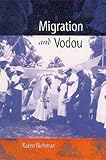
Karen E. Richman. Migration and Vodou. Gainesville: University Press of Florida, 2005. xxi + 356 pp. $65.00 (cloth), ISBN 978-0-8130-2835-4.
Reviewed by Grete Viddal (Department of African and African American Studies, Harvard University)
Published on H-AfrArts (June, 2006)
Long-Distance Religion: Transnational Vodou Community in the Haitian Diaspora
Karen Richman has written a detailed and moving ethnography, the end product of many years of research with a particular transnational community. Migration and Vodou tells the metastory of Pierre Dioguy, nicknamed Ti Chini, or "Little Caterpillar," a Haitian migrant laborer working in the rural American South. Originally from the village of Ti Rivyè (Little River in Haitian Creole), a coastal hamlet in rural Léogane (a district west of Port-au-Prince), Little Caterpillar toils to provide for his kin back home. Most families in Ti Rivyè have members deyò, or "outside," that is in the Haitian diaspora. Migrants from Ti Rivyè typically find work in labor camps for seasonal harvesters in the South from Florida to rural Virginia. Little Caterpillar and his extended family in Haiti become Richman's subjects (and collaborators) in crafting a nuanced analysis of power, resistance, performance, and religious change.
Contemporary ethnographies that explore Haitian religious and cultural practices in the United States, such as Karen McCarthy Brown's Mama Lola: A Vodou Priestess in Brooklyn (1991) or Liza McAlister's Rara! Vodou, Power, and Performance in Haiti and its Diaspora (2002), have typically focused on groups in New York City or Miami. Most of the migrants described by McCarthy Brown and McAlister arrive from the urban culture of Port-au-Prince and recreate their religious, musical, or festival traditions in places like Brooklyn's Prospect Park or Fort Greene neighborhood. Richman's book focuses on a different sort of community. In rural Haiti, "serving the spirits," the Vodou deities or lwa, is a family affair. Members of descent groups trace their eritaj, or inheritance, back to a founding ancestor. Both land and lwa are part of this heritage, and are inseparable. Worship cannot be transplanted to Florida; the spirits cannot be appeased from afar, disconnected from their native soil. In order to fulfill ritual obligations, migrants must sponsor ceremonies that take place back home in Ti Rivyè. How does this transnational community manage to practice religion across the distances that separate members? The ingenious utilization of a relatively recent technology plays a crucial role.
During the mid-1980s, cassette recorders became popular and affordable in the United States. This development occurred soon after a massive exodus of Haitian workers, the "boat people," risked their lives to enter the promised land of prosperity on rafts and sailboats. Little Caterpillar made it to the United States via sailboat in 1980, together with twenty of his relatives and neighbors. Richman explains that in order to communicate with home kin, illiterate migrants from Ti Rivyè began to engage couriers to carry cassette tapes to and fro between Florida and their homeland. In the hands of a people with a vibrant oral culture, these recordings developed into an art form. The cassette-letters Ti Rivyè migrants exchange with their home community include songs, poetry, and oral compositions of great intricacy. Richman found that island relatives may quote proverbs or sing sacred songs to infuse their communications with pointed and irresistible messages exhorting migrants to be more diligent in sending remittances or fulfilling ritual obligations back home. Hard-pressed workers enduring low pay and hostile conditions in the United States might reply with ingenious communiqués couched in song and verse drawing attention to their hard work and underappreciated efforts or difficulties in the far off land. Richman discusses the Haitian concept of voye pwen or "throwing the point," a verbal strategy using Creole's rich corpus of metaphors, metonyms, songs, and proverbs to indirectly, but elegantly and succinctly, "get the message across." She notes that both recording and listening to these cassette-pwen become "performance events" as extended families or migrant's stateside workmates gather round to add their own comments, clarifications, and remarks, even drumming and singing, to the recordings.
In addition to functioning as the primary means for the exchange of personal news, these cassette tapes serve in another extraordinary capacity. Entire rituals can be performed in transnational spaces between Ti Rivyè and south Florida. During Vodou ceremonies sponsored by migrants, a ritual participant will hold a cassette recorder (illustrated in Richman's photograph on the book's jacket) and make a soundtrack of the event, often narrating the unfolding activities. Other participants also approach the recorder to add their own messages and comments. Strikingly, she finds that even worshippers "mounted" or possessed by spirits during the ceremony may address the microphone, allowing the far-off migrant direct access to his or her tutelary deities via audiocassette!
Richman became acquainted with the transnational Ti Rivyè community while working as a legal aid intern for a farmworker assistance program in rural Virginia between semesters of graduate school. The organization needed someone to do outreach among recently arrived Haitian vegetable pickers. Richman realized that the migrants' intimate connection to their home communities, in the face of distance, financial barriers, lack of formal education, oppression, and discrimination, was remarkable, and that the role played by practice of Vodou in this transnational bond was significant.
Drawn to make it the focus of her doctoral dissertation, Richman connected principally with one worker who became her teacher and guide: Little Caterpillar. His life and eventual heartrending demise inspire the story of Migration and Vodou. Living with Little Caterpillar's extended family in Ti Rivyè, during eighteen months of field research, and later attending to community member's fortunes on both sides of the national divide provide the data and lens for Richman's deft analysis of authority, agency, defiance, negotiation, and religious transformation.
Richman discovers friction and conflict in the relationship between migrants and those at home. With no opportunity to earn a living on the island, relatives in Ti Rivyè experience and process feelings of vulnerability and dependency, waiting for the next migrant remittance to arrive. They navigate issues of power by controlling the keys to moral and spiritual authority, existing in a kind of Zion to the migrant's Babylon. Richman refers to the current Haitian rural underclass as a type of sham peasantry, a people transformed into a landless and vulnerable rural proletariat that now raises as its main crop its own children for eventual export as low-wage laborers to industries in the North. She also provides a functionalist analysis of the afflictions that plague these commodities of the diaspora (p. 185). Many migrants fear that malaise, ill health, or bad luck are attributable to the resentment of neglected gods at home or sorcery hurled from afar by jealous neighbors. Richman argues that the specter of majik, or hexing, disciplines migrants, tying them to home for appropriate remedies and intervention by spiritual specialists. Furthermore, the disappointments and failures that beset low-wage workers struggling in an alien society can be blamed on destructive majik. Lastly, migrant afflictions give home kin and their religious leaders roles of power and authority, as they become the arbiters of the spiritual solutions that provide relief for migrant's misfortunes. Richman does not romanticize her subject's ethos or spiritual belief systems. She probes issues of misogyny, greed, envy, and exploitation that entangle Haiti's peasant lifeways and make migrants into objects, converting diasporic laborers into the chief "product" that the Haitian economy generates.
In her efforts to explain the ties between Haitian underdevelopment and capitalist neo-colonial hegemony, Richman makes use of theoretical terrain laid out by Marxian structuralism and analysis of political economy. The power of her work lies in her ability to convincingly demonstrate how changes within religious practices respond to and frame peasant vulnerability at the hands of the Haitian elite and multinational industry. This anthropologist's work is grounded in both intensive ethnography and rigorous archival research. For example, chapter 4 covers Richman's examination of a century of Haitian law, land use, and land tenure in Léogane. Further investigation of regional oral history, local elite mercantilism, and the record of U.S. policies and development projects support her observations. Richman's combination of meticulous historical research with immersive ethnography yields a broader portrait of how subaltern communities negotiate relationships of power than many ethnographies offer. Her work parallels another recent book which discusses the transnational forces that stimulate ritual transformation, namely J. Lorand Matory's Black Atlantic Religion: Tradition, Transnationalism, and Matriarchy in the Afro-Brazilian Candomblé (2005), a work similarly based on both intensive archival and ethnographic research.
An example of Richman's insightful perspective on religious change can be seen in chapter 6, detailing her analysis of the symbolism of gifts offered to propitiate the Vodou lwa, or spirits. She collects both oral and published documentation indicating that, since the early decades of the twentieth century, some deities have been feted with offerings of processed foods or store-purchased treats associated with the diet of the Haitian upper class. Other spirits consume traditional peasant fare such as simply prepared starchy vegetables and grains. Divinities who exhibit white, foreign, or upper class tastes model behaviors alien to the Haitian sharecropper. Yet, at the same time, it is precisely these same lwa who symbolize authentic connection to "Guinen," or African ancestors. Richman comments "the more weakened and compromised a peasantry, the more traditionally peasant its invented customs may be made to appear" (p. 150); she then explains this paradox in terms of the century long history of disenfranchisement and loss of land tenure of the Haitian small farmer. Through their new eating habits, the lwa, although touted as exemplars of African heritage and authentic Guinea roots, "personify not peasants, but the forces encompassing them: the cosmopolitan elite, transnational agro-industrial corporations, and the neocolonial power" (p. 182).
Little Caterpillar's struggle for dignity, his efforts to provide for his kin and compatriots in Ti Rivyè, and the injustice he encounters encircle Richman's long-term ethnography that explores the ethos, formation, and functioning of one particular transnational community. Little Caterpillar/Ti Chini's mastery of oral tradition, particularly the art of "throwing pwen," and his spiritual commitment inspire her study of the role of migrants in the structure and practice of Vodou. Richman performed her initial fieldwork in Ti Rivyè during the early-1980s. I sense that the final form of Karen Richman's ethnography (a study twenty years in the making,) is more multi-faceted and profound thanks to the length of time which passed before publication.
Faculty will find Migration and Vodou relevant assigned reading for courses exploring a wide range of topics including religious change; Caribbean history; arts of the Black Atlantic; performance; consumption and production; political economy; development policy; mobility; and transnationalism. Although the book tells a moving and engaging story and Richman's writing style is not dense, the book was not written with an undergraduate or general audience in mind. Richman uses terms that may be only vaguely familiar to a readership outside the social sciences. Specifically, terminology like "alienation" and "commodity," used in Marxian concepts of labor and production, could have been identified and described, even briefly. College students will probably need some guidance from faculty or teaching assistants in defining the use of these words in Richman's context.
Migration and Vodou includes an audio CD featuring six recordings of cassette-letters exchanged between Little Caterpillar, his family in Ti Rivyè, and Richman. Also, the text of the book incorporates transcriptions of many songs and conversations in the original Haitian Creole, as well as English translations. This allows readers fluent in the Haitian language to interpret for themselves the potentially multi-faceted and subtle meanings of utterances in this artful oral culture.
Richman provides readers with a helpful glossary, as well as an efficiently organized bibliography and thorough index. Oddly, Richman's bibliography overlooks two scholars whose works include well-researched descriptions of Vodou ceremonies: Katherine Dunham, Island Possessed (1969) and Gerdès Fleurant, Dancing Spirits: Rhythms and Rituals of Haitian Vodun, the Rada Rite (1996).
If there is additional discussion of this review, you may access it through the network, at: https://networks.h-net.org/h-afrarts.
Citation:
Grete Viddal. Review of Richman, Karen E., Migration and Vodou.
H-AfrArts, H-Net Reviews.
June, 2006.
URL: http://www.h-net.org/reviews/showrev.php?id=11924
Copyright © 2006 by H-Net, all rights reserved. H-Net permits the redistribution and reprinting of this work for nonprofit, educational purposes, with full and accurate attribution to the author, web location, date of publication, originating list, and H-Net: Humanities & Social Sciences Online. For any other proposed use, contact the Reviews editorial staff at hbooks@mail.h-net.org.

