



Angelika Epple, Peter Haber. Vom Nutzen und Nachteil des Internet für die historische Erkenntnis. Version 1.0. Zürich: Chronos Verlag, 2005. 202 S. (broschiert), ISBN 978-3-0340-0683-5.
Reviewed by Beat Kümin (Department of History, University of Warwick)
Published on H-German (June, 2006)
Political Communication in Late Medieval Republics
After decades of relative neglect, medievalists and early modernists are rediscovering the Tagsatzung (Swiss Diet) as a rewarding research object.[1] Its exact nature--as neither a parliamentary assembly nor an international diplomatic congress--is not easily defined. In more or less regular intervals, the diet brought together representatives of the ruling elites from several cantons to discuss matters of common concern, typically foreign relations, conflicts involving confederates or associated territories, socio-economic problems and the government of condominions (Gemeine Herrschaften). In addition to such basic functions, the diet also constituted one of the few visible bonds of the cantons' very loose political association, which rested on a complex network of bi- and multilateral treaties rather than one common constitution.
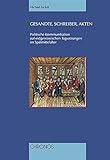
In this publication of his Ph.D. dissertation (Zurich, 2003), Michael Jucker approaches the diet from a fresh and original perspective. Following introductory remarks on recent theoretical approaches to writing culture in general and the emergence of written documentation in particular, he surveys previous work on the diet, above all the highly influential source collection Amtliche Sammlung der ältern Eidgenössischen Abschiede, compiled during the nineteenth century. The verdict on the latter is pretty devastating: marred by imprecise selection criteria, inadequate editorial policies and a "nationalist" fixation on finding evidence for early statehood, the collection seduced generations of historians into projecting collective government in the Swiss Confederation too far back into the Middle Ages (typically to the date of the first surviving treaty of 1291) and overestimating the institutional quality of the diet.
To obtain a more accurate picture, the author abandons traditional constitutional history in favor of a broader analysis of political communication. Questioning the model of a linear transition from oral to written exchange, Jucker seeks to contextualize the generation of records, to uncover the motives behind decisions to commit pen to paper and--above all--to assess the significance of human agency within a political body such as the diet. These objectives demand background research on delegates and scribes, more detailed reconstruction of proceedings at meetings and closer attention to contacts between delegates and their cantonal governments. The results of these investigations inform a closer analysis of the main categories of documents associated with the diet, above all the Abschiede (recesses), which Jucker interprets as draft treaties or minutes of ongoing business rather than binding agreements, and the Missiven (various types of correspondence linked to meetings and agenda items of the diet). The argument then turns to the administration of the major condominions, where the author finds little trace of active territorialization. Jucker shows that even a basic measure like the compilation of an Urbar (land register) was prompted by external challenges and the ensuing need to clarify the complex legal situation. The volume's final Exkurs offers somewhat more speculative observations on diplomatic ceremonial and the claim that delegates used non-verbal means of communication like their bodies and clothing to convey political messages.
Jucker's investigation produces a number of major new insights: proper diets of the entire Swiss Confederation--as opposed to mere arbitration or ad-hoc meetings involving some of its members--became more frequent only from the late fourteenth century and initially produced very little written documentation. The first records were kept by the council scribe of Lucerne, who decided to take rudimentary notes for his own benefit from around 1400. Cities like Lucerne retained a leading role when more formal minutes emerged from the mid-fifteenth century (in the context of a major internal conflict). After this point, delegates from other cantons started to bring back individual copies of Abschiede to their capitals, where they were archived and occasionally copied into dedicated Tagsatzung files. Verbal and symbolic communication during the meetings, however, remained paramount and the Abschiede alone provide only a very fragmentary impression of proceedings. There were no fixed rules about numbers of delegates, procedures and record-keeping: "Kurz gesagt: die Tagsatzungen existierten nicht als permanente Institution, sondern wurden jedesmal durch Interaktion neu geschaffen" (p. 79). Diets should thus be viewed as platforms for personal encounters and information exchange rather than as instruments of state formation. Endless referrals of contentious issues and the relatively free agency of delegates allowed only rudimentary control by cantonal governments.
While clear and well-written, Jucker's argument can be a little repetitive, due to a structure built on frequent recapitulation. The nature of medieval source material prevents the author from answering many of the more intricate questions raised in communication theory. Given that "ein Zugang zur eigentlichen mündlichen Kommunikationssituation auf den Tagsatzungen nur in Ausnahmefällen möglich ist" (p. 274), the book's agenda appears at times over-ambitious. Jucker's critique of the Amtliche Sammlung and one of its principal protagonists, Philipp Anton von Segesser, in turn, seems too harsh. Any nineteenth-century project is unlikely to meet present-day scholarly expectations, but this monumental collection remains an admirable achievement and--for many practical purposes--a valid first point of reference. Such quibbles, however, should not distract from the overwhelmingly positive impression left by this study.
Moving to the broader implications of Jucker's work, Gesandte, Schreiber, Akten adds further, weighty evidence to the ongoing reassessment of early Swiss history. Most scholars now reject time-honored notions of the medieval Swiss Confederation as a coherent, egalitarian and proto-democratic body with a mission to secure liberation from seigneurial (especially Habsburg) control. The cantons, they say, were oligarchic, opportunist and thus by no means "special cases." But does this revisionism risk throwing the baby out with the bathwater? The fact that a federation of urban and rural republics not only emerged, but actually survived for hundreds of years remains remarkable, and so does the existence of relatively inclusive, decentralized regimes at a time when most other polities endowed princes and monarchical institutions with ever greater powers.
Michael Jucker's work sheds valuable new light on late medieval political communication and illuminates the interplay of oral, written and symbolic media at the same time.
Note
[1]. Tamara Münger, "Hanse und Eidgenossenschaft--zwei mittelalterliche Gemeinschaften im Vergleich," Hansische Geschichtsblätter 119 (2001), pp. 5-48; Andreas Würgler, "Die Tagsatzung der Eidgenossen. Spontane Formen politischer Repräsentation im Spätmittelalter und in der Frühen Neuzeit," in Landschaften und Landstände in Oberschwaben. Bäuerliche und bürgerliche Repräsentation im Rahmen des frühen europäischen Parlamentarismus, ed. Peter Blickle (Tübingen: bibliotheca academica, 2000), pp. 99-117; Andreas Würgler, "Die Tagsatzung der Eidgenossen. Politik, Kommunikation und Symbolik einer repräsentativen Institution im europäischen Kontext 1470-1798" (Habilitationsschrift Bern, 2004).
If there is additional discussion of this review, you may access it through the network, at: https://networks.h-net.org/h-german.
Citation:
Beat Kümin. Review of Epple, Angelika; Haber, Peter, Vom Nutzen und Nachteil des Internet für die historische Erkenntnis. Version 1.0.
H-German, H-Net Reviews.
June, 2006.
URL: http://www.h-net.org/reviews/showrev.php?id=11899
Copyright © 2006 by H-Net, all rights reserved. H-Net permits the redistribution and reprinting of this work for nonprofit, educational purposes, with full and accurate attribution to the author, web location, date of publication, originating list, and H-Net: Humanities & Social Sciences Online. For any other proposed use, contact the Reviews editorial staff at hbooks@mail.h-net.org.

