



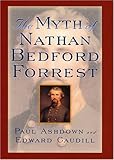
Paul Ashdown, Edward Caudill. The Myth of Nathan Bedford Forrest. Lanham: Rowman & Littlefield Publishers, 2005. xxii + 218 pp. $24.95 (cloth), ISBN 978-0-7425-4300-3.
Reviewed by Derek W. Frisby (Department of History, Middle Tennessee State University)
Published on H-CivWar (June, 2006)
There Will Never Be Peace: The Debate Over One of the Civil War's Most Contested Memories Continues
Major General William T. Sherman once remarked, "There will never be peace in Tennessee until [Nathan Bedford] Forrest is dead." Although the Civil War ended in 1865 and Forrest ironically passed away in 1877, there still was no peace, neither in Tennessee nor throughout the country, as the conflict raged on over the Civil War's public memory. To explore this phenomenon, Paul Ashdown and Edward Caudill, University of Tennessee journalism professors, have turned a critical eye toward the historical memory of controversial Confederate commander, Nathan Bedford Forrest. They reprise the themes of their highly acclaimed 2003 book, The Mosby Myth: A Confederate Hero in Life and Legend to do so. The Mosby Myth traced the legend that evolved around Virginia Confederate John Singleton Mosby by describing the "temporal elasticity" of Mosby's historical memory and its use to form a "usable past."[1] This novel approach to explain Mosby's myth unfortunately falls short in describing Forrest's.
According to the authors, Forrest "incorporates all the rude ingredients of the American tales that emerged from the primitive frontier.... violence, race, realism, sectionalism, politics, reconciliation, and repentance" (p. xx). Ashdown and Caudill start their examination by describing the syllabic symmetry and linguistic origins of the name "Nathan Bedford Forrest" as "faintly poetic with its suggestion of prophecy, place, and arboreal sanctuary" (p. 6). They proceed to argue that Forrest's rise from southern backwoods poverty to wealthy antebellum businessman contain the hallmarks of "a good American story" or Horatio Alger tale (p. xx). The authors sift through early-twentieth-century children's literature to demonstrate how southerners turned the early life of this slave-trader and future warrior chieftain into modern morality tales, paralleling the Greek legends of Hercules. Ashdown and Caudill also illustrate how biographers attempted to reconcile the inherent contradictions in Forrest's antebellum personality, demeanor, and livelihood, asking if Forrest was indeed the indomitable "boy on horseback," "a murderous, white-trash bully, the equivalent of a modern drug dealer masquerading as a Southern gentlemen in tailored white linen suit and broad-brimmed hat," or both (p. 9).
After briefly laying the antebellum foundations of the Forrest myth, the authors outline Forrest's military career and address the central, yet competing, components of the Forrest myth, the "Great If" and the "Fort Pillow Massacre/Ku Klux Klan" (p. xiv). The "Great If" myth argues that the more genteel, West Point-educated Confederate military establishment discounted the "reckless ruffian" Forrest, and in doing so, wasted an opportunity to win the war. As historian Emory Thomas observed, the Confederacy perhaps "failed to see the Forrests for the Lees."[2] Forrest's battlefield exploits are undeniably impressive, but their significance to the war's outcome continues to stir debate. Forrest's military achievements are remarkable given his educational background, often beleaguered supply situation, and quick adoption of dismounted cavalry tactics; however, they almost always occurred against second-rate, rear-area troops. When encountering first-line opponents, his record appears spotty at best. In short, he was often the best fighting among some of the worst. Additionally, the Confederate high command's ostracizing of Forrest was largely the fault of his own mercurial personality that made him a difficult subordinate officer to have around. Indeed, the Confederates' inability to cooperate with one another was endemic during the war, even within Forrest's own units, and inherent to their defeat. Nevertheless, as rank-and-file southerners searched for the cause of their defeat, they blamed the Confederacy's patricians and latched onto the myth that if their leadership had adopted the plebian Forrest's unconventional ways of war, victory would have followed. The persistence of this "Great If" myth fuels the campaigns of those wanting to elevate and honor the man they refer to as an "untutored military genius" or the "Wizard of the Saddle."
A discussion of Forrest's racial attitudes is notably absent from nearly all "Great If" arguments (and its cousin, the "Lost Cause"). A slave-trader, Confederate general, sponsor of the "Fort Pillow Massacre," and presumed Grand Wizard of the Ku Klux Klan, Forrest remains a lightening rod for detractors who claim he, as well as the Confederacy, are unworthy of the public's admiration. For proponents of the "Fort Pillow Massacre/Ku Klux Klan" myth, he remains an enduring symbol of American racism, someone to be scorned rather than revered. The competing claims of the "Great If" and the "Fort Pillow Massacre/Ku Klux Klan" have polarized the Forrest myth, and as the final chapter concludes, these antagonists have played a key role in the contentious debate over the public memory of Forrest and the Civil War.
Ashdown and Caudill also examine the forces that have allowed Forrest to linger so prominently over southern history and literature. In an interesting, although belabored, investigation of how the Southern Agrarians seized upon Forrest's legend, they provide an example of a culture seeking a "usable past." Countering northern critics of southern society, Andrew Lytle's 1931 Bedford Forrest and His Critter Company energizes the Forrest myth by serving as transition from history to fiction, a point where the present puts history to work (p. 126). Lytle created "an alternative myth, one that cast the agrarian tradition and values as an antidote to industrial modernism and its inevitable spiritual corrosion" (p. 109). For the Agrarians, Forrest became a folk hero. He, like the South, emerged as an innocent, primitive force, finding success in agrarian, frontier values during the antebellum period, but during Reconstruction, those same traits made him "a noble entity sullied by amoral carpetbaggers," resulting in failed business ventures, and ultimately, a return to the land (p. 110). Novelists, too, have struggled with Forrest's myth. Forrest challenges fiction writers because he serves as both "Hydra and Hercules," and because his romanticism and heroic gestures clash with the skeptical nature of the novelist (p. 125). Forrest has captured the imagination of James Sherborne, Perry Lentz, William Faulkner, and others until he has become "one of the most protean characters in all of literature" (p. 167). Through an exhaustive series of short book summaries, Ashdown and Caudill illustrate how authors have employed Forrest's image in American literature and aptly demonstrate how "the Forrest Myth is now practically a literary genre unto itself" (p. 167).
Despite several interesting arguments, The Myth of Nathan Bedford Forrest is a shadow of The Mosby Myth. Unlike its predecessor, the Forrest volume rests upon a shaky historiographical foundation. The authors do evaluate the veracity and motives behind the only Forrest-sponsored narrative, written by Thomas Jordan and J. P. Pryor in 1868, as well as Andrew Lytle's 1931 Agrarian-inspired biography, but overlook fertile ground for similar types of analysis. Ashdown and Caudill's introductory chapters on Forrest's life, for example, rely mainly on Jack Hurst's good but rather generic Nathan Bedford Forrest (1994). They occasionally reference Brian Steel Wills's A Battle from the Start (1992), a creative psychological portrait that places Forrest squarely within the southern culture of honor, but they make little if any effort to evaluate its contribution towards humanizing Forrest. For their section on Forrest and Fort Pillow, they cite heavily Richard Fuchs's An Unerring Fire (1994), an agenda-driven, poorly researched, insipid regurgitation of the official Congressional report, and thus, a dubious source at best. Regrettably, Ashdown and Caudill were unable to incorporate the wealth of newly published and forthcoming research on Fort Pillow and public memory into their study. The last chapter, "Only the Dead Can Ride," however, expands upon Tony Horowitz's Pulitzer Prize-winning Confederates in the Attic (1999) and Court Carney's excellent 2001 Journal of Southern History article on the bifurcation of Forrest's memory in Memphis. Such historiographical inconsistencies may stem from the pressure to capitalize on the success of The Mosby Myth by producing another volume too quickly on a subject with whom they were less familiar. The authors' initial collaboration combined their lifelong fascination with Mosby and the creation of historical memory. Their enthusiasm and passion for Mosby showed in their work, creating an innovative contribution to the Civil War historiography. The Forrest installment appears as a more commercialized effort, still thought provoking but stilted and formulaic by comparison.
Ashdown and Caudill explain that the national debate over Forrest's contested image "is over contemporary culture, institutions, and attitudes" rather than the particulars of Forrest's life, and they demonstrate how the Forrest myth in all its incarnations are "malleable to the extent that either one can subsume the other" (p. 193). This "malleable" property of Forrest's memory is also perhaps why The Myth of Nathan Bedford Forrest seems less effective than The Mosby Myth. The Mosby myth's "temporal elasticity" allowed it to transcend its Confederate origins to become more representative of the American character. Regardless of how the public reshapes it, the Forrest myth will remain inexorably anchored in time to the Confederacy and, as a result, inhibit its ability to form a "usable past."
Notes.
[1]. Paul Ashdown and Edward Caudill, The Mosby Myth: A Confederate Hero in Life and Legend (Wilmington: Scholarly Resources, 2002), pp. 113, 180.
[2]. Quoted in Ashdown and Caudill, The Mosby Myth, p. xviii.
If there is additional discussion of this review, you may access it through the network, at: https://networks.h-net.org/h-civwar.
Citation:
Derek W. Frisby. Review of Ashdown, Paul; Caudill, Edward, The Myth of Nathan Bedford Forrest.
H-CivWar, H-Net Reviews.
June, 2006.
URL: http://www.h-net.org/reviews/showrev.php?id=11893
Copyright © 2006 by H-Net, all rights reserved. H-Net permits the redistribution and reprinting of this work for nonprofit, educational purposes, with full and accurate attribution to the author, web location, date of publication, originating list, and H-Net: Humanities & Social Sciences Online. For any other proposed use, contact the Reviews editorial staff at hbooks@mail.h-net.org.

