



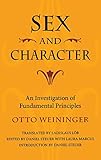
Otto Weininger. Sex and Character: An Investigation of Fundamental Principles. Bloomington and Indianapolis: Indiana University Press, 2005. liv + 437 pp. $75.00 (cloth), ISBN 978-0-253-34471-7.
Reviewed by Daniel Vyleta (Junior Research Fellow, Fitzwilliam College, Cambridge)
Published on H-Histsex (June, 2006)
Authoritative Edition of an Idiosyncratic Classic
Ladislaus Loeb's new translation of Geschlecht und Charakter represents the first complete English language edition of Otto Weininger's controversial investigation into the nature of woman and man, which was first published in Vienna in 1903. As such it makes redundant the anonymous 1906 translation which was marred by textual omissions, mistranslations and the wholesale suppression of Weininger's copious appendix of notes. Loeb has produced a text that reads fluently, yet enacts Weininger's often pompous phrasing. The translation retains the original's full breadth of learning, its repetitiveness and reversals. Weininger's preoccupations with Platonic ontology and Kantian ethics are put into sharp relief; his anti-materialism and anti-empiricism wrestle with his biological terminology and presuppositions, and produce that tantalizing mix of absurdity and insight that had so many of his German readers spellbound in the course of the century following its initial publication. If the goal was to make accessible to an English readership a fascinating source documenting Viennese attitudes towards sexuality, gender equality, modernity and Jews at the turn of the last century, the volume is a resounding success and will surely find its way onto the reading lists of cultural history courses at undergraduate and graduate level.
Controversy arises when it comes to appraising the book's theoretical content. Weininger's argument, in brief, is that all real, "empirical" men and women partake in the pure, quasi-Platonic types of "Man" and "Woman" in different degrees. The fluid continuum that exists between these two binaries can be traced physiologically and characterologically and the ratio between "M" and "W" in any given individual governs the rules of his or her sexual attraction to others (including the rules of homosexual attraction). "Woman" as type lives a purely animal existence devoid of individuality, conceptual thought, and ethics, which, pace Kant, are defined as the sphere of activity that transcends the mechanical universe of cause and effect. In effect, therefore, "Woman" is that creature described by contemporary natural scientific/determinist theories; she can be accounted for in purely materialistic terms and is governed, above all, by her sexual drive. "Man," by contrast, has memory, logic and ethics, hence individuality. He partakes in the animal need for sexuality, but is not governed by it. Jews (and other "lower" races including "Negroes" and, interestingly, Englishmen, who are likened to Jews) represent a psychological "type" analogous to "woman," although the two differ in their "aggressiveness" (higher in Jews than in passive "woman") and their capabilities for conceptual thought (which Jews possess but do not couple with "belief," a central category for "Aryan Man's" exercise of their humanity). The book finishes in a celebration of sexual abstinence as the only means by which "Man," as an ethical creature, can avoid violating the Kantian demand that he never use another human being as a "means" rather than an "end"; Weininger reprimands us that even if "Woman" cannot be called human in the full sense, and even if existing women give every reason to regard them as irredeemable in their femininity, men ought to act according to the assumption of their theoretical capacity to embrace masculinity, reason and duty. In short, Sex and Character makes for sombre reading.
In the face of all that is unpalatable about Weininger's thesis, Daniel Steuer's well-crafted and insightful introduction argues that the young Viennese's philosophical contribution can be separated from his misogyny and antisemitism, and offers a (gentle) rebuke to the ahistoricity of those who judge Weininger's methodology and findings on the bases of their own preference for enlightenment rationality. Steuer goes on to suggest that, once "freed of its metaphysical application to gender and to race, [Sex and Character] can be seen as a philosophical plea against the exclusion of phenomena which lie outside an instrumental and functional conception of the world" (p. xxxiii). It is unclear, however, whether this perspective entirely avoids the evaluatory ahistoricity that is elsewhere bemoaned; its temptation, surely, must be both to shear the book of its offensive aspects as being historically contingent and hence incidental to its "meaning," and then go on to hail Weininger's heroic stance in the face of modernity's drive to reification. Nor is it clear whether Weininger's ethical and metaphysical preoccupations can in fact be separated from his notorious characterizations of "Woman" and "Jew." In fact, what is chilling about the account given in Sex and Character is precisely how easy it seems for its author to graft a Kantian ethical picture onto his misogynist and racist convictions, just as his biologism and Platonic realism can coincide and complement each other within the trajectory of his argument. As such the book raises familiar worries about the pliability of enlightenment thought towards an "exclusionary" direction.
Weininger's wholesale feminization--and "judification"--of empiricism and modernity is further exacerbated by the fact that the continuum between the polar opposites of "Man" and "Woman" turns out to be rather more discontinuous than his early chapters indicate. "I have seen many women with male traits, but never a single woman who was not still basically a woman," Weininger asserts (p. 163, his emphasis). To some significant degree, then, the ideal types of "M" and "W" can and should be mapped onto actual men and women, and, by implication, onto actual Jews and Aryans. But even without this conflation of the typological with the historically manifest, the normative quality of the binaries that govern Weininger's ontology and epistemology are disquieting, and hint at the fascistic potential of Platonic "realism" and phenomenological intuitionism. While the text's historical value seems clear, therefore, its philosophical contribution will remain disputed.
Finally, the new translation will attract those interested in Weininger, the man, and the mystery that surrounds his motivations for suicide. In fact, despite the--often well-deserved-- scorn piled onto the genre of psycho-biography in both its popular and academic incarnations, it is to some degree inevitable that one reads the book as a compendium of Weininger's anxieties and obsessions, and, through his, the anxieties and obsessions of a generation of young Viennese men--a cohort who found themselves caught between the excitement over scientific discovery and (relative) social mobility, and the yearning for the supposed simplicity of yesteryear that so characterizes modernity. Here, too, the clash between the temptation to reduce Weininger to a "case study" and his own insistence on man's unique, autonomous individuality produces a reading experience at once frustrating and tantalizing. One must thank the translator and editors of the present volume for making this experience possible for a wider audience.
If there is additional discussion of this review, you may access it through the network, at: https://networks.h-net.org/h-histsex.
Citation:
Daniel Vyleta. Review of Weininger, Otto, Sex and Character: An Investigation of Fundamental Principles.
H-Histsex, H-Net Reviews.
June, 2006.
URL: http://www.h-net.org/reviews/showrev.php?id=11857
Copyright © 2006 by H-Net, all rights reserved. H-Net permits the redistribution and reprinting of this work for nonprofit, educational purposes, with full and accurate attribution to the author, web location, date of publication, originating list, and H-Net: Humanities & Social Sciences Online. For any other proposed use, contact the Reviews editorial staff at hbooks@mail.h-net.org.

