



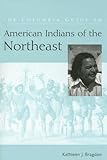
Kathleen J. Bragdon. The Columbia Guide to American Indians of the Northeast. New York: Columbia University Press, 2001. xv + 292 pp. $45.00 (cloth), ISBN 978-0-231-11452-3; $22.95 (paper), ISBN 978-0-231-11453-0.
Kathleen J. Bragdon. The Columbia Guide to the American Indians of the Northeast. New York: Columbia University Press, 2001. xix + 292 pp.
Reviewed by Roger Carpenter (Department of History, Indiana University of Pennsylvania)
Published on H-AmIndian (June, 2006)
Kathleen Bragdon, professor of anthropology at the College of William and Mary, has compiled a fine addition to the Columbia University Press guides to the native peoples of the Americas. Like the other books in the Columbia Guides to American Indian History and Culture series, this guide to the native peoples of the American northeast lacks the comprehensiveness of, say, the Smithsonian Institute's mammoth Handbook of the North American Indians, but then again, it is not its intent. While the Columbia series does not share the depth and detail of weightier reference works, it also lacks their drawbacks in terms of price and poundage.
Bragdon effectively synthesizes much of the current scholarship regarding the native peoples of the American northeast, organizing the book into four major parts. Part 1 is an overview of the northeast culture area and is divided into four chapters. The first chapter defines the geographic limits of the region, and gives the reader a brief synopsis of its climate and ecology. Bragdon also provides the reader with an overview of the history of the peoples of the northeast from pre-Columbian times to the present. She also provides the reader with a summary of the different peoples of the northeast, such as the Northern, St. Lawrence, as well as the Iroquoians of the Great Lakes. Bradgon also includes sections that examine the Algonquin peoples who lived in coastal areas stretching from present-day New York down into Virginia, as well as their northern relatives in the Canadian Maritimes and southern New England.
Chapter 2 looks at the effects of European colonization in the early contact period. Bragdon briefly explores the consequences of European contact, trade, and diseases on Native Americans, and further subdivides the chapter into the various regions of the northeast (the Maritimes, southern New England, Great Lakes, etc.). She also spends some time on the interactions of different people with Europeans.
Chapter 3, "The Expanding Frontier," looks at European settlement in the northeast in the seventeenth and eighteenth centuries. It includes a section on people who remained in their former homelands and lived "behind the frontier," but for the most part, it deals with the movement of peoples from one area of the northeast to another (or in some cases, leaving the region altogether) as Europeans pressured them through warfare and treaties to abandon their lands.
Chapter 4 looks at the changes that have taken place in the native northeast from the mid-nineteenth century to the present. This chapter examines relations with the U.S. government, the role of local Indian agents, and the entry of native peoples into specialized forms of labor, such as whaling in New England. Moving into the twentieth century, Bragdon examines the effects of boarding schools on native children. She also looks at the U.S. government's termination policy of the 1950s, the movement of native peoples from reservations into urban areas in the northeast (such as New York City), and the beginnings of political activism and the rise of pan-Indianism. Bragdon also looks at current issues such as gaming and efforts at lingustic and cultural revival.
Part 2, "People, Places, and Events in Northeast Native History" provides the reader with brief descriptions that range from a single sentence to a page-length paragraph covering tribes, bands, important personages, conflicts, acts of colonial and U.S. governments, and important historical incidents relative to the region's native peoples.
Part 3 is a historical timeline of northeastern Indian history. This is the shortest section (only eight pages) of the book and its placement seems rather odd. Usually such a short, ancillary section is consigned to the back of most works, in an appendix. One wonders why this section is here.
Following the timeline, however, is what is easily the strongest (and longest) part of the book, the "Resource Guide to History and Theory," which Bragdon divides into eighteen different subheadings. She provides the reader with contact information for many of the Native American tribes and bands in the Northeast, listing individuals who serve as points of contact, as well as their addresses and telephone numbers. Under the second subheading in this section, "Primary Sources and the Northeast," Bragdon lists research sources in such disciplines as anthropology, archeology, ethnology, history, and linguistics. Her listings of sources are by no means exhaustive, but then again, they are not meant to be. Bragdon attempts to give the reader a sampling of sources form nearly every discipline or sub-discipline concerned with native peoples, and overall she does a good job.
The weakest part of this section is the listing of electronic sources. Bragdon appears to have adopted a "kitchen sink" approach, throwing in everything remotely related to native people. She lists several websites that offer information on casinos and other Native American gambling outlets. Keeping in mind that the book was originally published in 2001, some of the web addresses are no longer valid. Other electronic resources (such as the Huntington Free Library for example) are still in existence but have changed their address, and can be easily located by the curious reader with a little Googling. Oddly, Bragdon ignored some valuable online resources that were available in 2001, such as Early Canada Online.
Overall, Professor Bragdon has compiled a good useful guide. It is far from the best in its field, but it does give one a decent overview of the history and culture of the native peoples of the northeast. For undergraduate students who are starting a research project in Native American History, this would be a good place to start, although I would caution them regarding the shortcomings of some the electronic resources.
If there is additional discussion of this review, you may access it through the network, at: https://networks.h-net.org/h-amindian.
Citation:
Roger Carpenter. Review of Bragdon, Kathleen J., The Columbia Guide to American Indians of the Northeast and
Kathleen J. Bragdon, The Columbia Guide to the American Indians of the Northeast.
H-AmIndian, H-Net Reviews.
June, 2006.
URL: http://www.h-net.org/reviews/showrev.php?id=11851
Copyright © 2006 by H-Net, all rights reserved. H-Net permits the redistribution and reprinting of this work for nonprofit, educational purposes, with full and accurate attribution to the author, web location, date of publication, originating list, and H-Net: Humanities & Social Sciences Online. For any other proposed use, contact the Reviews editorial staff at hbooks@mail.h-net.org.

