



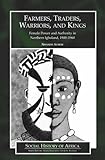
Nwando Achebe. Farmers, Traders, Warriors and Kings: Female Power and Authority in Northern Igboland, 1900-1960. Portsmouth: Heinemann, 2005. xii + 274 pp. $99.95 (cloth), ISBN 978-0-325-07079-7; $29.95 (paper), ISBN 978-0-325-07078-0.
Reviewed by Felicia Nwalutu (formerly Chief Ethnographer, Benin Museum (Nigerian Commission for Museums and Monuments), and Michael Onyedika Nwalutu)
Published on H-AfrArts (June, 2006)
Female Kings and Male Priestesses: A Study of Nsukka Igbo Gender Conceptions and Manifestations
Author Nwando Achebe presents women as active participants in the making of history, using "gendered" history to challenge the orthodox African historiography that characterizes women as both subservient and subordinate to their male counterparts. She frames her reconstruction of Nsukka-Igbo history using an indigenous chronology. Finally, through the individual experiences of women, she explores the religious, political, economic and social structures of Nsukka communities which empowered women to rise to high positions of social and political authority in the pre-colonial and colonial periods. The most serious flaw in the book is a failure to address the complexity of Igbo gender constructs manifest in the position of "male priestesses" associated with female deities. Nonetheless, we think the book represents a significant contribution to the understanding of Nigerian Women's History in particular and African historiography in general. The writing is succinct, the arguments are as convincing as they are logical, and the cases reflect an in-depth study and understanding of Nsukka Division as well as Igbo cosmology.
For those interested in a more detailed view, Nsukka division is the fourth largest division in Igboland. It is situated at its extreme north and shares boundaries with Akpoto and Igala. It was also the last area of the region to be effectively conquered by the British in the 1920s. Achebe's work reveals that the Nsukka world-view allowed the female principle extraordinary power, creating a context for Nsukka women to take actual leadership roles in the religious, political, and economic life of their towns. As goddess, the principle provided for the various needs of different communities, whether it was protection, as in the case of Nimu Kwome and Nnemuru ora, or adjudication of justice in order to right previous wrongs, as in the case of Efuru (p. 96).
However, the arrival of the British brought about a number of changes, most significantly for this study, the establishment of "warrant chiefs" to oversee the affairs of the communities, a destabilizing factor, and the introduction of Western religion. Western religion was seen as male-centered and opposed to prevailing female deities. Thus, "an approachable male Christian God replaced the need for goddesses who had been the agents of the genderless Nsukka God, Ezechitoke" (p. 94)--causing Nsukka women to lose their grip on power as their offices as priestesses, diviners and healers were usurped.
In the first chapter, Nwando Achebe sets the scene, examining the place and evolution of the female principle in Nsukka-Igbo culture, including women's activities, in both the human "visible world," and the non-human "invisible world." In the second chapter, she delves into the historical origin, roles, and evolution of particular medicines and goddesses, priestesses and diviners through oral evidence. Since her focus is to advance the historicity of a gendered Nsukka religion, she bases her discussion on traditional evidence surrounding the female principle by offering a searching analysis of Nsukka manifestations of spiritual power.
In Nsukka division, goddesses either represented deified women, medicines (ogwu), or natural phenomena. Medicines could be private or public, protective or aggressive. They ranged from personal amulets and crossroads medicine to such powerful shrine medicines as Adoro of Alor-Uno, a powerful community goddess widely reputed for her war-time exploits. Adoro was created to fill a need for protection and the repopulation of a war devastated community as well as to defend her community from enemy invasion. Since these roles are similar to feminine activities in the visible physical world, the deity was designed to be female. Her roles later expanded to incorporate judicial competencies as her shrine became a court of final arbitration. Nwando Achebe also asserts that the arrival and subsequent establishment of the British colonial government saw a vigorous move by the colonial administrators to destroy the deity, a move tactically resisted by the communities the deity served.
However, a shift occurred as Christianity became more established. Nsukka female converts refused to be subjugated in this new male-centered religion. Some re-invented themselves in the churches, taking on responsibilities that resulted in their distinction at home and abroad, as in the case of Lady A. A. Obayi (p. 96). Others established pseudo-orthodox churches where they became revered as leaders, founders, diviners, and healers. Such women challenged the community deities who stood in their way, as rival powers. Thus, Prophetess Ngozika Ogbu contended against Adoro, perceived as her competitor, but also subconsciously and, in her own unique way, re-enacted the cycle of Adoro's intervention, in her superhuman role of savior, deliverer, protector, and healer. This is exactly the role that Igbo women and the female principle have played at critical times in the histories of their communities (p. 67).
In the third chapter, Achebe examines the participation of Nsukka women as farmers, traders, potters and weavers in the mainstream of economic activities, showing in no uncertain terms how these hardworking women translated their economic successes into political and social power and authority in the pre-colonial and colonial periods. She classifies the women into the four skill categories noted above. Each skill category is explored through individual case studies that feature two successful farmers (Ogbonnaya of Adiani and Bernadette Ani of Uvuru), a trader (Onokoro Nwa Enyi Nwoti, a.k.a. Mama Ojii of Aku), three potters (Mary Odo of Eha Ndi Agu, and Eha Alumona and Bridget Ajibo Echena of Nrobo), and, finally, a weaver (Orute Achigwu of Obeke-Edem).
In Chapter 4, "Women in Community Politics: Colonialism and the Strategies of Female Resistance," the author contends that the pre-colonial political structure of Nsukka should not be viewed solely from the physical world perspective--that is, women's roles in the human world--but should be studied from the spiritual standpoint as well. She insists that in the spiritual constituency female divinities feature as the political heads of their communities and were assisted by their human agents citing the obolokos (female human spiritual workers) and the adaogus (female warriors) as her examples. She also looks into the activities of the human agents that executed the verdicts of these deities, the Umuada Mma or human daughters of the divinities endowed with power by their parent deities to operationalize their injunctions in the community. She further highlights the important roles of the female masked spirit, Abere, who doubled as an agent of social control, a judge of moral conduct, a community night guard, a law enforcement entity, and a court of arbitration.
Nwando Achebe agrees, for the most part, with a categorization of political organization in Igboland by those historians who argue that a dual-sex political system, in which power and authority were divided between the sexes in a complementary fashion, was operational; yet she suggests that Nsukka Division, politically, was less rigid and allowed members of the Otu Umuada (assembly of daughters) to function in both the male and female arms of government. She further subdivides the human constituency into two female arms of government, the Otu Umuada and the Otu Ndiomu-ala (assembly of wives). In some Nsukka communities, such as Aku, these two arms of female government actually combine forces in a general Women's Assembly. Exploring patterns of female resistance in both pre-colonial and colonial Nsukka political activities, she also identifies seven strategies which included the use of strikes, boycotts, force, sit-ins, sitting on or making outright war on men, and nudity. Although these strategies were targeted at wrong-doers and unacceptable male-favoring policies in the pre-colonial period, they were refocused subsequently on the obnoxious policies of British colonial administrators.
In the fifth chapter, Nwando Achebe presents the story of Ahebi Ugbabe, a female ruler whose life makes a fascinating case study of gender, individual power, and excess; sex and sexuality; and colonial encounter. It is a story that tells much about indigenous sanctioned boundaries of acceptable female political expression and some of the ways individual Nsukka women acquired power and negotiated the colonial environment for their own gain. Ahebi Ugbabe exemplifies the conflict between individual ambition and group solidarity.
A book like Nwando Achebe's Farmers, Traders Warriors and Kings: Female Power and Authority in Northern Igboland, 1900-1960, offers so much that little or no room is left for criticism. Her literary style makes social history easy to read and understand. By starting her work with either an English translation of an African proverb or an Igbo expression of the sub-theme, the author contextualizes her history within an indigenous worldview. She successfully demonstrates that Nsukka Igbo women commanded power; they sought for and acquired positions of authority in the pre-colonial period as individuals and as a group, even though individualized autocratic female power and agency had no place in Nsukka's dual-sex, community-oriented society (p. 216). Of considerable significance is the author's argument that researchers cannot adequately analyze the landscape of Nsukka (or any other African society for that matter) without investigating the central place of women and the female principle in the spiritual life of that society (p. 26).
On a slightly more critical note, first of all, the author makes clear that she is writing for Igbos in Diaspora and "non-Igbo" African Scholars. Yet she fails to provide adequate or immediate English translations for the Igbo-language phrases initially used so effectively to provide context, running the risk of confusing, or even alienating, her non-Igbo speaking target audience. For example, throughout chapter 3, the four major zones of farmer, trader, potter and weaver were expressed in the Igbo language without English translations.
Furthermore, a work that attempts to analyze women and gender perceptions, conceptions, constructions, and manifestations seems incomplete without further elaboration on such vital issues as the office and the costume of male priestesses. This, after all, is a work that evaluates the female principle and the position of her human agents who may be biological or sociological females. Achebe herself notes that "perhaps most remarkable is the fact that these male priestesses insist that they have not in fact become women, but are women--an assertion that raises still more questions about the nature and complexity of the Igbo gender construct" (p. 230).
Of less importance, perhaps, is her suggestion that the warrant chief's coercion of women into marriage was one of the factors that led to the 1929 women's war (in reference to Bernadette Anni's exercise of her marital right to refuse a suitor). Other research suggests that this is incorrect.[1] First, Northern Igbo women did not participate in that war. Rather, it was the Owerri and Ngwa Igbo women, together with their Andoni and Ibibio sisters, who fought the war and, certainly, they did not express such opinion in their testimony before the Commission of Inquiry.
Despite these observations and the occasional typographical error, we recommend the book to students and scholars. It is well written and researched, and represents a substantial addition to the historical literature.
Note
[1]. See Felicia Ihuoma Abaraonye, "The Women's War of 1929 in South-Eastern Nigeria" Women and Revolution: Global Expressions, ed. M. J. Diamond (Netherlands: Kluwer Academic Publishers, 1998), pp. 109-132.
If there is additional discussion of this review, you may access it through the network, at: https://networks.h-net.org/h-afrarts.
Citation:
Felicia Nwalutu. Review of Achebe, Nwando, Farmers, Traders, Warriors and Kings: Female Power and Authority in Northern Igboland, 1900-1960.
H-AfrArts, H-Net Reviews.
June, 2006.
URL: http://www.h-net.org/reviews/showrev.php?id=11848
Copyright © 2006 by H-Net, all rights reserved. H-Net permits the redistribution and reprinting of this work for nonprofit, educational purposes, with full and accurate attribution to the author, web location, date of publication, originating list, and H-Net: Humanities & Social Sciences Online. For any other proposed use, contact the Reviews editorial staff at hbooks@mail.h-net.org.

